The Reclaimed
A story of Ashmother — where humans hold a single frozen station in the orbit of an ice giant, the only resource is a moon under the ice, and the one warm-blooded thing in the whole cold system is killed and built into weapons.
Korr had been cold for fourteen months and he had stopped believing in the other thing.
There was supposed to be an other thing. Somewhere down the long chain of stations and transfer orbits that had carried him out here there was supposed to be a planet with a sun close enough to matter, where heat came up out of the ground for free and a man could stand in it without a suit and not feel the cold reaching in through the seams to find the water in him. He had grown up on a world like that, or near enough. He could no longer make himself feel it. Fourteen months in the orbit of an ice giant will take a memory of warmth and freeze it so slowly you don't notice the day it cracks.
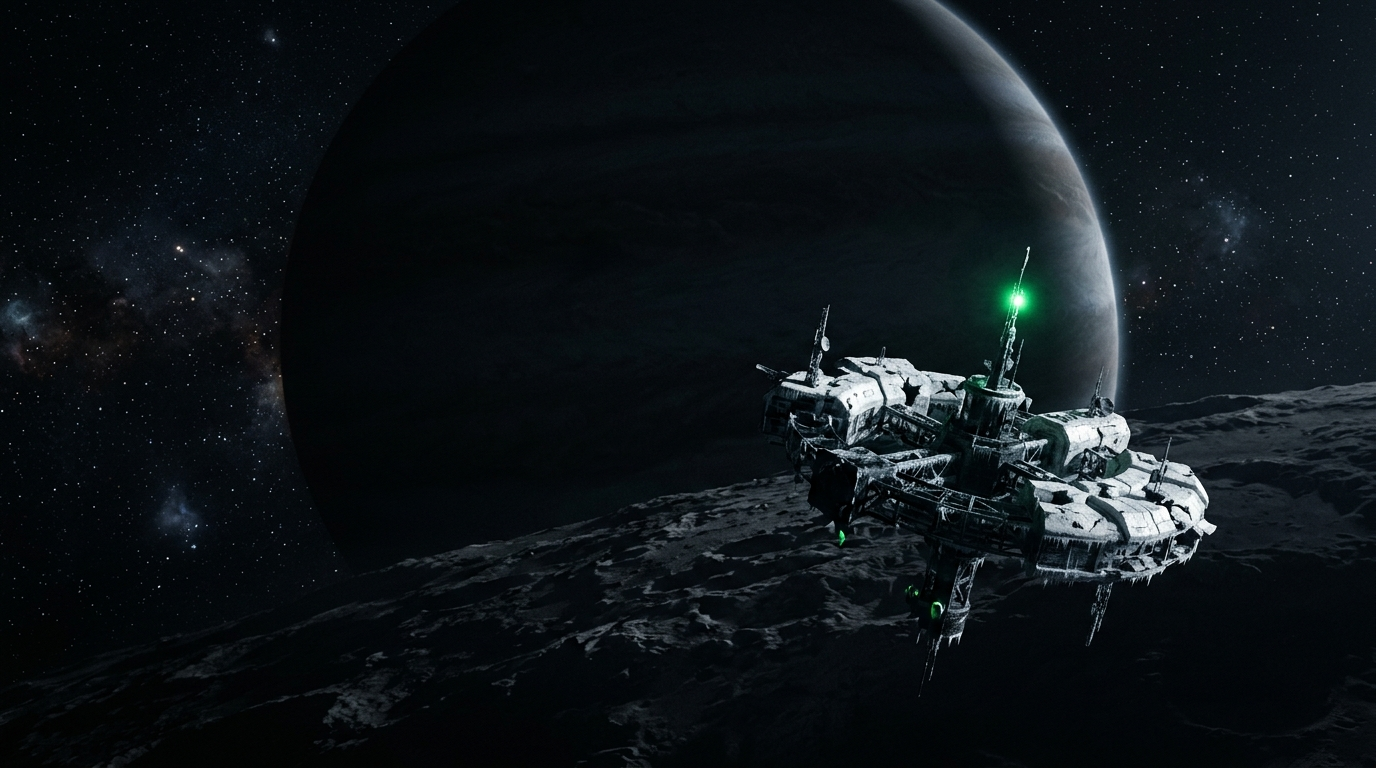
The station was called Vigil Station, officially, and the Icebox by everyone who had ever drawn a tour on it. It hung in a high cold orbit of the gas giant the navy had numbered and nobody had bothered to name, a banded wall of blue-grey weather a thousand times bigger than anything had a right to be, and against that wall the station was a chip of bone, a few hundred souls in a tin can with a green running light, turning slowly so the same face never froze twice. Out the wardroom port the giant filled half the sky and gave no heat at all. It was the coldest beautiful thing Korr had ever learned to hate.
"You're shivering, Sergeant," the armorer said.
"I'm always shivering. It's a feature."
"It's the cold."
"No kidding."
The armory was the warmest compartment on the Icebox and it was still cold enough that Korr kept his gloves on. They had brought him down here for the issue, the two of them alone with a rack of dark shapes and a single work light, because what they were about to hand him was not the kind of thing you signed for at a counter with a line behind you. The armorer was a thin nervous specialist named Oyelaran who would not quite meet his eyes, and Korr had been a long enough time in the service to know that when a man won't meet your eyes over a weapon it is because of something the weapon does, not something it can't.
"They tell you what it is," Oyelaran said. It wasn't a question. He was stalling.
"They told me it's a man-portable directed-energy weapon that doesn't need a cell. Refuels itself off ambient." Korr looked at the rack. "They told me it's the reason we can hold a line out here when every cell we ship in costs more than the man carrying it."
"That's what it is." Oyelaran reached up and took one of the dark shapes off the rack with both hands, the way you lift something you respect or something you're afraid of, and turned, and set it on the bench under the light, and Korr looked at the thing he was going to carry into the cold and felt the bottom go out of his stomach.
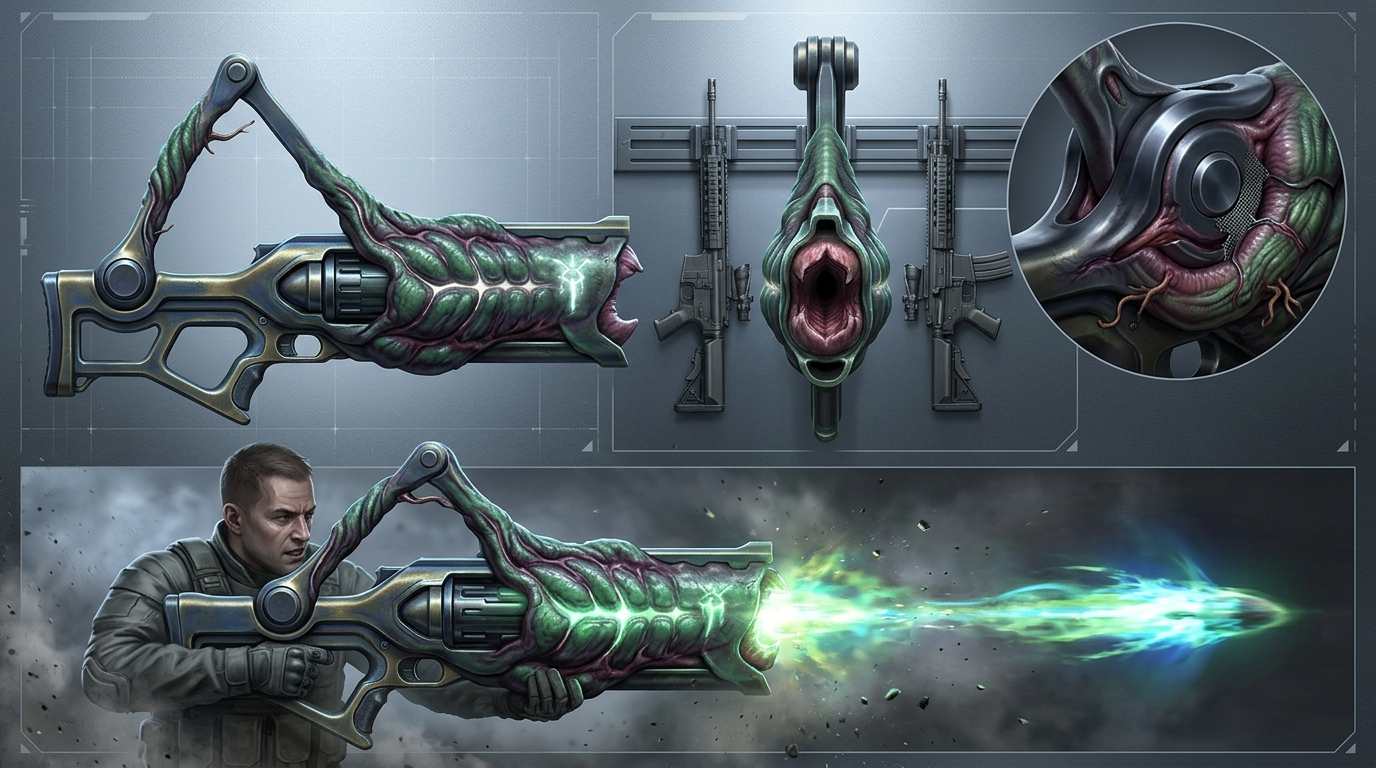
It was a rifle the way a coffin is furniture.
The chassis was conventional enough — a long alloy frame, a stock, a grip, a trigger group, the cold familiar geometry of a service weapon. But the frame was only scaffolding. Grown into it, filling it, being it, was an animal. A ribbed body the length of his forearm, mottled green going to deep arterial red along the flanks, and the red was red because it was blood, and the green pulsed, slow, with something that was not electronics. At the muzzle end the thing had a mouth. A maw, ringed and wet, and as Korr watched it the maw opened a fraction and closed again, opened and closed, a slow patient working, and a thin sound came out of it that he felt behind his back teeth.
"It's alive," Korr said.
"It's a Ghede." Oyelaran said the word the way the briefing officers said it, flat, scrubbed of whatever it had meant to whoever named it. "Filter-feeder. Off the reefs, down on the moon. In the wild it pulls trace energy out of the seawater, concentrates it, holds it, and when something comes at it, it spits — hot enough to put a hole through bone at three meters. A living capacitor. Grows itself. Charges itself. Costs nothing." He swallowed. "You feed it through the breech. It does what it always did. Takes what you give it, refines it, spits it back as a directed discharge. You'll get more out of it than any cell weapon on this station."
"It's alive," Korr said again, because the first time hadn't gone anywhere.
"It can't be switched off," Oyelaran said, very quietly, and now he did look at Korr, and Korr wished he hadn't. "That's the part that's not in the briefing slide. You can feed it or you can starve it. That's the whole of your control. A fed one fires when you want it to. A starved one —" He stopped. "Keep it fed, Sergeant. There's a procedure. The cell ports load right here, into the breech, into — into it. It takes the charge, it holds it. When you fire, it spends what it's holding. And it makes a sound when it spends it."
"What kind of sound."
Oyelaran picked up a half-charged cell off the bench and, with the unwilling care of a man feeding something he's been told not to name, fitted it into the breech. The maw took it. The green light along the body came up brighter, climbing the ribs like a tide, and the whole weapon shifted minutely in its cradle, settling, satisfied — and then it let the breath out.
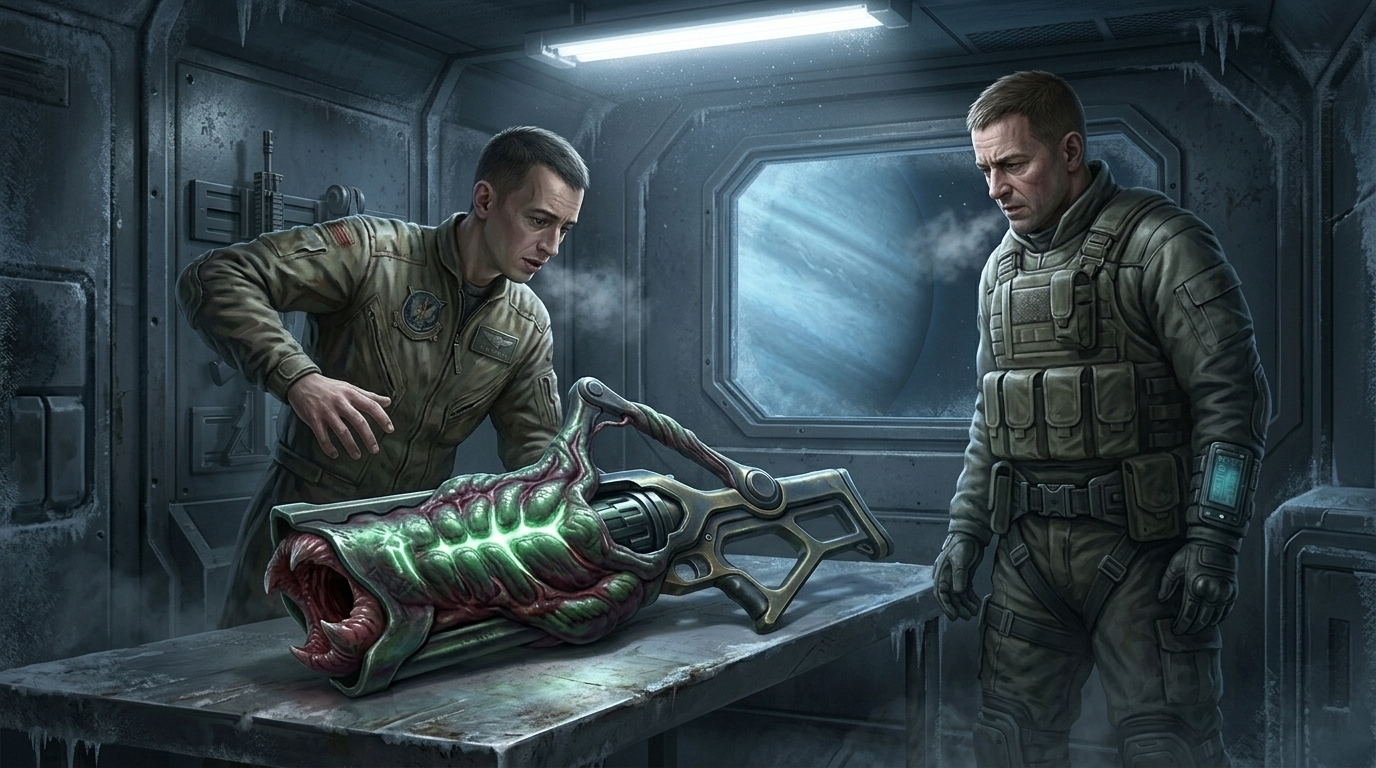
It sighed.
There was no other word and Korr did not look for one. It was a long, low, shuddering exhalation, the sound of a thing that has been holding something heavy and is finally allowed to set it down, and it was the most human sound Korr had heard in fourteen cold months and it had come out of a gun.
The armory was very quiet. Out beyond the hull the dead giant turned and gave no heat.
"You'll get used to it," Oyelaran said, and they both knew he was lying, and Korr picked the thing up off the bench because it was an order and because every other man holding the line out here was already carrying one, and the moment his gloved hands closed around the warm living flank of it the cold he had carried for fourteen months reached a place even it had never gotten to.
It was warm. The gun was warm. It was the only warm thing he had touched since the last transfer orbit, and it was warm because it was alive, and they were sending him down to the one place in the whole frozen system where warmth still came up out of the ground — to kill the things that made it, and carry their screaming bodies into the dark.
"When's the drop," Korr said.
"Six hours. Surface op. Reef-stripping detail lost contact, they're sending you down to walk the site and pull the beacon out of the Cantor's Mercy." Oyelaran hesitated. "Sergeant. Down there. If you hear it sigh and you didn't pull the trigger —"
"Then what."
"Then something else is talking to it." He wouldn't say more than that. "Just — keep it fed. And come back up."
Korr carried the warm thing to his rack and lay in the cold with it sighing softly against his chest, and somewhere below them both, a quarter million kilometers down through the dark, under a roof of ice in a warm black sea, a great many small green voices were singing, and did not yet know that one of their own had been taught to sing in a cage.
The drop pod hit the ice like a fist and Korr was cold before the hatch even blew.
That was the thing nobody warned you about and everybody learned: the moment the pod cracked, the moon came in. Not air — Ashmother's surface had a breath of something thin and sterile that the suit wouldn't let him taste — but cold, a cold with a grain to it, a cold that had been lying out here under no sun for four billion years and resented being disturbed. The suit fought it and lost a little at every seam. His readout said the surface was a number that didn't mean anything. His body said get inside or die and there was no inside, there was just the long flat white running out to a bruise-colored horizon under a sky owned entirely by the giant, blue and banded and enormous and giving, as ever, no heat at all.
"Beautiful," Korr told it, and hated it, and started walking.
The rifle rode warm against his chest, sighing now and then, soft, content. He'd fed it before the drop. He tried not to listen to it.
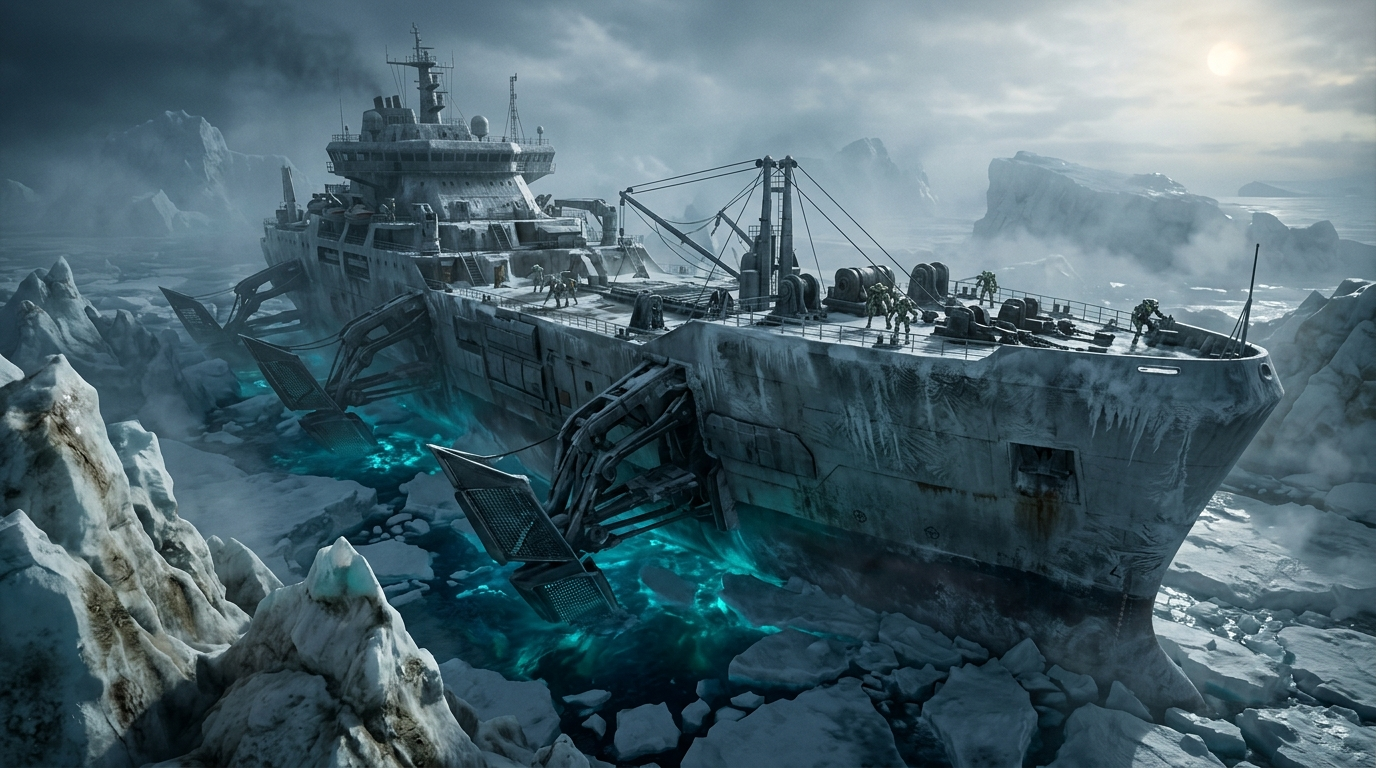
The reef-stripping site was four kilometers across the floe and he smelled it before he saw it, or thought he did — the suit couldn't pass a smell, but something came up through his boots, a wrongness in the ice, and when he came around the last pressure ridge he stood and looked at what the Cantor's Mercy had done and understood, for the first time, in his body, what the briefings had been so careful to keep abstract.
They had opened the ice. A great rough wound of it, a shaft cut and melted down through kilometers of glacier to the warm black sea beneath, and around the lip of that shaft the harvest ship lay on its side where the ice had heaved up and closed on it and crushed it like a man closing his hand on a moth. Eighty meters of hull, frost-gloved, the crane arms still slung out over the hole, and down in the hole, far down, a teal glow that was the last light of the reef the ship had come to strip — or the first light of something the stripping had woken. Korr couldn't tell which and didn't want to.
He keyed his comm. Nothing came back but the hiss of the giant's radio belt. The detail that had been working this site was not answering and had not been answering for two days and the beacon that would tell him why was somewhere in the dead ship below him.
He started down the ice toward the wreck, and high above, in the cold air over the shaft, the first of the Glasswings lifted off the hull where they had been waiting, and turned their lovely oil-slick fans toward the warm thing that had come, sighing, down onto their ice.
A quarter kilometer below, under the roof of the world, Vresh felt the warm thing arrive the way you feel a draft from a door opened in another room.
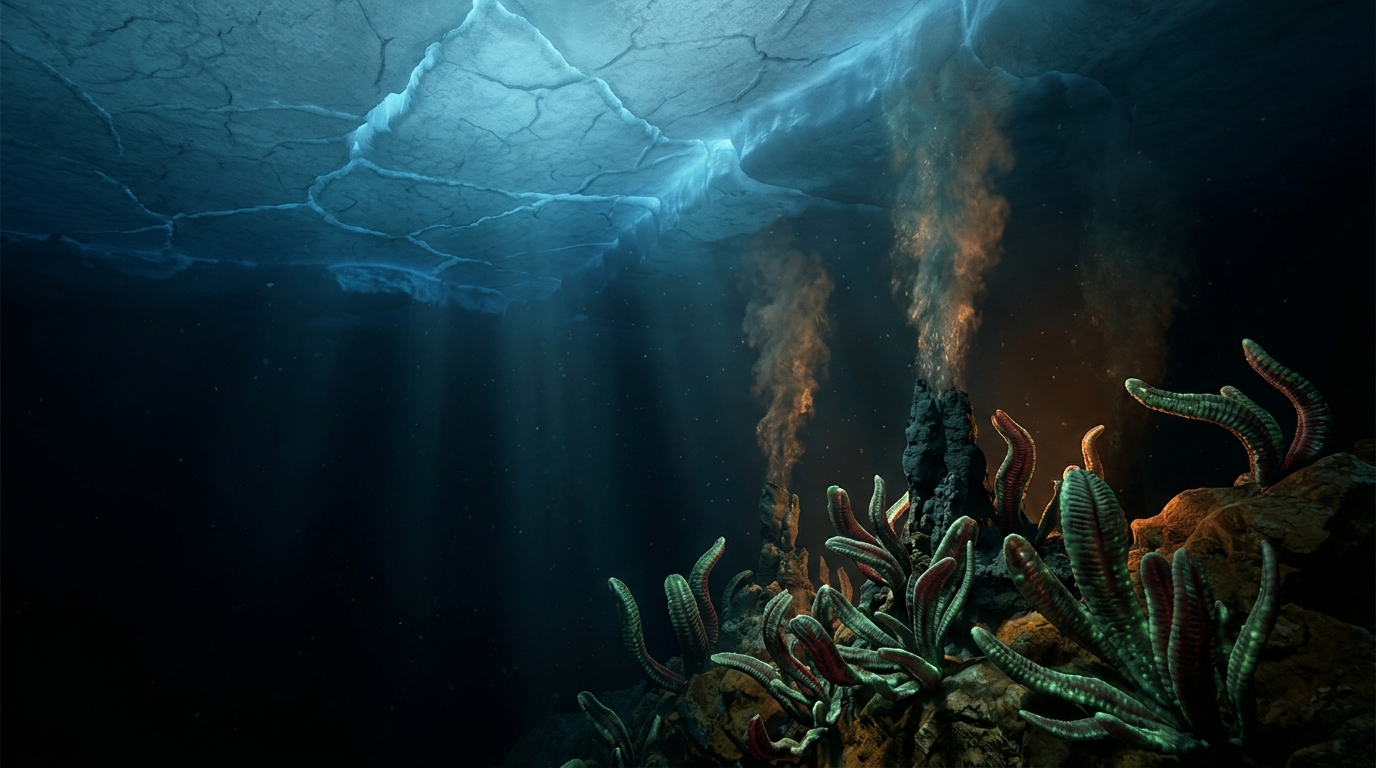
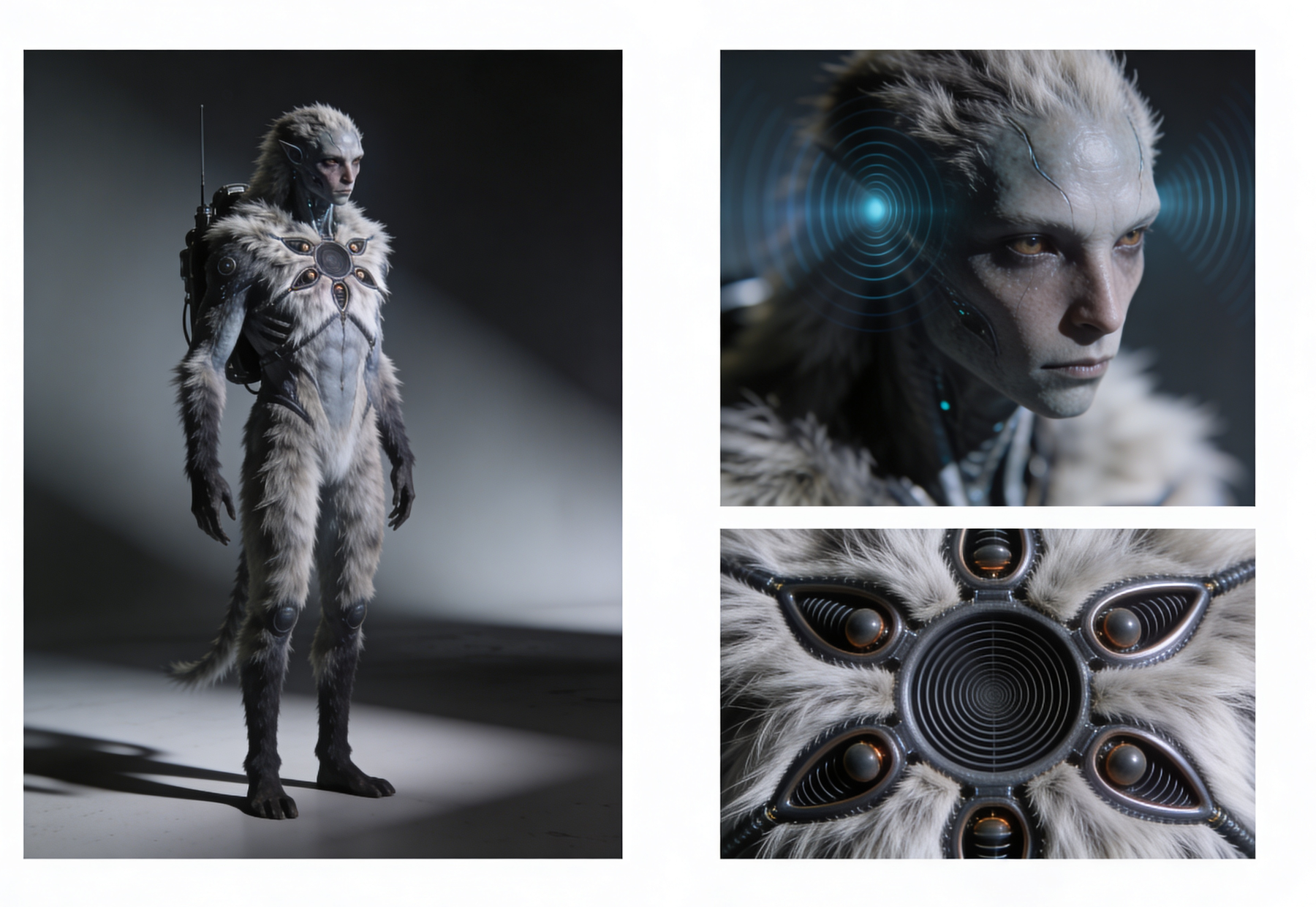
The People did not have a word that meant hearing and a different word that meant feeling, because the disc did not let them lie to themselves about the difference. What came up through the cradle of the chest was simply the song — the whole standing chord of the moon, the reef-voices and the vent-hum and the slow blue pulse of the great ones moving in the dark, all of it at once, all of it always, the sound of a living world singing to itself in the warm under the ice. Vresh had been born into that song. Every one of the People had. You did not learn it. You woke up already inside it, the way a fish wakes up already inside the sea.
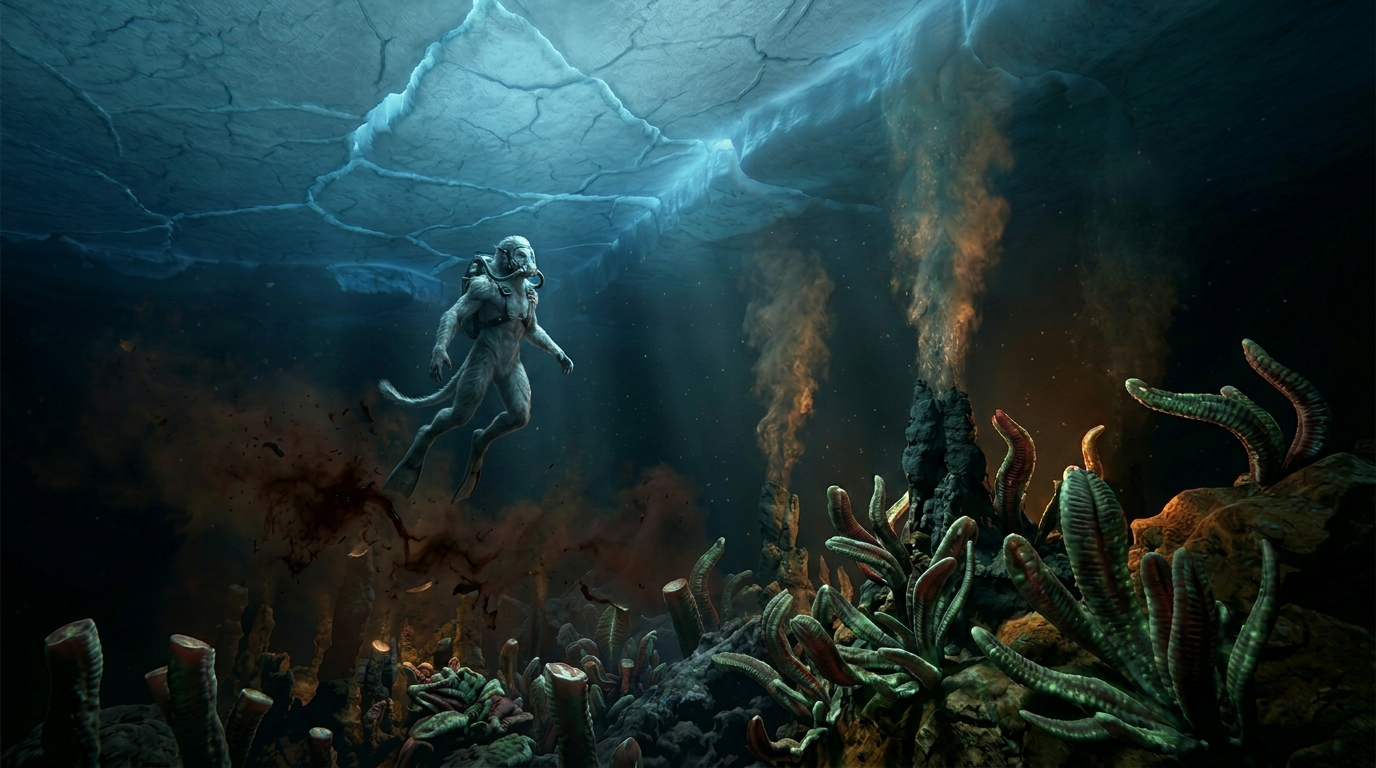
And for two days there had been a wound in it.
Vresh had been at the harvested reef when it happened — had come, with the others, when the song first tore, and they had hung in the warm dark above the cut rock where a whole reef-voice had been and was now only silence and a cloud of drifting blood, and they had grieved in the way the People grieve, which is to open the disc and let the absence pass through you so that you carry a piece of it and the dead are not made to be silent alone. That was the wound: a hole in the chord the shape of a hundred voices that the sky-things had cut out and carried up.
But one of the voices had not gone silent.
That was the part Vresh could not put down. One of the reef-cousins, taken up with the others, was still singing — far off, faint, high above, beyond the ice, out where the song had no business going — and it was singing the one note the People had no answer for, the note a voice makes when it is in a pain that will not stop and cannot end. It had been making that note for two days. It did not rest. It could not rest. Somewhere up in the cold the sky-things had built a cage around a cousin's agony and would not let it die, and every hour of those two days the caged voice had called down through the ice, help, help, I am here, why have you left me here, and the whole People had been able to do nothing but hear it.
Vresh was young, as the People counted it, and the young do not yet know how to set a thing like that down. So when the caged voice moved — when, this morning, it came down, down out of the high cold toward the ice, toward the wound in the world where it had been taken from — Vresh did not tell the elders. Vresh went to the shallow caves under the south shelf where the great ones slept out the long cold, and sang the old waking-song into the dark, and one of them opened its plumage and knew the song and let Vresh climb the cradle of its spine.
There was only one thing left to give a voice in that much pain. Vresh meant to give it. Not to the sky-thing that carried the cage — the sky-thing was nothing, a cold soft animal far from anything that loved it. To the cousin. To open the disc wide enough, at last, that the dying voice could hear, before the end, that it had never once been forgotten.
The great one rose under Vresh and shook the frost from its wings and walked up out of the warm dark toward the ice and the cold and the cage, and the whole moon sang around them, wounded, and waited to see what the young one would do.
The Glasswing came across the ice the way light comes across water — not as a thing moving but as a place where the dark got brighter.
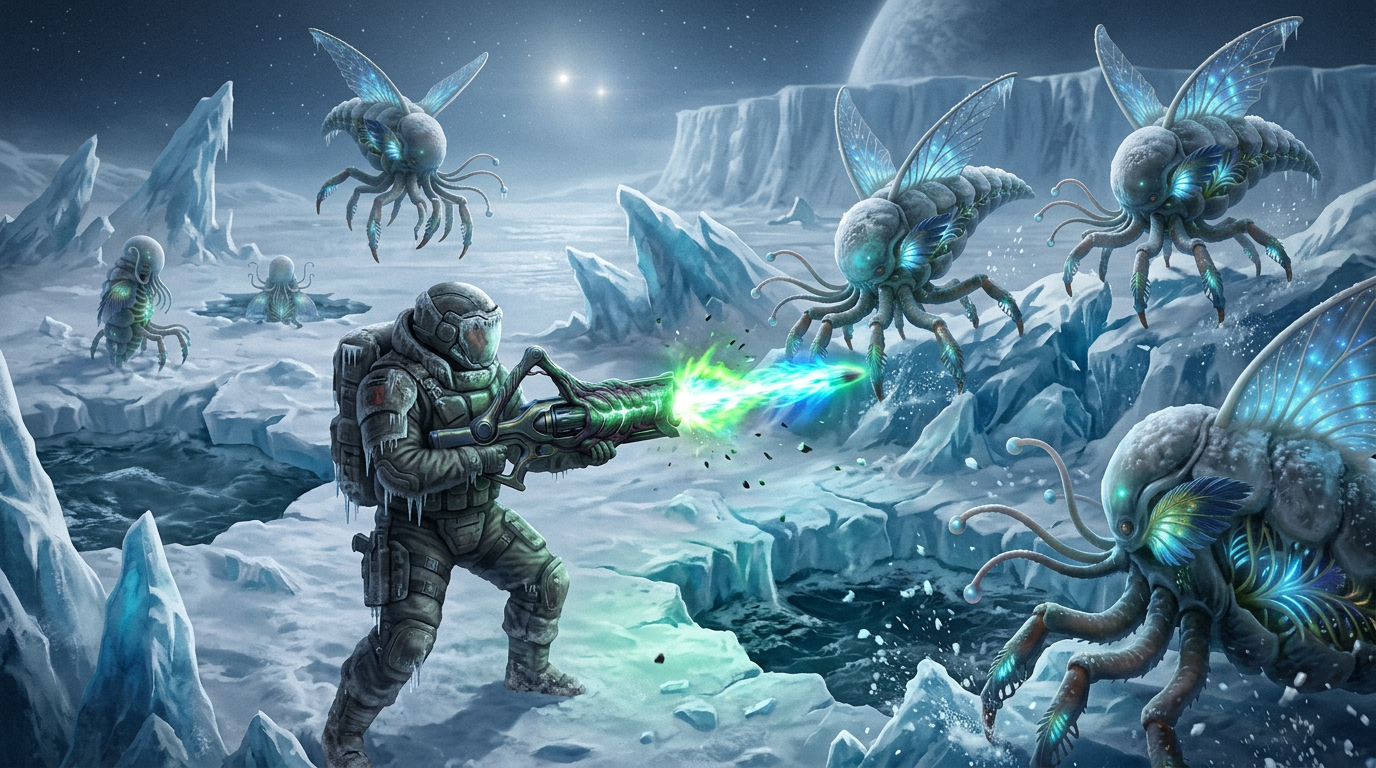
Korr saw the wings first, because the wings were meant to be seen: twin fans of membrane stretched on fingerbone, catching the bleed-light from the giant overhead and throwing it back in oil-slick blues and golds, the falling snow caught and held in the veins of them like a held breath. Beautiful. He had been a long time in the cold and the beauty of it reached him before the sense did, and that was the whole design — that you would stand and look while the rest of it arrived.
The rest of it was a segmented body the length of his arm and then longer, pale-armored plates frosted white, a soft underbelly that pulsed with a green light he knew, recognized, because it was the reef's light, because this thing ate what the reef made. Two ranks of legs, jointed wrong, each ending in a hook of black chitin that did not slip on ice. And where a face should be, a cluster of feeding palps moving with slow underwater patience, and above them a fan of antennae fine as frost-feathers, reading the air, reading him — his heat, his breath, the salt-stink of his fear.
It did not rush. Glasswings do not rush. They drift, lovely and unhurried, into the space around a warm thing, and they wait for the warm thing to do what warm things do in the cold — stop, stare, slow, sleep. The hooks are for after. And there was not one of them. Korr turned a slow circle on the ice and counted four, then six, lifting off the wreck and the ridges all around him, fanning their wings, drifting in, and felt the deep animal pull to simply sit down in the snow and admire them until he stopped being afraid, until he stopped being anything, and that pull was the closest thing to a voice the Glasswings had, and they were singing it to him together now, a slow cold lullaby with hooks in it.
He fed the rifle instead.
The breech-maw took the cell and the gun sighed — and every Glasswing on the ice flinched at once. They flinched because they knew that sound in their nerves, knew it the way a thing knows the scream of the prey it has hunted since before either of them had a name — the sound of a Ghede in agony — and for one half-second their lovely drifting faltered, the lullaby broke, and in that half-second Korr put the discharge through the nearest one and the snow lit up gold and went dark and wet.
Then it was work, ugly and fast, the way it always was. He backed to a wall of blue ice so nothing could come from behind and he fed the thing and fired and fed it and fired, and each time it sighed before it screamed light, and each sigh dropped the others into that half-second of flinch, and he learned in ninety seconds of terror to time his shots to their hesitation, to use the dying cousin in his hands as a bell that froze them just long enough to kill them. Four. Five. The sixth came in low under a wing and got a hook into his thigh, into the suit, into the meat, and the cold poured in through the hole and he screamed and jammed the warm muzzle into the soft green belly of it and made the gun sigh one more time and the Glasswing came apart around the discharge.
And then it was quiet, and he was bleeding cold, and the snow around him was gold-dark with the ruin of beautiful things, and the rifle in his hands let out a last soft contented breath, fed, fed, and Korr stood in the wreckage of the lovely murderous creatures and hated the gun more than he had ever hated the cold.
Because the gun had liked it. He had felt it. Every time it sighed, the warm living thing in his hands had been, for one instant, glad — and he could not tell anymore whether it was glad to kill or glad to be, for one moment, doing the only thing it had left, even now, even like this. He didn't know which was worse. He stopped letting himself wonder. He packed snow into the hole in his thigh until the suit sealed cold around it, and he turned, limping, toward the dead ship and the shaft and the warm black sea below, where the beacon was, and where — though he did not know it yet — the song was about to come up to meet him.
The beacon was not in the ship.
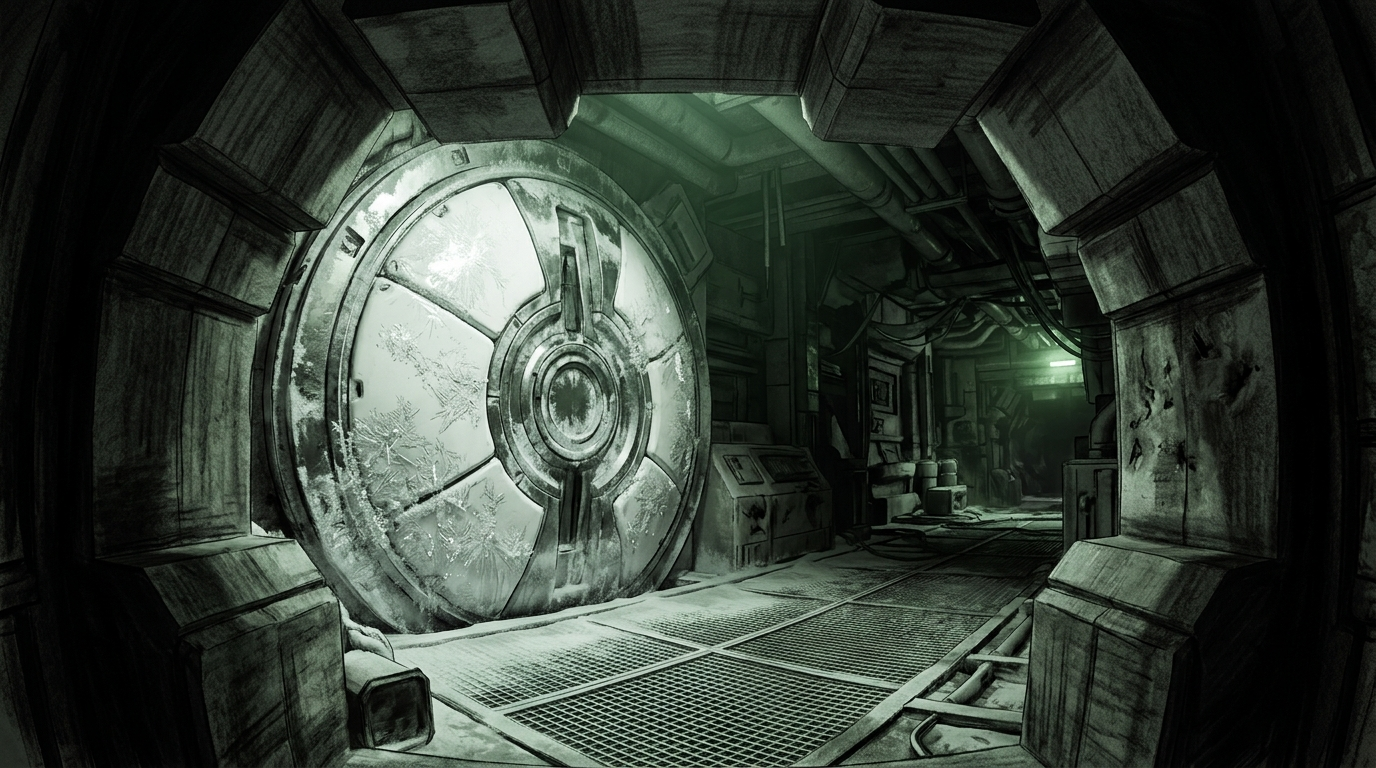
Korr found that out the slow way, the cold way, climbing down through the canted dead corridors of the Cantor's Mercy with his thigh screaming and his lamp throwing shadows that moved wrong on the frost. He found the crew. Not all of them — enough. They had not died of the cold, though the cold had them now. They had died at the cut, at the lip of the shaft, doing the work, and the work had killed them, and Korr stood in the buckled hold where the harvest tanks still held their cargo and understood the second thing the briefings had kept abstract.
The tanks were full of Ghede. Alive. Dozens of them, ribbed and green-and-red, floating in cold reef-water going slowly to slush, and they were all of them making the sound. The thin sound. The sound his rifle made between the sighs. He stood in a room full of caged singing and his own gun answered it from his chest, sang back, I am here, I am here, and for a moment all of them were singing together, the tanks and the gun, a chord of pure caged agony, and Korr put his back against the frozen bulkhead and slid down it and sat in the cold and could not for a moment make himself be a soldier.
The beacon signal, when he finally raised it on the suit, was not coming from the ship. It was coming from below — from down the shaft, down in the warm dark, a quarter kilometer down where the reef had been. Someone had taken it down there. One of the crew, maybe, at the end, carrying the one thing that could call for help down toward the one warm place left, the way an animal crawls toward heat to die. Korr looked down the black throat of the shaft, and felt the warm breath of the sea coming up it, the first warmth in fourteen months that wasn't a gun, and he did the thing he had been sent to do and did not want to do. He went down into it.
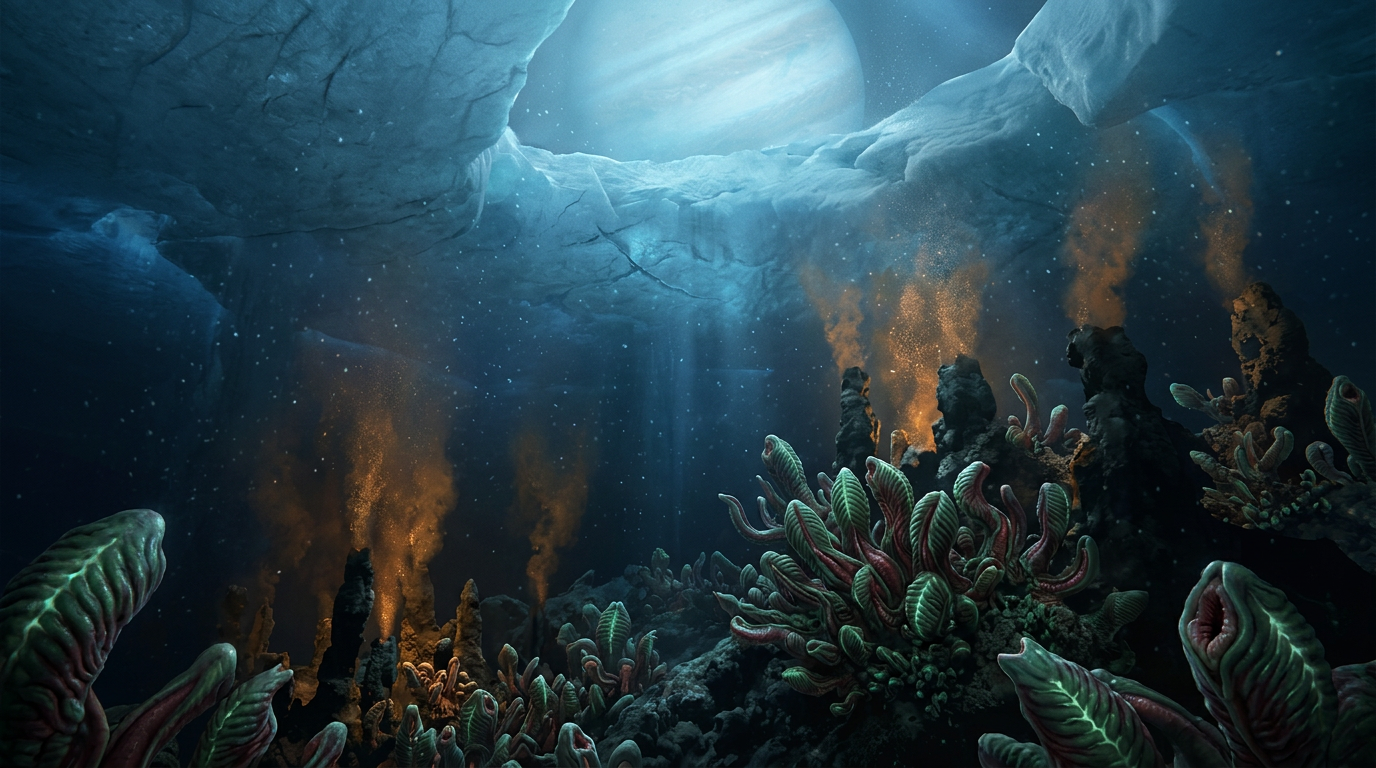
He went down on the crane cable, hand over hand, the rifle slung and sighing, down out of the cold and into the warm, and the warm was worse than the cold because the warm was alive. The shaft opened. The ice ceiling soared away above him, vast and cracked and lit from somewhere far off with a blue that bled down through the fractures, and below and around him the warm black sea opened out, and in it, on the broken vent-rock where the harvest had not reached, the reef was still living.
He hung on the cable in the warm dark and looked at it and it was the most beautiful thing on the moon and he had come from a people who built it into guns.
They covered the rock, the Ghede, the whole and living ones, hundreds of them, ribbed bodies swaying in the thermal current, breathing light, mottled green going to deep coral red, and where they opened their maws to feed they showed the same wet ringed mouths that screamed in the tanks above and in the gun on his back. They were not screaming here. Here, in the warm, in the dark, at home, they were singing — a low green chord, content, ancient, indifferent, the sound a world makes when it is simply being itself and has never once imagined a cage.
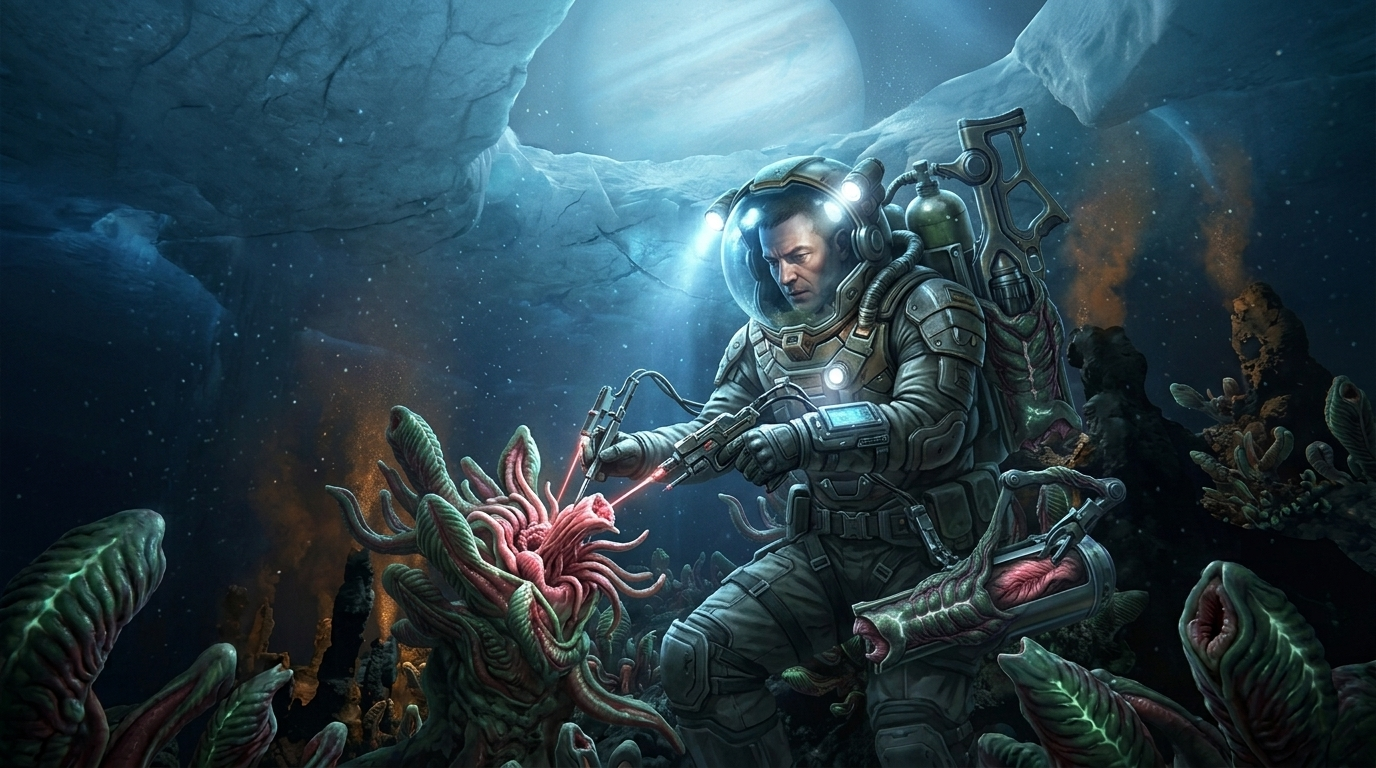
And his gun heard them.
The rifle came off his back. He didn't decide it. His hands brought it around because it brought it around, the warm living thing straining in its alloy cradle toward the reef, toward home, toward the hundred voices it had been cut away from, and the maw worked and the green light climbed the ribs and the gun made a sound Korr had not heard it make before — not the sigh, not the scream, but a third thing, a high reaching note, a calling — and out on the rock a hundred reef-cousins lifted their voices and called back, and the discharge built in the breech with nobody's finger near the trigger.
Korr clung to the cable in the warm dark with a weeping gun in his hands, a thing made of a murdered cousin reaching out to touch the living family it had been stolen from, and he understood, finally, all the way down, the thing the war was about. He was not carrying a weapon. He was carrying a kidnapped child past the window of its mother's house, and it had seen her, and it was screaming her name, and there was not one thing in the cold or the warm he could do to give it back.
He was still hanging there, undone, when the song changed — when something vast and pale detached from the dark at the edge of the reef and rose toward him, and on its back, lit by the blue bleed of the broken ice, rode a thing with silver fur and amber eyes and a turning disc of light at the center of its chest.
The ice gave Korr up to the open before he was ready for it.
He had climbed back out — back up the cable, back up the cold throat of the shaft, hauling himself and the calling gun out of the warm and into the killing cold because down there was no beacon he could reach and no fight he could win, only a grief that would drown him. He came up over the lip into the white and the bruise-colored dawn with his thigh dead and the rifle sobbing softly against him, and the land simply ended its hiding, and he turned, and the war finally looked at him.
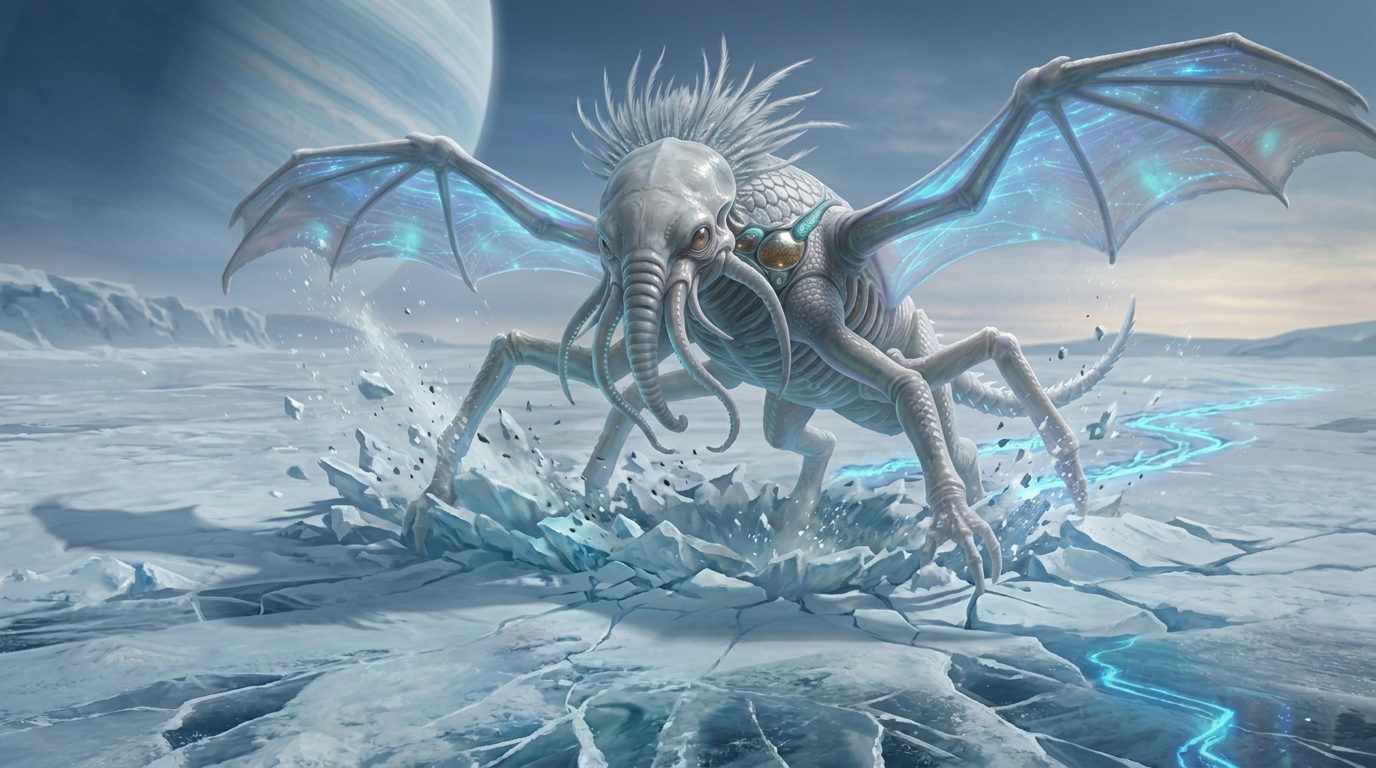
It came up out of the shaft behind him. Not down a ridge — up, up out of the warm dark on six pale splayed legs, taller than the dead ship's crane, bone-white, a great walking architecture of fused plate hauling itself onto the ice with the slow indifference of weather. Where a face should be was a cluster of pale tentacles moving in underwater patience; above them a corona of sensory plumage read the whole white world at once and read him. Its half-furled wings ran with cold blue fire, and behind it, written down the ice in a long luminous line, was the track of its climbing — the moon signing the path of its own apex across itself.
And on its back, low between the wing-roots, in a cradle of resonance gear glowing the same orange as the great one's belly, rode one of them.
Korr had seen the People only in gun-camera stills and in the dark. Now, in the gray morning, the rider sat up — fur silvered white over a body lean and gray as wet stone, a tail laid along the apex's spine, ears flat — and at the center of its chest the disc, the six-point organ of concentric rings, turned, and listened. Its eyes found him and burned amber, and they were not the eyes of an animal and they were not afraid, and Korr understood with a cold that had nothing to do with the ice that the monster was not the monster. The monster was the horse.
His thumb found the firing stud. The rifle, feeling it, made the small glad motion it always made.
And then it didn't.
Vresh had felt the human before the great one's plumage did — felt it the way you feel a wrong note in a song you have sung your whole life. The caged voice was here, close, screaming and screaming, and the disc carried it up through the cradle and into the bone behind the breastbone until Vresh's whole body rang with a cousin's two-day agony. And there, at the lip of the wound in the world, stood the sky-thing that carried the cage. A soft cold animal, smaller than the great one's foot, far from anything that loved it, holding against its chest the screaming heart of the People's grief.
Vresh did not reach for a weapon. The People's grief was not a weapon.
Vresh reached, instead, with the disc — opened it wide, the way you open your arms, and let the dying cousin in the metal hear, for the first time in two days, a voice from home that knew its name.
Across the gap of ice the green light in the human's hands faltered. The screaming changed. It was not relief. It was almost worse than relief. It was a thing in unbearable pain discovering, at the very end, that it had not been forgotten — and the sound it made then went into Vresh like a blade and into the human's hands like a tide turning, and the great one under Vresh lowered its plumed head and knew the voice too, and a tremor of old hunger ran its spine, and Vresh laid a hand flat on the cradle and sang it still. Not that one. That one is ours to grieve.
Korr felt the gun go strange in his hands.
The discharge had been building, the breech hot, the maw wide — and then, between one heartbeat and the next, the rifle stopped pulling toward the trigger. The green light banked low. The wet machine in his grip, the thing that sighed every time he made it kill, went still in a way it had never gone still, listening to something out across the ice — to the rider, the disc, the amber eyes — and Korr, who had carried this weapon for fourteen months and hated every sound it made, felt through the stock a thing he had no word for and the alien had a whole religion for.
The gun did not want to fire. The gun wanted to go home.
For a long moment nobody moved. The dead ship ticked and settled in its grave of ice. The giant turned overhead and gave no heat. Two soldiers in two different griefs, on the same gray morning, both trying — in the only grammar each of them had — to put the same creature to rest.
Korr's thumb came off the stud.
He did not lower the rifle. He did not raise it either. He stood there in the wreck-light with the screaming gone soft in his hands and looked up at the thing he had been taught was the enemy, and found, on its back, only somebody who had heard the same terrible sound he had, and answered it sooner.
And that was when the ice to the east broke open, and the other one came — the one with no rider, the one the singing had called up out of the deep, the one that had come not to grieve but to feed.
It came out of the broken ice the way a building would, if a building decided to hunt.
The riderless one was bigger than Vresh's mount and older and there was nothing in it that the disc could sing to. Vresh tried — Vresh opened the disc and reached for it the way you reach for any of the great ones, with the waking-song, the kinship-song, the be-still — and the wild one did not answer because the wild one was not listening to the People this morning. It was listening to the same thing the gun was listening to. It was listening to the caged cousin scream, and to the reef sing back, and to all that raw spilled Ghede-voice ringing across the ice, and to a thing that has hunted Ghede since before the ice, that sound is not grief and it is not music. It is a table being set.
It came for both of them because it did not know there were two sides. There was only warm meat on the cold ice and a great deal of singing, and it came through the floe at them with its pale wings flared wide to gather the dawn and its plumed head low and its tentacles spread, and Vresh's mount screamed and reared and Korr was thrown flat on the ice and the rifle skidded from his hands and lay there sighing in the snow, and for one whole second the human and the People's child looked at each other across three meters of cracking ice with the same animal understanding: that thing is going to kill us both and it does not care which of us is first.
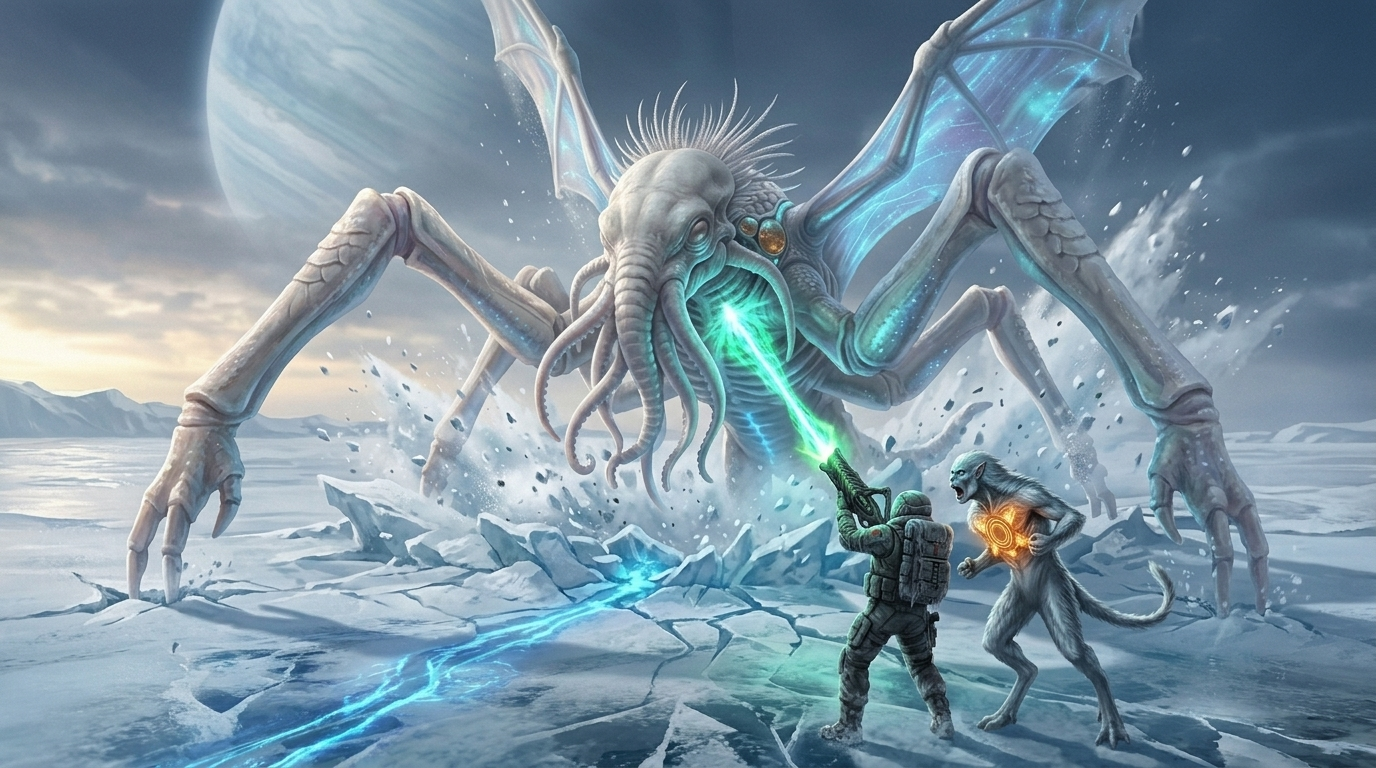
Then they were back to back without deciding to be, because that is what two living things do when a third thing that large comes for them, war or no war.
Vresh got there first with the only tool the People carried — not a weapon, the disc, the disc opened to its fullest and aimed, a single focused shout of PREDATOR, FEAR, FLEE flung into the wild one's plumage, every alarm-note the reef had ever taught the People to throw, and it landed and the wild one flinched, broke stride, screamed, and Korr understood the half-second the way he'd understood the Glasswings' half-second — understood that the alien had just rung the same bell he'd been ringing all day, the bell of something terrible is here, and that the bell only bought you that one half-second, and that the gun was lying ten feet away in the snow.
He went for it across the ice on his dead leg and his hands and he got it and he rolled onto his back under the falling weight of the apex and he did the thing he had sworn in the warm dark he would never do again. He fed it everything.
Both cells. The reserve. The whole of what he had, jammed into the breech at once, more than the procedure allowed, more than the thing could hold — and the Ghede in his hands took it, took all of it, because taking was the only thing it had ever known how to do, refined it in the ribbed gut that had been built to do this in a warm sea ten thousand years ago, held it, and Korr looked up at the eyeless plumed head coming down at him and he did not pull the trigger.
He didn't have to.
The gun fired itself. The Ghede spent itself. It had heard its family across the ice and it had been screaming for two days and it could not go home and it could not stop and there was only one thing left it had ever been for, and a child of the People had just opened a disc and let it know it was not alone, and so the Reclaimed Ghede gathered all of itself, all the stolen charge and all the two days of agony and all the last of its small green life, and it let it out.
It did not sigh.
It sang — one note, enormous, the loudest and last thing it would ever say, a column of green-white fire that took the wild apex under its lowered head and lifted it off the ice and unmade it, blew it backward in a thunder of light across the floe, and the snow lit up green for a hundred meters and the ice rang like a struck bell and somewhere far below the whole reef went silent for the first time in the moon's memory, listening, as one of their own spent the very last of itself in the cold above.
And then it was over, and the wild one was a steaming ruin sliding into the dark water, and the green light went out of the gun in Korr's hands all at once, and did not come back.
He lay on the ice and felt it die. The warmth he had carried for fourteen months, the one warm thing, the kidnapped child — it cooled in his hands, the ribs going slack in their alloy cradle, the maw falling open and still, and the thin sound it had made every moment of every day, the screaming he had hated, stopped. Truly stopped. He had wanted it to stop for two days and now it had and the silence was the worst thing he had ever held.
Across the ice, the child of the People knelt in the snow where the great one had thrown it, hand pressed to the disc, and Vresh felt it too — felt the caged voice that had torn the song for two days finally, finally go quiet, not into a new cage but into the only freedom the sky-things had left it. The wound in the chord closed. The cousin was at rest. The People's two-day grief let go all at once and what was left in its place was not relief either. It was the silence where a voice had been.
They stayed like that a while. The human on his back, the People's child on its knees, ten meters apart on the ice, both of them holding the same quiet.
They did not become friends. There is no version of this where they become friends. There was still a war, and a frozen station in the sky, and a People who would still ride up out of the warm to meet the next ship that came to open the next reef, and a navy that would still send the next ship. Korr knew it and Vresh knew it in whatever the People had instead of knowing. None of that had changed.
But the thing they had both been chasing was at rest, and you cannot kneel in the same silence as someone and go on believing they are only a monster.

Vresh rose first. The young one climbed the cradle of the great mount's spine, and the great one turned its plumed head once toward the human — read him, his cooling gun, his dead leg, his small warm dying animal heat — and then it turned away, because the disc told it to, because Vresh had decided something the elders would not have. Before it bore the rider back down into the warm, Vresh did one last thing. The disc opened, narrow this time, aimed — and into the human's dead suit-comm, into the one channel a sky-thing might hear, the People's child pushed a single coordinate. Not in words. In the only grammar they shared now: a pulse, a direction, a there. A place across the ice. A structure the humans had photographed a hundred times and never recognized, because it did not look like a building to them — a second beacon, a People-thing, old, that would carry a voice up off the ice to the cold station in the sky.
The Choir had always known where the working beacon was. They had simply never had a reason to tell a human. Now there was one dead cousin's worth of reason, and it would have to be enough, because it was all there was.
Then the great one walked down into the shaft, into the warm dark, and was gone, and the song closed over it, and Korr was alone on the ice with the giant turning overhead and giving no heat at all.
He got up. It took a while. His leg was a dead cold thing and the silence in his hands was worse. He looked down at the rifle — the spent Ghede, slack in its cradle, the maw open, the green gone — and he understood that he was not going to carry it to the beacon. He had carried it long enough. He had carried it two days too long.
He knelt, in the snow, in the cold, on the floe above the warm sea, and he laid the gun down.
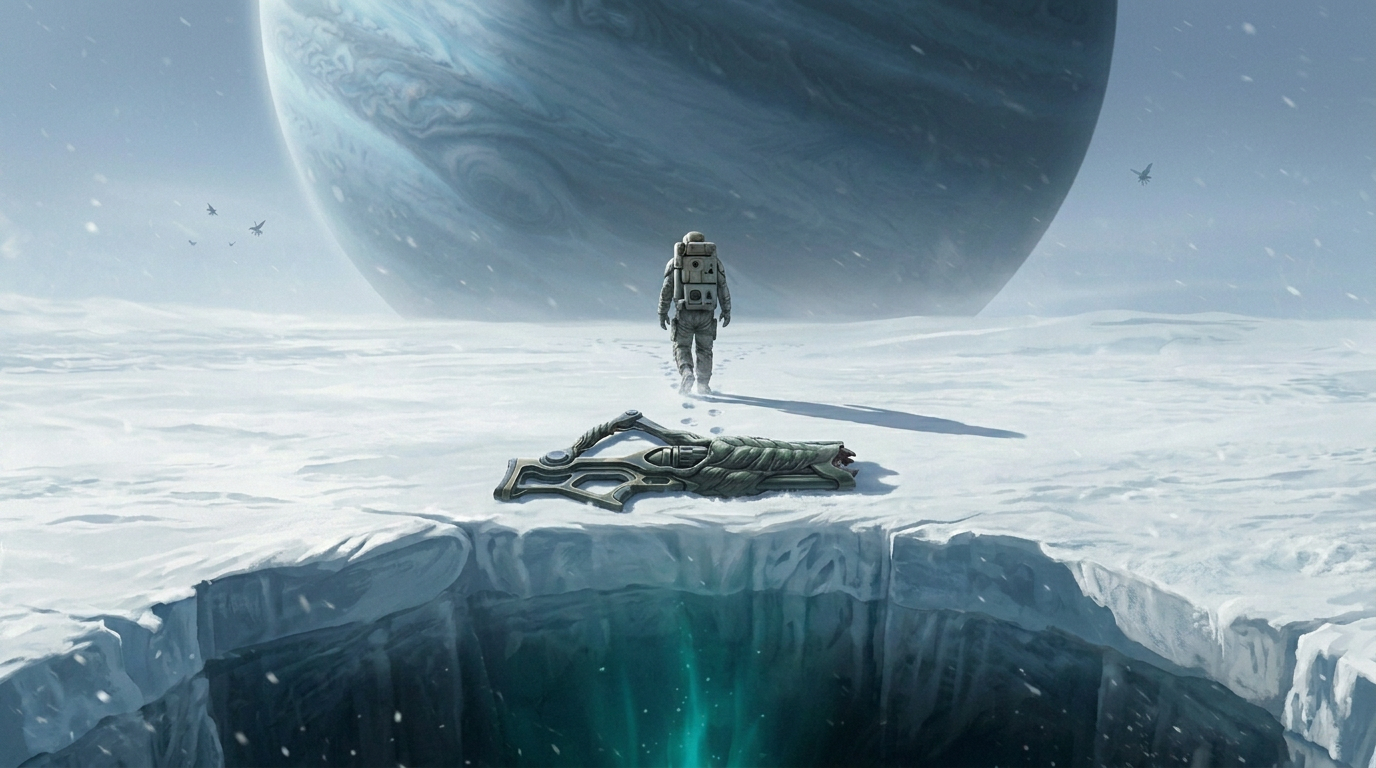
He did not have the words for what it was. The People had a whole religion for it and Korr had nothing, no song, no disc, no kinship with the warm dark, only fourteen cold months and a thing in his hands he had finally let die. So he did the only thing he had. He pressed the open maw closed with his glove, gently, the way you close the eyes of the dead, and he laid the rifle down on the ice over the shaft where the warm came up, pointed down, toward home, toward the reef, toward the hundred green voices that had sung back. An offering he didn't have the words for, to a family that didn't have the forgiveness for, in a war that wasn't going to end. He laid it down anyway. It was all he had.
Then he turned, and limped out across the white toward the place the alien's pulse had marked, toward the cold beacon that would call the cold station that would send the cold ship to carry him back up into the cold, where it was safe, where there was nothing warm at all.
Behind him, on the ice, the giant turned, and the reef sang, healed by one voice, and somewhere down in the warm dark a young one of the People carried home a piece of a silence that a human had helped to make — and the gun lay where he had set it, cooling toward the temperature of the moon, pointed at the only warmth left in the world, finally, after everything, quiet.
It had wanted to go home.
He had given it the closest thing he had.