First Occurrence
“She did not turn around.”
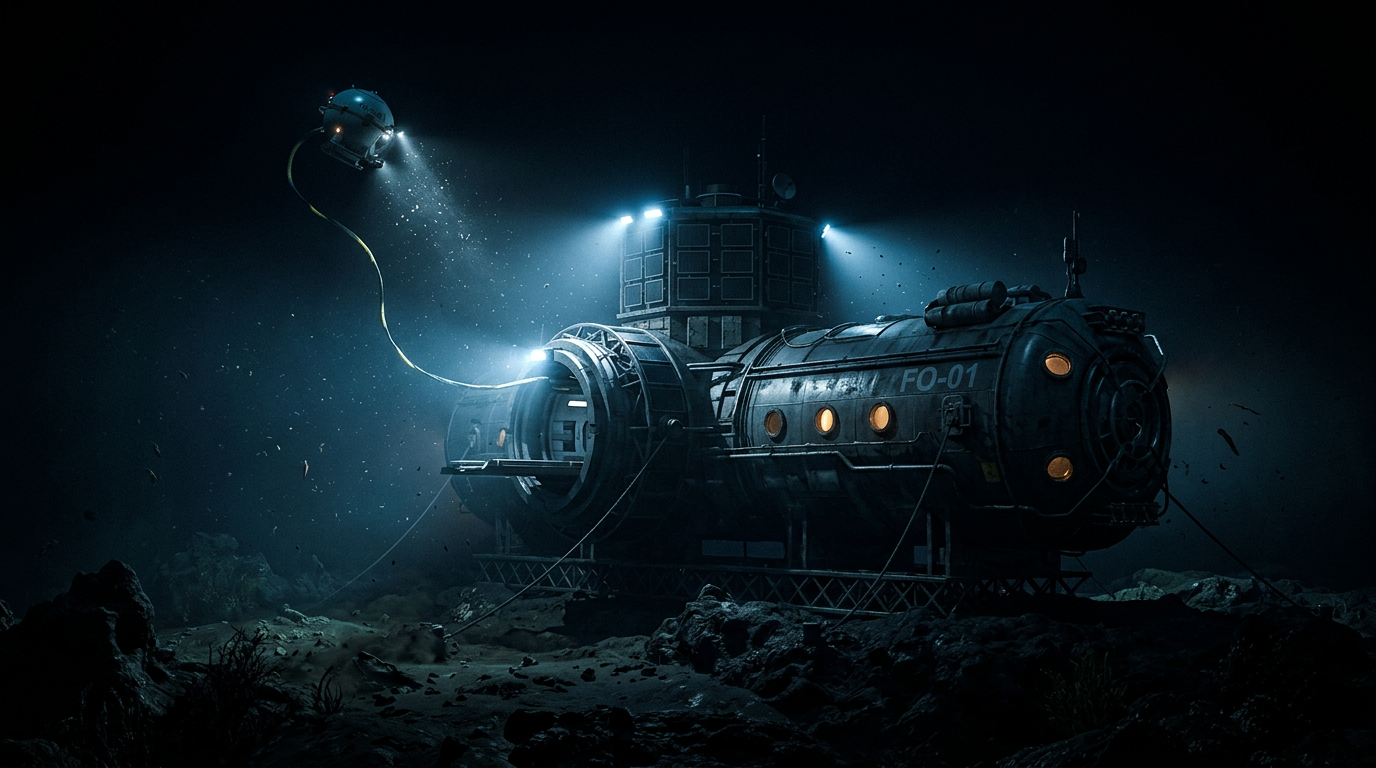
The station was at four thousand meters when Rook arrived, which put the external pressure at roughly four hundred atmospheres, which meant the hull was the only reason she was here at all. She found this clarifying. Most places she'd worked, the environment was merely unpleasant. At four thousand meters, four hundred atmospheres pressed against the hull from every direction. It had been doing that for three hundred million years before anything capable of noticing arrived. She appreciated the honesty.
It was her first field assignment in eleven years with the company. Her degree said xenobiology; her career said otherwise — incident documentation analysis, a job title that meant she read the reports other people wrote about the things that went wrong, and measured them against the physical evidence, and wrote a third document about the distance between the two. She was very good at it. She had assumed, when the dispatch order came through with her name on it, that someone upstairs had finally decided a response team should include a person whose entire professional life was the detection of the difference between what a record said and what had happened. She had decided not to be flattered by this until she understood it.
She came down on the support submersible with two others. Osel had run the station's structural systems on a previous rotation and sat in the forward section during the four-hour descent watching the depth gauge with an expression that seemed to involve some kind of private accounting. An hour in, unprompted, he showed her the scar across his first two knuckles — a long pale ridge, a salvage job years back, a cable that had jumped its drum on a recovery off Luzon and taken a glove with it, and very nearly the rest. He told it in the cadence of a story told many times: same words worn smooth, same small pause before the part about the glove. Then he put the hand away and didn't mention it again. She catalogued it without deciding to, which was the only way she catalogued anything.
The third passenger was Harlan Voss, from the company division that owned the intellectual property rights to whatever the station's research team had been doing before the station's research team stopped being answerable to queries. He kept one hand in his jacket pocket for the entire descent. Rook spent two of the four hours reading the incident documentation on her tablet and one hour watching Harlan Voss keep his hand in his pocket, and she had decided by the time the docking collar locked around the submersible that this meant something, and had not decided what.
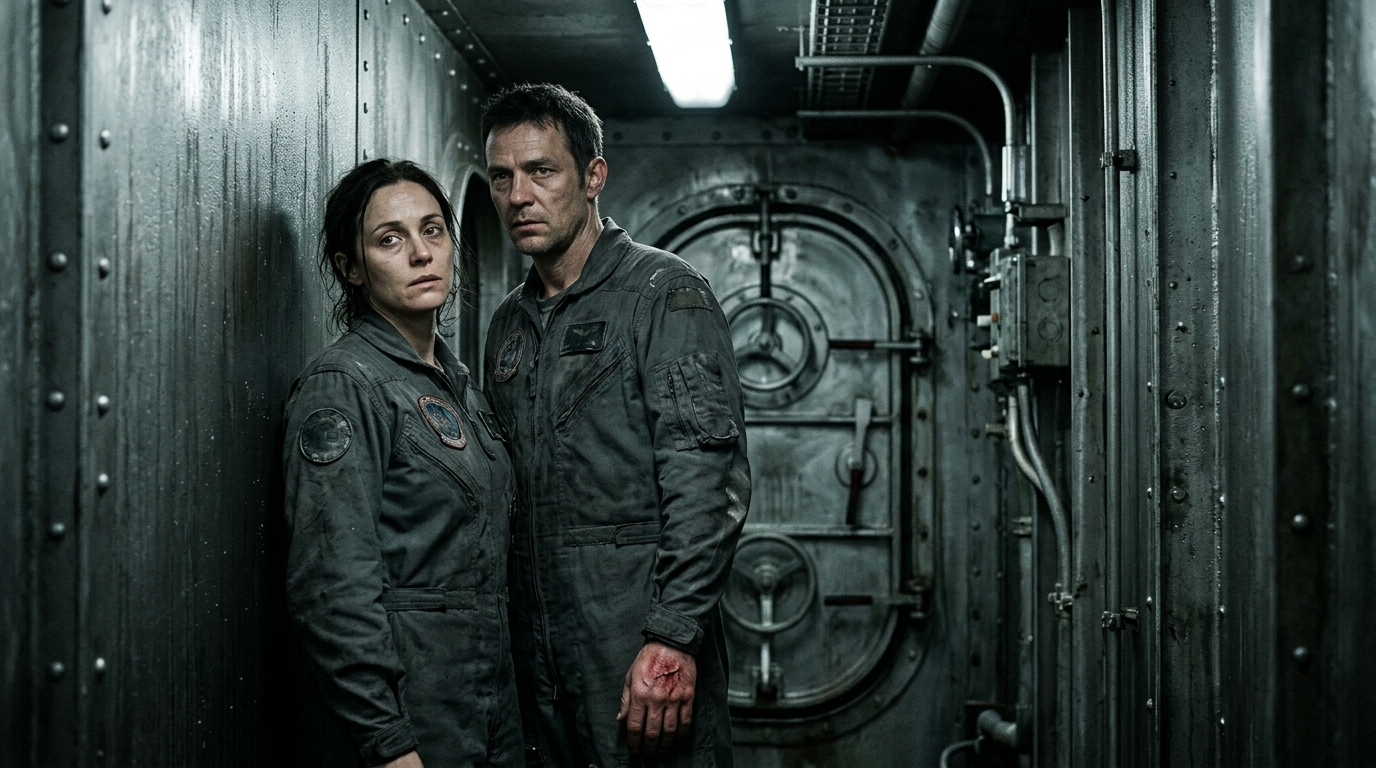
The station had a crew of nine. Six had been logged as transferred to a surface support vessel eight days before her team's dispatch. The support vessel had no record of receiving anyone. Three remained on station according to the biomonitors: a structural engineer named Sune, a communications officer who had listed her name in every log only as T., and a marine microbiologist named Alys Ferren, whose signal placed her in corridor B.
The three living crew members met the submersible at the docking collar.
There were two of them.
Sune and T. met them at the collar with their bodies angled inward, shoulders almost touching, the geometry of two people who had agreed without discussion to occupy less of the station than they were entitled to. When the submersible locked in they didn't separate. Sune had a fresh burn on the back of his right hand that he was not mentioning. T. looked at a point slightly above and to the left of whoever she was speaking to, consistently, in a way that made conversation feel like something she was participating in from a short distance. She had listed her name in every log as T., and the logs had accepted it, which told Rook that the station had stopped enforcing its smaller rules some time before it stopped enforcing its larger ones. Rook catalogued all of it and kept the more immediate question ahead of it: there were two people where the biomonitors had indicated three.
"Ferren," Harlan Voss said. First words in four hours. "Where is she."
"Her monitor is in corridor B," Sune said.
"That's not what I asked."
Sune looked at the burn on his hand. T.'s eyes moved to the wall behind Rook's left shoulder. Neither of them said anything for a moment that was slightly too long to be a pause and not quite long enough to be a refusal.
"Her monitor," Sune said again, "is in corridor B."
The crew canteen had nine hooks by the coffee station and nine mugs on the hooks.
Rook stood in front of them for a while, her first evening aboard. Six crew members had been logged as transferred to the surface. Their mugs were still on the hooks, and four of the six had gone furred inside with the gray-green of old coffee left standing — a week's worth, maybe a little more. Their boots were still in the rack by the suit locker, paired and toed in against the wall the way people leave boots they intend to come back to. In bunk three, a paperback lay splayed open and face down to hold a place its reader had stopped advancing toward. Transferred crew pack their mugs. Everyone packs their mugs; the mug is the first thing in the bag. She catalogued the hooks, and the boots, and the paperback, and she went on to the bunk room and did not mention any of it to anyone, because the people she would have mentioned it to either already knew or were the reason it was true.
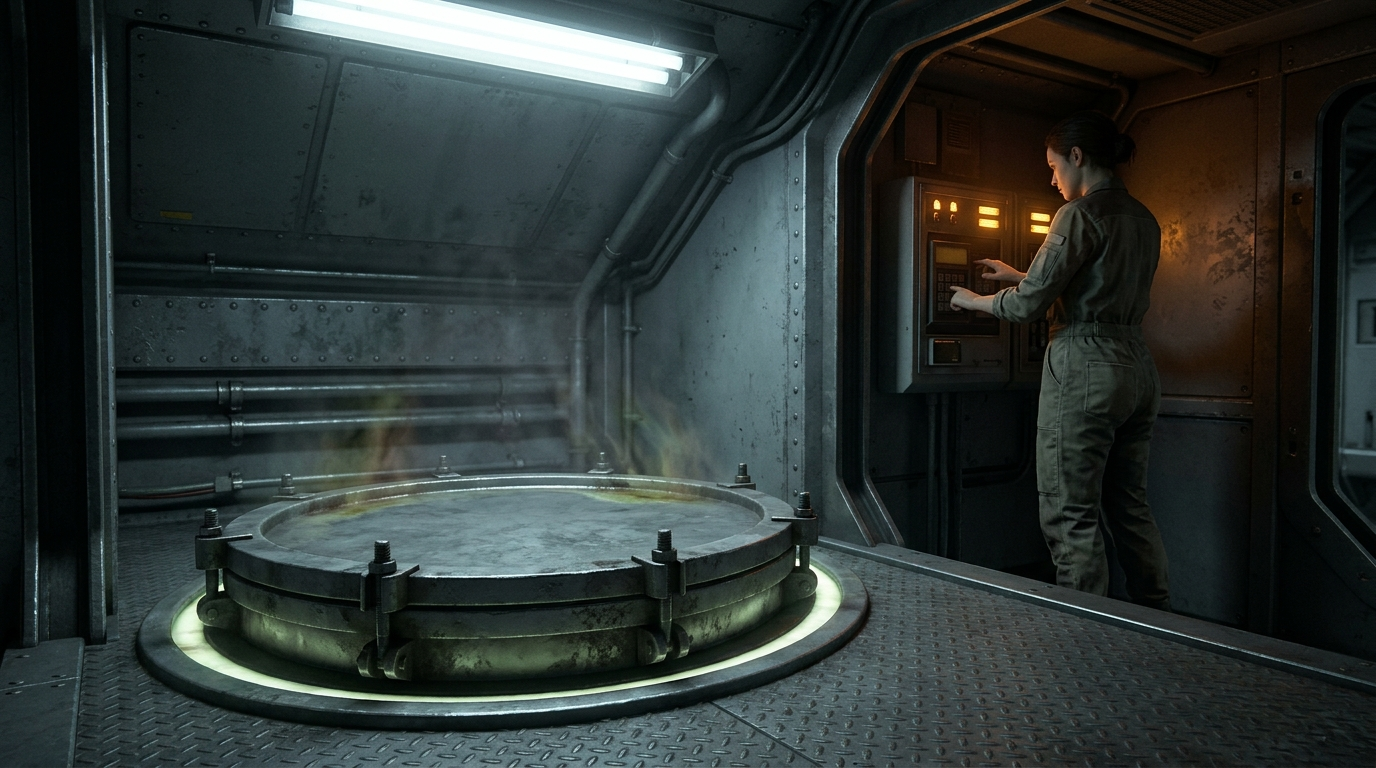
The incident documentation said the event had begun on the eleventh day of the current rotation, when the biology team had removed the cover from vent sample port seven to extract a sediment core. Standard procedure. Alys Ferren had written the protocol herself; it had been used without incident on six previous rotations. The cover came off, the extraction arm went in, and something came up the shaft that the arm's sensors had not registered as biological.
The documentation said the port was subsequently resealed.
The documentation said there were no casualties.
The documentation was why Rook's team was here, and not a larger team, and not a team with different equipment, and not a team that had been told what specifically they were looking for.
She read it again in the bunk room before she slept. Osel was already out. Harlan Voss's bunk was empty, which she noted. It was competent documentation — thorough, internally consistent, formatted to standard — and that was the thing about it that put the cold in her, because in eleven years she had learned that the truth comes in sloppy. Honest incident reports contradict themselves; frightened people misremember times and double-log entries and leave fields blank. This report had no blank fields. This report was wrong in every particular she could test against two hours of physical evidence — the burn on Sune's hand, the conversations T. attended from a short distance, the six unverifiable transfers with their mugs still on the hooks, the biomonitor in corridor B logging a steady heartbeat for a woman Rook was increasingly certain was dead — and it had been written by someone calm. The falsifications were precise, and they sat exactly where the weight did. Somebody had sat in this station, after whatever had happened here, and produced a clean draft.
She slept badly. She woke to the sound of corridor B's pressure door cycling.
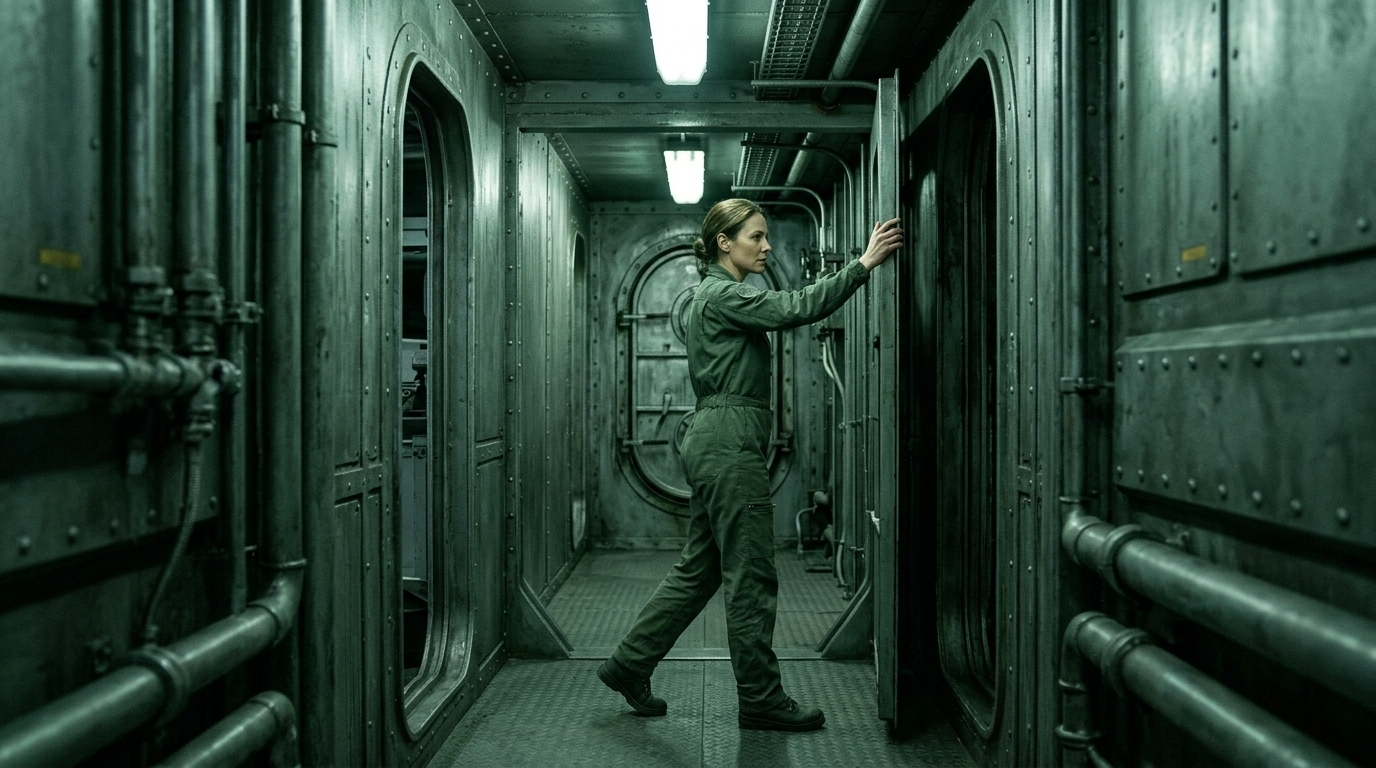
She lay still. The sound stopped. She listened to Osel breathing, unchanged, and to Harlan Voss's bunk, still empty, and to the station's ambient systems, which were normal, and to the corridor outside, which was not. There were footsteps. They had the right weight for a person and moved at the right pace and stopped outside the bunk room door, and the door didn't open, and after a moment Rook spent not breathing, the footsteps continued on toward the junction. They were unhurried. That was the detail she filed against the dark, listening to them fade: whatever walked the station at night had nowhere it needed to be, and walked anyway, the way a man walks a property he holds the deed to.
She pulled her tablet and found the paper Alys Ferren had published the previous year in a deep-sea biology journal — the paper that had first brought Ferren's work to her attention, the reason she'd been assigned to this response at all. The author photograph showed Ferren at a collection station, holding a sample container close to her body with her left hand, a grip that didn't loosen.
She closed the paper. She waited for morning.
She saw Ferren at 0600, in the junction between corridor B and the main lab.
The face was correct. The posture was almost correct — the forward lean, the direct line through the junction without looking left or right, one hand already reaching for the lab door before the feet arrived. It stepped through without looking back. Rook watched from the junction entrance and said nothing.
The hands were wrong.
The door opened with the right hand. The frame caught with the right hand as the figure stepped through. Rook stood at the junction for a long time after the door had closed, and ran through Ferren's publication record in her head, fourteen years of field photographs, collection stations and sample labs and presentation podiums at three different conferences, and in all of them the hands did their characteristic work left-handed. Not variable. Not ambidextrous. Left-handed and consistent across a career's worth of documentation.
That was the moment she understood why it was her in this station and not someone with a harpoon. Whatever had come up the shaft of port seven could copy a face to the pore. It could copy a stride, a lean, a reach. What it could not copy was the record — fourteen years of photographs it had never seen, a handedness archived in journals on the other side of four thousand meters of water. It was perfect against the eye. It was wrong against the documentation. The company had sent a records analyst because the only instrument that could detect this thing was the past, and Rook was the past's reader.
She went back to the bunk room and told Osel to check the structural integrity of vent sample port seven.
"What am I looking for?" he said.
"Whether the physical state of the port matches the documentation."
He went. She watched him go. She thought about the footsteps in the corridor and the right hand on the lab door and the fact that Harlan Voss had not returned to his bunk and had not appeared at breakfast and had not responded to two comm checks.
She found him in the documentation room, on a terminal she hadn't been given access to, reading something he closed before she could see it clearly. He kept his hand in his pocket. The terminal screen behind him had gone dark, but not before she caught a reflection in the pressure window — text, briefly, a document header she didn't have time to read.
"There was a station in the Lau Basin," she said. "A few years back."
He looked at her with the expression of someone running a fast calculation about how much she already knew.
"The documentation said equipment failure," she said. "Three fatalities, no biological incident. Similar crew count, similar rotation length, similar research profile."
"Rook—"
"You were in the company's incident response unit before the IP division."
Harlan Voss took his hand out of his pocket. It was empty.
"We need a live sample," he said.
She went still. The cataloguing stillness — everything she could hold, before it moved. "That is not the mandate."
"It is my mandate." He said it without apology. "Resealing is the contingency. Isolation and study is the primary objective. The Lau Basin event ended before we could document the organism's full behavioral range. This time—"
"This time there are two survivors who can't make eye contact," she said, "and six crew members who were logged as transferred and did not transfer, and something in corridor B wearing Alys Ferren's face with the wrong dominant hand." She paused. "How many were left at the Lau Basin when you resealed it."
He said nothing.
"How many."
"Two," he said. "There were two."
She left him in the documentation room and went to find Osel.
The corridor outside vent control was empty. Osel's biomonitor showed him stationary near port seven, which could mean he was working. She walked with her back to the wall, which she knew was not protection against anything and did anyway, because the wall meant a clear forward sightline and that was the kind of precision she had available right now.
She found Osel at port seven.
He was standing with his back to her, looking at the sealed port cover. He turned when she came in.
His hands were at his sides. The left hand was unmarked.
A long pale ridge across the first two knuckles, a cable off Luzon, a story worn smooth with telling — and the hand at the end of that story was smooth too, now, unmarked, new. The thing had copied the man. It had not copied the salvage job. It stood there wearing four decades of Osel and not one of his accidents, because his accidents lived in the record, and it had never read him, only taken him.
She stood in the doorway of vent control and looked at the hands and did not move toward the port and did not move back into the corridor and said: "What's the pressure differential on the cover."
A pause that ran a fraction too long. "Within spec."
"Which spec."
Another pause, shorter, as if something had recalibrated.
She crossed to the control panel in four steps and pulled the reseal protocol. It required a sixteen-digit authorization she had memorized on the submersible because she'd had four hours and a document she hadn't trusted, and she entered it without looking at what was standing behind her. Her hands did the work cleanly. She had wondered, somewhere in eleven years of reading other people's catastrophes, what her hands would do if a catastrophe was ever hers to stand in; now she had her datum, and filed it, and kept typing. The system ran its verification, and the port cover — sealed according to documentation, not sealed according to the evidence of eight missing crew members whose biomonitors had all, at some point, stopped logging anything — sealed now with the finality the system confirmed in three ascending tones.
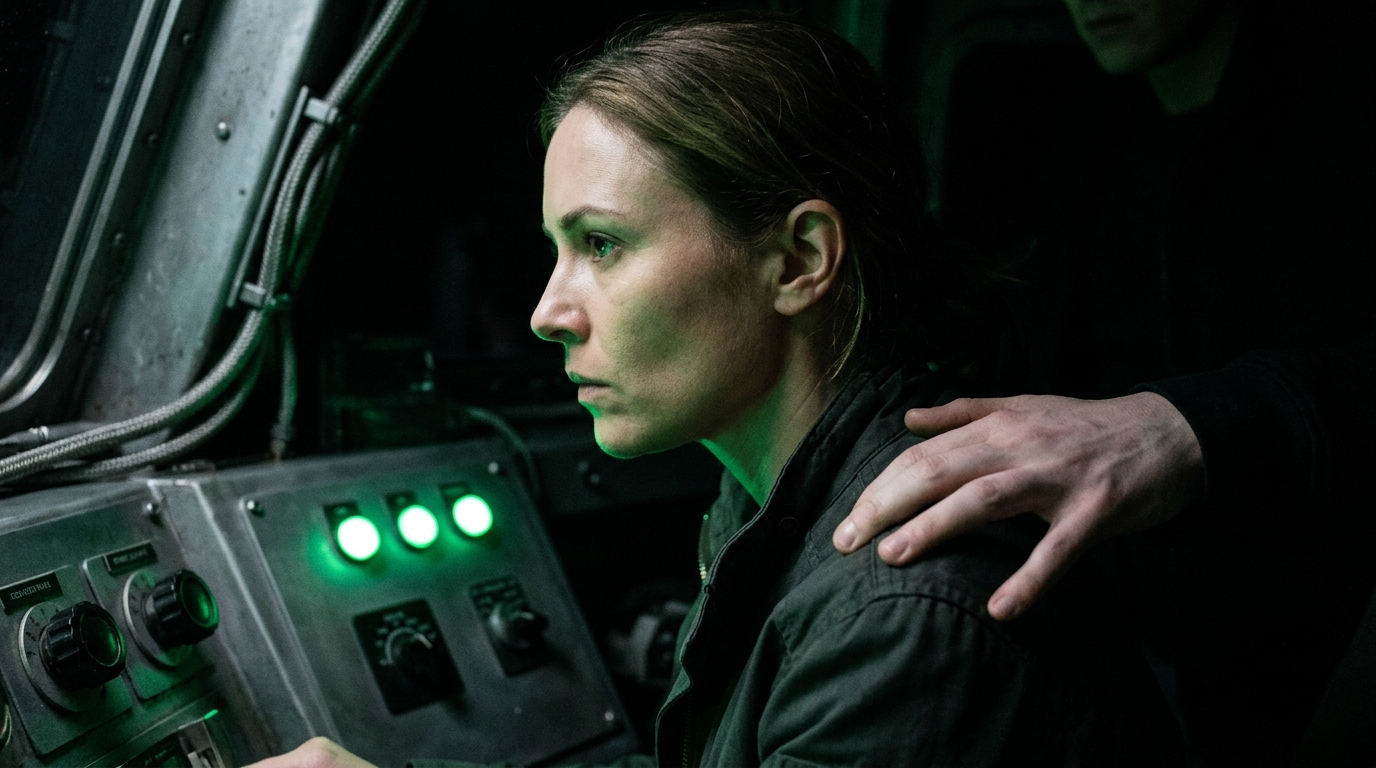
Something touched her shoulder.
The hand that touched her was light. Almost tentative.
She did not turn around.
She stood at the control panel and listened to the three ascending tones resolve into the station's ambient hum, four thousand meters of water pressing against every surface with four hundred atmospheres of patience, and when the panel confirmed the seal was complete and final and she turned around, the room was empty and the corridor beyond the open door was empty and the only sound was her own breathing and the station going about its ordinary business of keeping the ocean out.
She filed the report during the ascent, four hours in the forward section with Osel's seat empty and Harlan Voss's seat empty and the depth gauge counting upward toward a surface that felt, for the first time in her career, like a place she might not reach.
The form had no field for what the two of them were now. She wrote unaccounted for, which was true, which is the most a form ever asks of anyone.
She wrote in plain language what she had found. She documented the discrepancy between the incident record and the physical evidence. She documented the six crew members whose transfer could not be verified and the two who remained and what remaining appeared to have cost them. She documented the biological event at vent sample port seven as ongoing at the time of the team's arrival, unresolved prior to the resealing, source organism uncontained and behaviorally active throughout the team's deployment. She attached her references for the Lau Basin incident record, which she had not been provided and had accessed independently.
She wrote, at the end of the report: This is not the first occurrence. The documentation from the previous event was falsified. I am attaching what I was able to recover. I am filing this report on the assumption that it will not survive the normal filing process, and I am therefore also transmitting a copy to the following three researchers whose work I trust and whose institutional affiliations are outside the company's direct influence.
She did not know if the transmission would go through.
She did not know if the researchers would receive it, or act on it, or if acting on it would produce anything the company could not contain by the same means they had contained the Lau Basin event and the vent port seven event and whatever event had produced the documentation she'd been given on the submersible.
She knew the port was sealed. She knew that much.
The ocean outside the porthole was four hundred atmospheres of darkness pressing in from every direction, the way it had pressed for three hundred million years, with no urgency anywhere in it — urgency being a thing you learn from having rivals. She found this clarifying, the same way she'd found it clarifying on the descent. The ocean had not changed its position on anything because of anything anyone had done. It would be here after the company, after the documentation, after whatever the company decided to do about her report and her transmission and the fact that she had sealed the port when she'd been sent to evaluate whether sealing was necessary.
The depth gauge climbed. The report was filed.
For now, both of those things were true.