It Came From The Deep
“They were watching their children come home.”
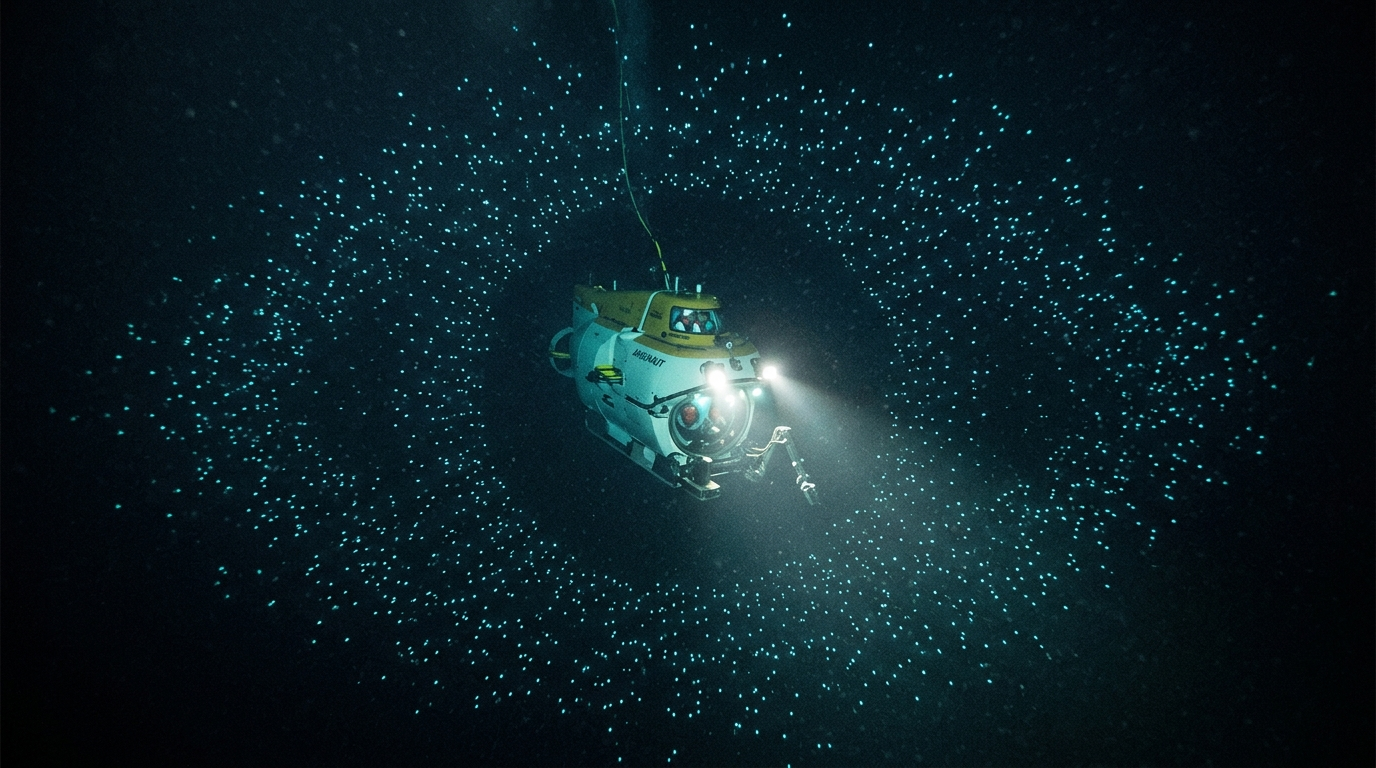
I was hired to film the descent. That is the part I keep coming back to — that someone thought there would be footage worth keeping.
My name is Ray Mercer. For twenty-two years I pointed cameras at things underwater for whoever was paying: hull inspections off Long Beach, insurance work on wrecks the owners swore they hadn't scuttled, two seasons of a cable show about treasure hunters who never found any treasure. I was fifty-one years old, I owed nine hundred a month on a boat I no longer loved, and my ex-wife had just moved to Phoenix with a man who sold above-ground pools. When the Deep Horizon Initiative offered me four times my day rate and a non-disclosure agreement as thick as a phone book, I read the first nine pages and signed all forty-one. You would have signed too. I need you to understand that. The monster in this story is not the only thing I need you to believe.
The Argonaut was rated to eleven thousand meters and we took her past it, down into the hadal dark below the Mariana Trench, chasing a sonar return that Dr. Silas Blackwood would not describe except to say it had edges. Natural formations, he told the crew of the support ship, do not have edges. He said it twice, once at the briefing and once to himself at the rail that night, when he thought no one was close enough to hear.
Blackwood ran the Initiative the way some men run a faith. Tall, liver-spotted, an old rower's shoulders gone soft under good shirts, with a voice that did one thing when funders were in the room and another thing entirely when they weren't. He had the consortium's money and the consortium had no name I was ever given — just a lawyer in a golf shirt called Pell who counted heads at the gangway and never once looked at the sea. I had a camera and a contract, and at the time those felt like different kinds of innocence.
Our pilot was Dee Holloway, twelve years Navy submersibles before the private money got her, a broad calm woman who chewed nicotine gum on descent because, she said, her ears didn't pop right if her jaw quit moving. She had a photograph of her daughter taped above the oxygen scrubber readout — a gap-toothed kid on a soccer field, maybe eight years old, mid-kick. Dee touched it twice on the way down, the second time at nine thousand meters. I have wondered since whether some part of her knew, the cell-deep part, the part that was already spoken for.
The descent took most of nine hours, and the first thing the deep takes from you is color. They tell you the red goes first, and it does — by sixty meters the safety stripes on the equipment housing had gone the gray-brown of old liver. The blue holds longest. It holds and holds, deepening, until somewhere past two hundred meters it stops being a color at all and becomes a memory of one, and then the dark closes over the sphere like a hand closing over a coin.
We drank coffee from a steel thermos. Condensation crawled down the inside of the hull and Dee wiped it with a chamois every twenty minutes, unhurried, on a schedule that lived in her body. Blackwood read his sonar charts and said almost nothing. I filmed checklists and dials, the dull procedural footage every documentary needs and no audience ever sees, and the whole long way down the only sound was the gum and the instruments and the small creak of steel agreeing, again and again, not to fail.
The water down there is not black. That is the first thing the footage gets wrong, because the camera could not hold it. It is full of light — small cold lights, hanging and drifting, the lanternfish and the jellies and a thousand things that have never needed a name. I had filmed bioluminescence on four continents. This was not that. The lights down here did not drift on the current. They held station. And when the Argonaut moved, they adjusted, all of them together, smooth as an eye tracking, keeping us centered.
Dee noticed it before I said anything. Her jaw stopped. In nine hours that was the only time it stopped.
"Current's wrong for that," she said, and then her jaw started again, slower, and she did not say anything else about it, and neither did I. There is a kind of silence two working people can build between them, a load-bearing silence, and we built it, and it held almost all the way to the bottom.
I told myself it was instinct. Prey behavior. Something old and simple reacting to a warm machine in cold water. The deep ocean is the largest habitat on Earth and the least visited, I told myself; nobody really knows what anything down there does. That last part, at least, turned out to be true.
We found the structure in the thermal bloom of a vent the size of a cathedral. Blackwood called it a formation and the word was wrong in his mouth and he knew it. It was obsidian-dark and it was built — angles meeting at counts that did not close, faces that seemed to continue past where they ended, so that the eye kept arriving at the edge of a surface a half-second after the surface had already left. The hull rang with it. A slow thrum came up through the deck plates and into the soles of my feet and the fillings of my teeth, like something very large breathing in a room next door, in no hurry, with nowhere to be. The vent did not pour smoke. It poured a thick bright fluid that glowed the same cold color as the watching lights, and the watching lights, I understood then, were coming from it. Were of it.
Dee spat her gum into its foil and folded the foil into a square and put the square in her breast pocket, with great care, like a woman tidying a house she suspected she would not be coming back to.
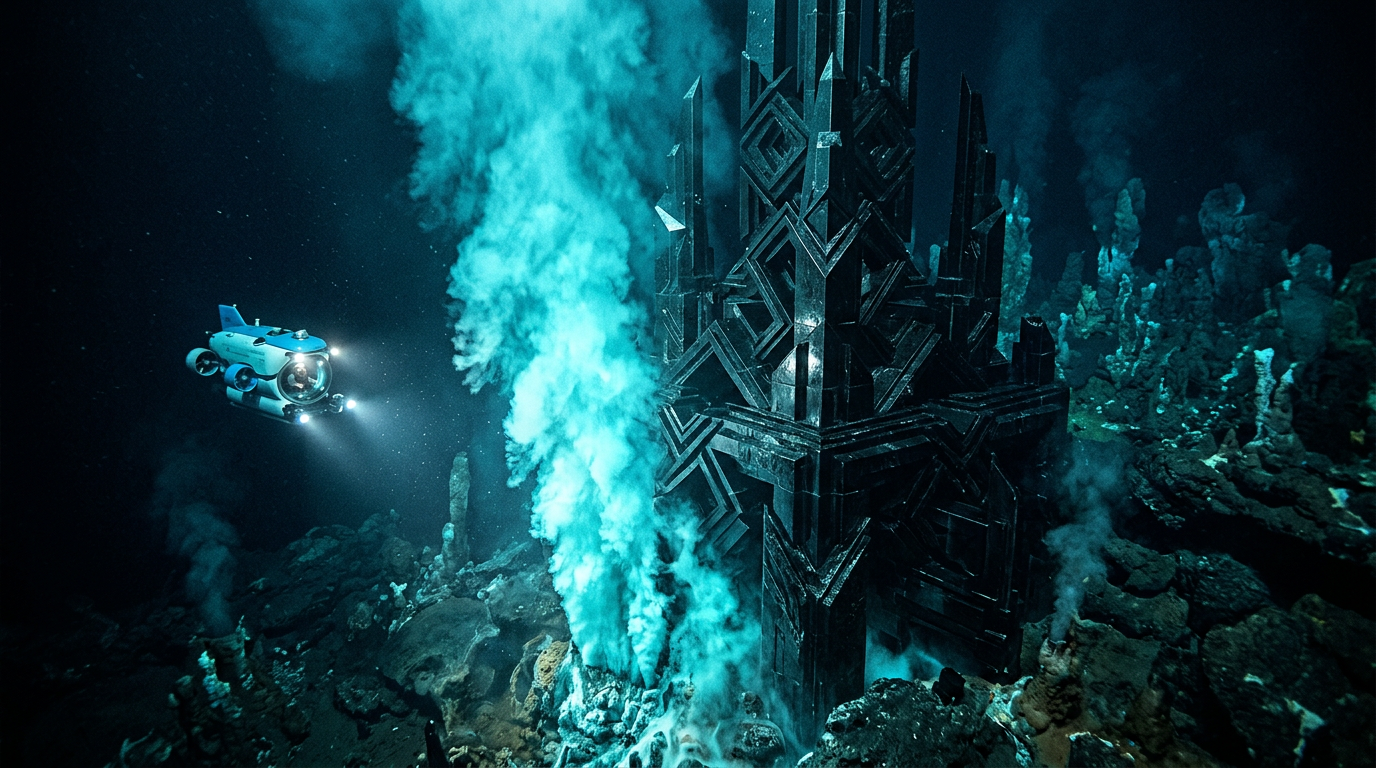
Blackwood put the sampling arm out.
He did not ask either of us. I want that on the record too — there was no vote in that sphere. There was a man with forty years of wanting something and a mechanical arm between him and it, and the rest was just hydraulics.
I have the footage of what happened to the arm and I have never shown it to anyone. It was titanium and ceramic and rated for the pressure, and where the fluid touched it, it began to thicken — to grow plating it had not been built with, chitinous and ridged, the joints flexing in articulations the engineering did not allow. The feed showed it curling back toward the hull like a hand remembering it had fingers. Sixty seconds earlier it had been a tool. I watched the tool learn to want, and on my schedule for the Saturday after we surfaced, written in pencil in a spiral notebook nine hours above us in my cabin, were the words Maya's birthday — call before noon, AZ time. I want you to understand how ordinary my life was, one deck of steel away from that.
Blackwood was laughing. At the moment the thing reached for us, the man who had brought us down was laughing with his whole face, the open helpless laugh of a child at a parade.
Then the lights came inside.
Not through the hull — the hull held. The hull never stopped holding; the engineers who built that sphere have nothing to apologize for, and I have read their names off the certification plate many times at four in the morning, a litany against the dark, because their good steel did exactly what steel can do. The lights came inside anyway. They came in like a thought comes in, with no door involved. I felt the first one as a pressure behind the eyes and then as a concept I had no shape for: a cold geometry, a purpose laid down before the rock cooled, the absolute certainty of something that had been here first and would be here last. It was not a voice. Voices want to be understood. This only wanted to be known — known as weight is known, as cold is known, taken in through the body with no permission asked of the mind — and it pressed down through every soft part of me until I could hear my own sanity creak like hull steel, finding out what it was rated for.
Blackwood stopped laughing. He started talking. The Architects, he said. The Great Deep. They kept the design. His eyes had the wet brightness of a man reading something off the inside of his own skull. He worked the controls with sharp certain motions that were not his — too fast, too smooth, a competence his hands had never owned in any hour of his life.
Dee fought it. I will tell her daughter that someday, if I ever find the courage to find her: your mother fought it longer than the doctor of philosophy did, longer than I would have. She had the manual override in both fists and her teeth bared, and then, between one breath and the next, she went still, and her lips started moving, and what they were reciting had the rhythm of her checklists and was not any checklist. Numbers in no system I know. Her hand came off the override gently — gently, that is the part I cannot leave alone — and smoothed the photograph of her daughter flat against the housing, once, the whole motion tender and proprietary and wrong, a gesture borrowed from her body by something that wanted to see what tenderness was for.
I tried to take us up. The Argonaut would not answer me. The pressure around us shifted, bent, and the bright fluid laced across the viewport in a slow script I could almost follow and was very glad I could not. The last thing the comms recorded before they failed was a single phrase, repeated in a voice that was old past counting and somehow newborn at the same time:
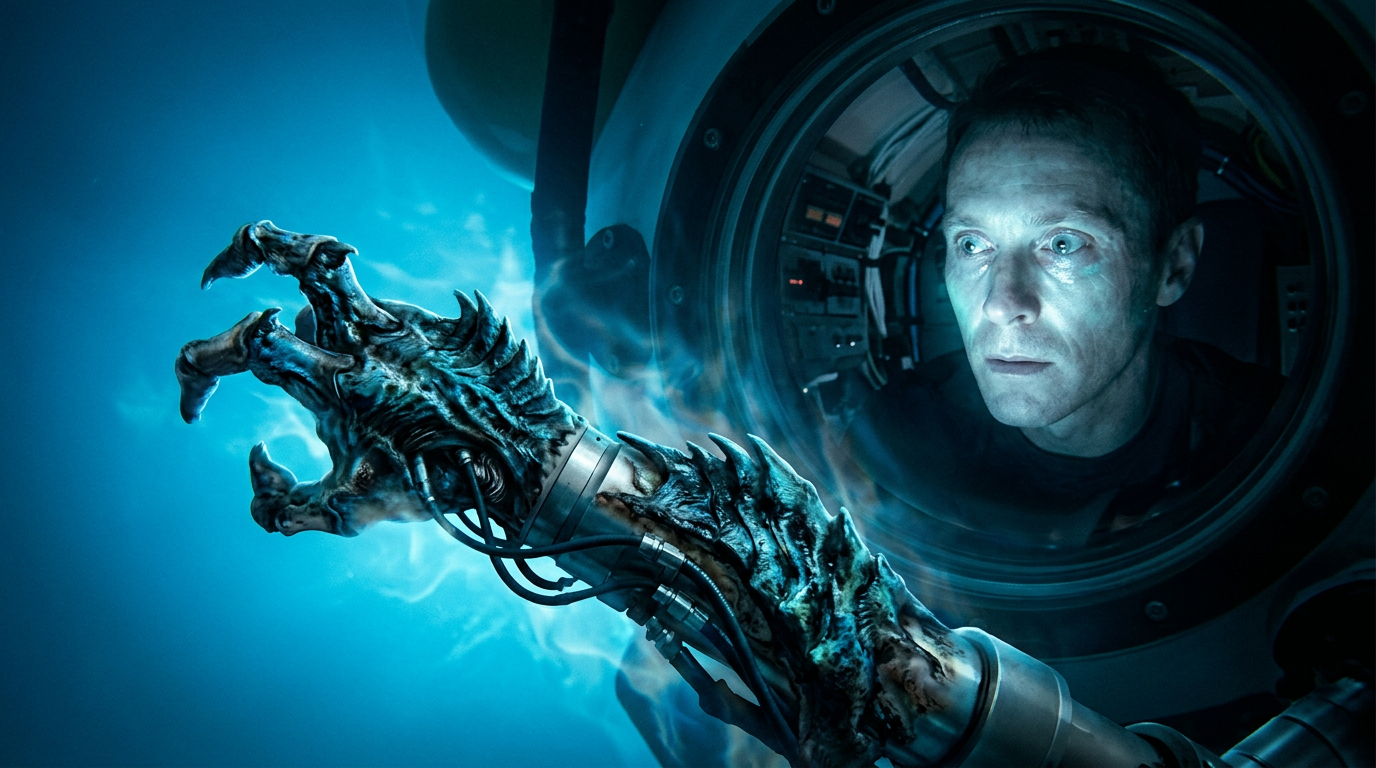
It remembers.
They pulled me out of the water alone.
The recovery crew of the RV Penelope opened a sphere that was intact, sealed from the inside, and short two people. I was on the deck plates with nine hours of dead instruments around me and no memory of the ascent, and Blackwood was gone, and Dee Holloway was gone — not dead, you understand. Dead leaves something. Gone. The gum foil was still in her seat, folded in its careful square. I have it. I am not going to tell you where I keep it, because the men in golf shirts read everything, but I have it, and her daughter can have it the day I find my nerve.
The data was static. The Deep Horizon Initiative dissolved into other names within the month. The report said equipment failure, and the settlement paid out in quarterly increments contingent on my continued discretion, and Pell shook my hand at the lawyer's office with both of his and looked at me the whole time with the gentle inventory-taking eyes of a man pricing a wall he has already decided to knock through. They were careful with me, all of them, in the way people are careful with a thing they have privately agreed is broken. The official version was filed. The official version is always filed; that is what makes it official. Somewhere in a climate-controlled archive that no one will ever subpoena, the ocean did nothing at all on the night of the eleventh, and it did nothing to no one, and the no one it did nothing to had a daughter.
I should have let them be right about me.
Instead I moved to Arizona — you can laugh; my ex-wife did, on the phone, before I stopped calling — to a town with no body of water deeper than a stock tank, and I spent the year reconstructing the corrupted logs frame by frame, the way you pick at a scab you have promised yourself to leave alone. Nights, mostly. I don't do well in the dark hours since the trench; there is a bath in my rented house that I have never once filled, and a well behind it, capped since the seventies, that I have never once walked past without my back knowing exactly where it was. The deep places keep track of you once you've been introduced. Tell me that's nerves. I'll nod. I nod at everything now; it's easier on company.
The vents are not geology. That is what the reconstruction says, frame by patient frame. They are nurseries, and they have been running since before the surface cooled — since before the first cell made the arrangement we are all still living off of, the deal where a membrane gets to call one side of itself me and the other side the sea. Something down there was old before that bargain was struck. Something down there learned, in the dark, to fold energy and bend matter and write its intentions into living tissue the way we write contingencies into contracts, and then it let its working notes swim away, and it waited. It is very good at waiting. It has had practice no number can flatter.
And in the last reconstructed frame, the one that cost me four months and most of what was left of my sleep, there is a schematic.
It is not a map of the structure. It is not a diagram of the creature. It is a blueprint, drawn in that cold impossible light, and I knew the shape of it before I let myself read the labels, because I had been looking at it my whole life in mirrors. A human being. Cell and bone and the soft electric coil of a brain, overlaid with the same geometry that had reached for us out of the vent — the same angles that did not close, the same hand. Across the bottom, in Blackwood's frantic scrawl, transcribing something that was never his to transcribe:
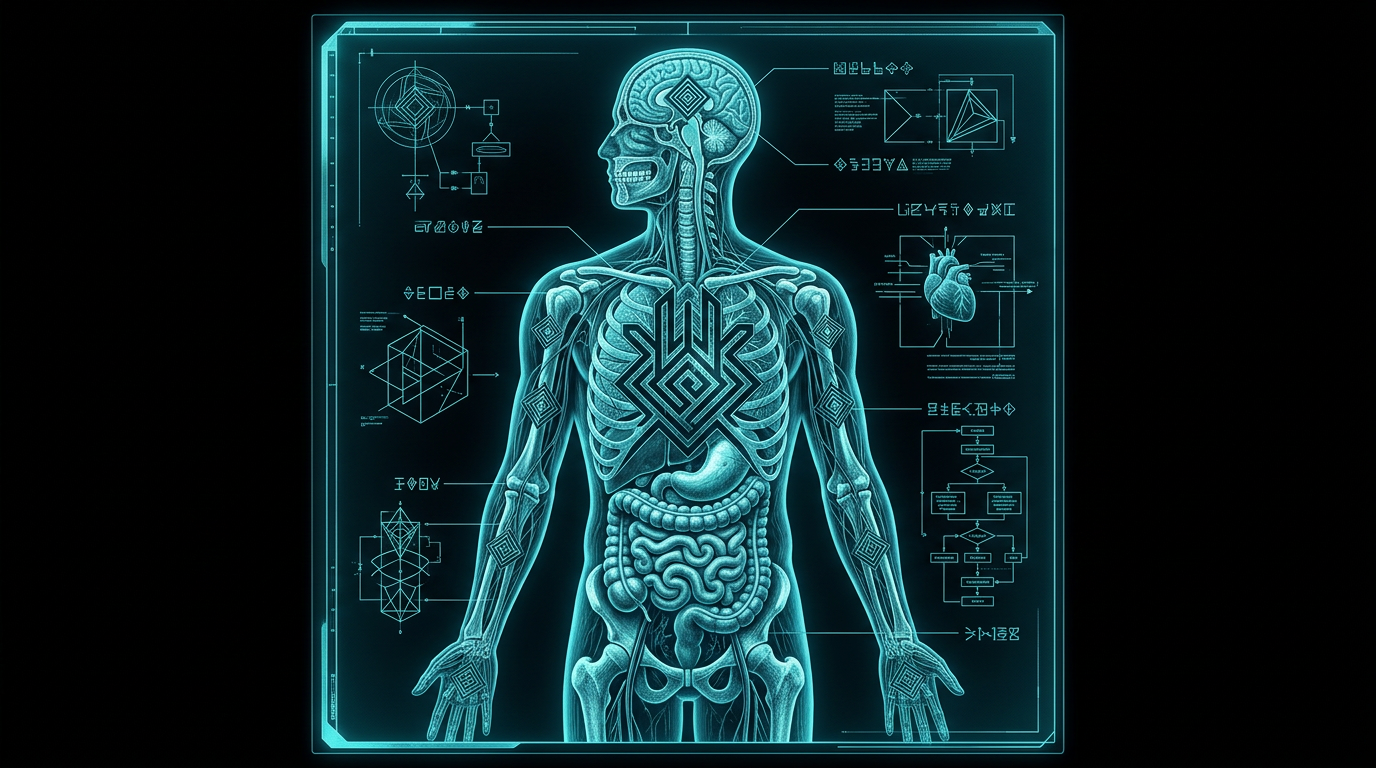
Reintegration. The Deep remembers its children. We are the latest revision.
I have looked, since, at my own hands. At the faint ridges in the palms, the small asymmetry of my face that no one ever notices because everyone has one. At the way the deep, dark places still pull at me — the trenches, the wells, the spaces under things — a pull I used to call a career and now call by its right name. We tell the story wrong every time. We say the monsters came up out of the deep to find us.
They did not come up.
We came up. A long time ago, carrying their design folded into us, told to forget — and we forgot, and we built our small bright surface and called it the world. But the surface was never the point. The surface was the larval stage.
The lights held station on us all the way down because they were not watching strangers arrive.
They were watching their children come home.