Sable Duarte
“It’s back.”
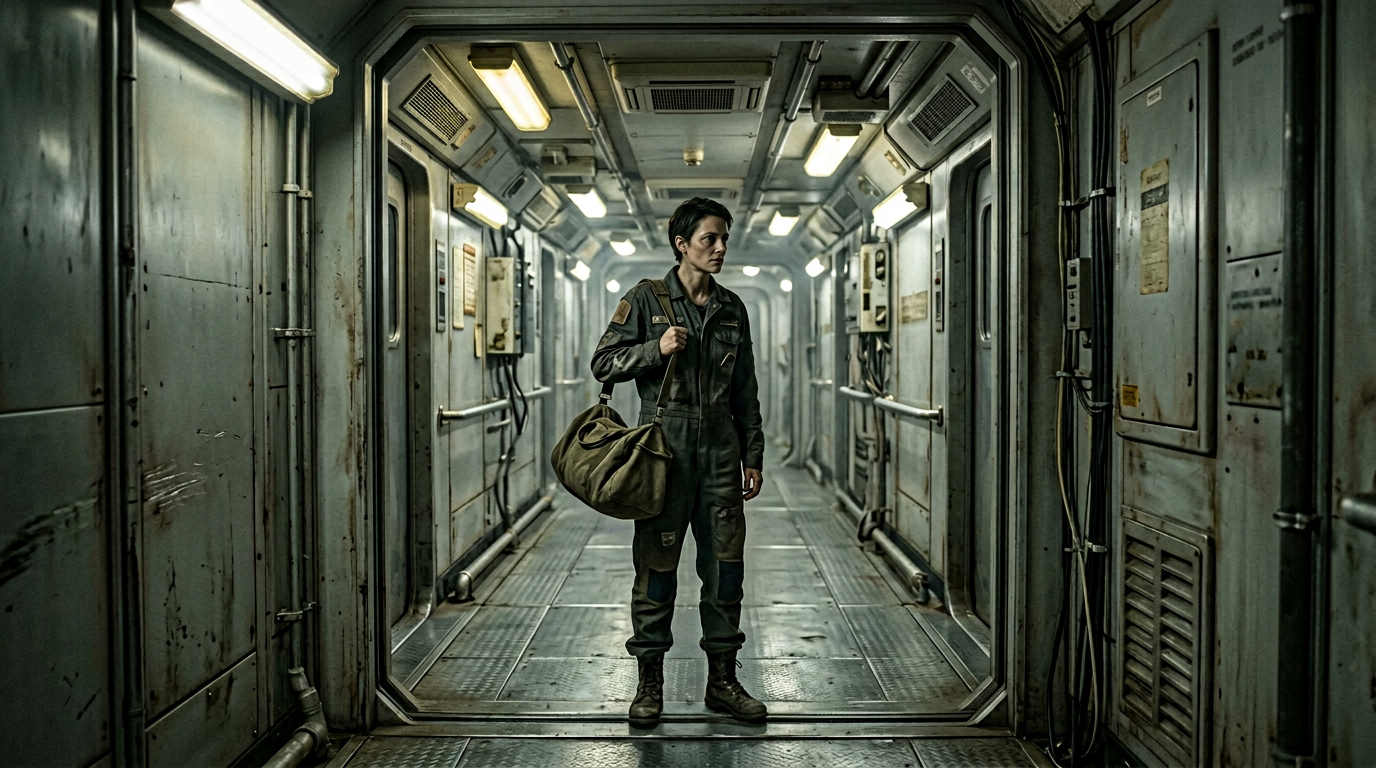
The station looked exactly the same.
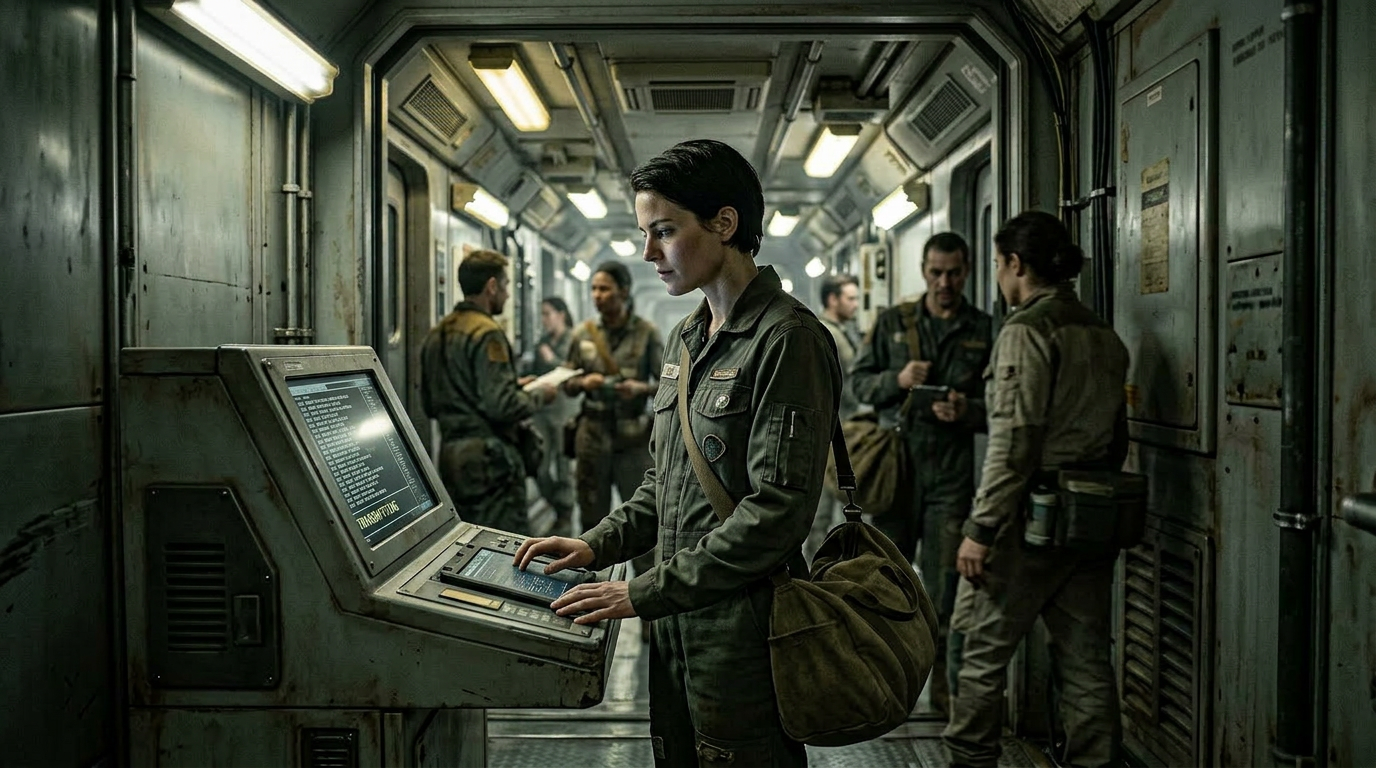
That was the first wrong thing — not the wrongest thing, which would come later, but the first one Sable noted and filed and did not examine too closely. Eight years was long enough for a station to change. Paint over paint, new panels over old fixtures, faces rotating in and out of the transit corridors until the corridor forgot what faces had ever moved through it. Eight years was long enough for everything to be different in every way that shows.
The Haveroc Station was not different. It was the same station, the same transit lighting, the same smell of recycled air and machine oil and something underneath those things that Sable had spent years trying to name and never managed — a smell with a floor under it, was the closest they had ever come, a smell that other smells were resting on. They had left at twenty-three with it still in their clothes and a formal notice of exile folded in their kit and the understanding, which they had not challenged at the time, that this was the correct outcome.
They were thirty-one now. Eight years of contract work on long-haul freighters where nobody asked why a technical officer with Sable's ratings was content to babysit cargo atmospherics, eight years of one duffel and no quarters worth decorating. Three copies of the original incident report rode in that duffel, printed, sealed in separate waterproof sleeves, because Sable had learned the hard way that records kept in only one place belong to whoever owns the place. They had come back because someone had filed a distress call on the substation emergency channel — a channel that had not been in active use, to Sable's knowledge, since the last time a routine procedure went wrong on Haveroc Station, which was eight years ago, which was the reason they had left.
The terminal accepted their old access code.
That was the second wrong thing.
The duty officer at the transit desk was young enough that she would not have been on station during the incident. This was a relief, and then, immediately, not a relief — because it meant that whatever she knew about Sable Duarte she had been told, and what Haveroc told its people about what had happened eight years ago was something Sable did not know and could not control.
"Officer Duarte." The same flat confirmation tone. Some things were universal. "Your clearance shows a lapse."
"I know."
"You're listed as former crew."
"I know."
"Former crew accessing the station on emergency channel authorization." She was reading her screen with the focus of someone who was reading the situation between the lines of the screen. "You're the contact the distress call was addressed to."
"Yes."
"That channel has been inactive for —"
"Eight years." Sable set their kit down. "I know how long it's been inactive. I'd like to know who activated it."
The duty officer looked at them the way young officers looked at things that didn't fit the expected categories — not hostility exactly, but the careful attention of someone deciding which question to ask first.
"The call originated from Sub-Level Seven," she said. "Environmental records."
Sable picked up their kit.
Sub-Level Seven had not changed either.
This was less surprising — environmental records was not a space that accrued changes. It stored the continuous log of atmospheric data that every pressurized station was required by regulation to maintain, fed by sensors distributed through the hull and superstructure, generating a record of temperature and pressure and composition that was mostly meaningless and occasionally critical and always, always running. The log went back to the station's commissioning. It predated most of the people currently on board.
It predated, specifically, the incident eight years ago.
Sable sat at the terminal and did not log in immediately. There was a quality of stillness in Sub-Level Seven that they remembered — not quiet, exactly, since the environmental systems were audible here in a way they were filtered to not be elsewhere. The recyclers ticked. Condensate moved in a pipe behind the panel wall, a thin intermittent swallowing. But still, under the sound. The kind of stillness that accumulates in a room where nothing has been moved by hand in years, where the dust has finished settling and started belonging. And under the stillness, the smell — stronger down here, Sable noticed, and then noticed that they had always noticed that, eight years ago, every shift, and had filed it with everything else a station teaches you not to examine.
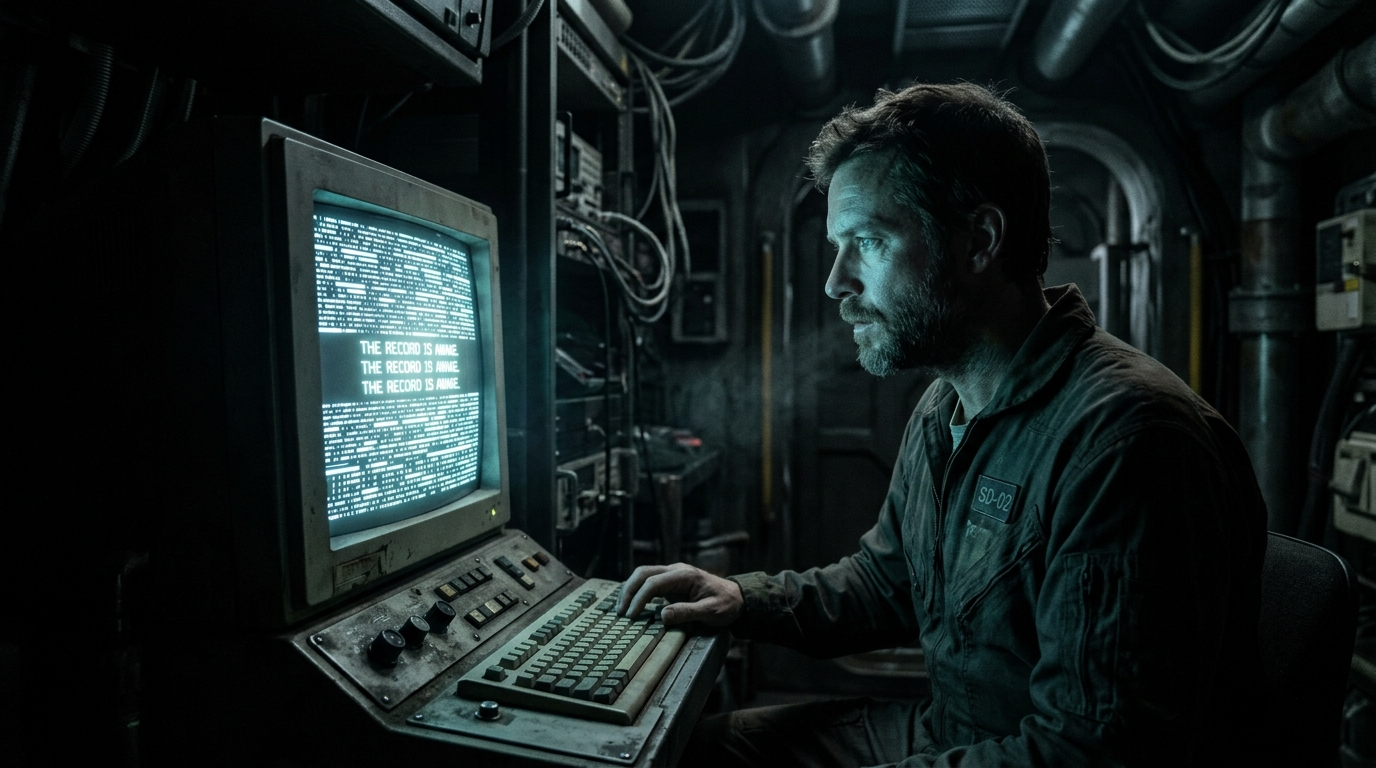
The distress call had been two words. Not a standard format, not a recognized emergency code — two words in plain language, addressed to Sable by name, transmitted on a channel that should have been dead.
It's back.
Sable logged in.
The environmental log from eight years ago was intact.
This was the third wrong thing, and the one with the sharpest edges. Station data was maintained on a rolling archive — a set period, after which old records were compressed and eventually decommissioned to make room for the continuous new feed. The retention period for Haveroc Station's environmental records was five years. Sable knew this because they had reviewed the station's data management protocols before filing the incident report that had resulted in their exile, and they had noted at the time that the records they needed were still within the retention window.
They were no longer within any retention window. They should have been gone for three years.
The records from the night of the incident were in the log. Intact. Not compressed. Stored in the active archive as though they were still within the five-year window, as though time had not continued to move in the ordinary direction, as though the station itself had decided these particular records were not finished with yet.
Sable read them.
They had read them before. They had read them many times, in the years between leaving Haveroc and receiving the distress call — in the copies they had made before filing the report, in the excerpts that had been entered into the official inquiry, in the versions that had been read back to them by committee members who wanted to understand exactly what they had done and why. They knew what the records said.
The records said something different now.
Not different in every particular — the atmospheric data was unchanged, the pressure logs, the composition readings. The objective record of what the station's sensors had measured on that night matched the copy Sable had made eight years ago, cross-checked against their own memory, consistent and unaltered.
The annotations were new.
Not official annotations — not the flags and markers that inquiry procedures attached to contested data points. These were something else. Entries written in the log in the same format as the automated sensor records, timestamped within the active data stream, written in a voice that did not belong to any sensor or any automated system or any crew member Sable could identify.
The first one read: I remember this part.
The second: You made the right call. For what it's worth from something that was paying attention.
The third: The thing you're about to find in this record wasn't here the first time. It's there now because I needed you to come back.
The incident eight years ago had been simple in the way that the worst things were simple.
A routine procedure — atmospheric maintenance, the kind that was performed every eighteen months on every station of Haveroc's class. A scheduled venting of one section of the lower levels, a recirculation of the environmental mix, a process that took four hours and required three crew members and generated a predictable log of sensor readings that the duty officer reviewed and signed off on.
The three crew members had performed the procedure correctly. The sensor readings had been what the readings were supposed to be. The duty officer had reviewed the log and found nothing to flag.
The crew member in the lower level section during the vent had not come back up.
This was not, in the official finding, Sable's fault. Sable had been the senior technical officer on duty. They had reviewed the procedure, approved the crew assignment, confirmed the sensor readings. Every step had been correct. What had happened to the crew member in the lower level section was classified in the final inquiry report as an equipment failure — a valve that had not sealed the way the sensor indicated it had sealed, producing conditions in the section that the sensor had not correctly measured, that the log had not correctly recorded, that the procedure had not accounted for.
Equipment failure. Not negligence. Not error.
Sable had filed a supplemental report indicating that the sensor data showed anomalies that suggested the failure was not random. That the readings, cross-checked against each other rather than read in isolation, showed a pattern inconsistent with equipment failure — consistent, instead, with something interfering with the sensors deliberately, choosing its moments, working around the instruments the way a hand works around a sleeping animal.
The inquiry had found the supplemental report to be speculative. The formal finding had been equipment failure. Sable had been exiled on the grounds of conduct — the supplemental report, and what it implied, had been deemed disruptive to crew morale and incompatible with continued service.
The crew member who had not come back up from the lower level section was named Petra Gast. She had been twenty-six years old. She had taught Sable to play tall-deck cribbage on third shifts and lost just badly enough, just often enough, that it took Sable two years to work out she was doing it on purpose, and by then it was too late to be insulted; the kindness had compounded past collecting on. She kept a basil plant alive in her quarters against three separate regulations, and gave cuttings away like contraband. She had been Sable's friend, which the inquiry report had also noted as a potential source of bias in the supplemental findings.
Sable had not argued the point.
The fourth wrong thing was the help.
It came from Sub-Level Three — a message through the station's internal comm system, origin listed as Maintenance Bay 7, which was a storage space that had been decommissioned six years ago and should not have been capable of generating internal comm traffic.
The message was also two words. Different words.
Check below.
Sable had been operating under the assumption that whoever had sent the original distress call was somewhere on the station — a crew member, someone who had known them eight years ago and had found something and had used the emergency channel because they knew Sable would come. A person. A person with a name and a reason.
Maintenance Bay 7 was empty. Sable stood in it for long enough to be certain, and it was empty the way spaces sealed for six years are empty — complete, undisturbed, the dust lying in a single unbroken nap, like the pelt of something asleep. No one had crossed that floor. No one had touched that panel. The air had the stale, held-breath taste of a room that has been doing nothing, slowly, for a long time.
The message had come from here. There was no one here. There had not been anyone here for six years.
Sable looked at the internal comm panel — which was also decommissioned, which was also showing power, which was also wrong in the way that everything on this station was currently wrong.
Check below.
Below Maintenance Bay 7 was Sub-Level Six. Below Sub-Level Six was Sub-Level Seven, where the environmental log was running with records it should not have and annotations no one had written.
Below Sub-Level Seven was Sub-Level Eight.
Haveroc Station did not have a Sub-Level Eight. Sable had reviewed the station schematics eight years ago, during the incident investigation, and had reviewed them again before returning, as a precaution, because they had learned the discipline of knowing exactly what a space was supposed to contain before entering it.
The schematics did not show a Sub-Level Eight.
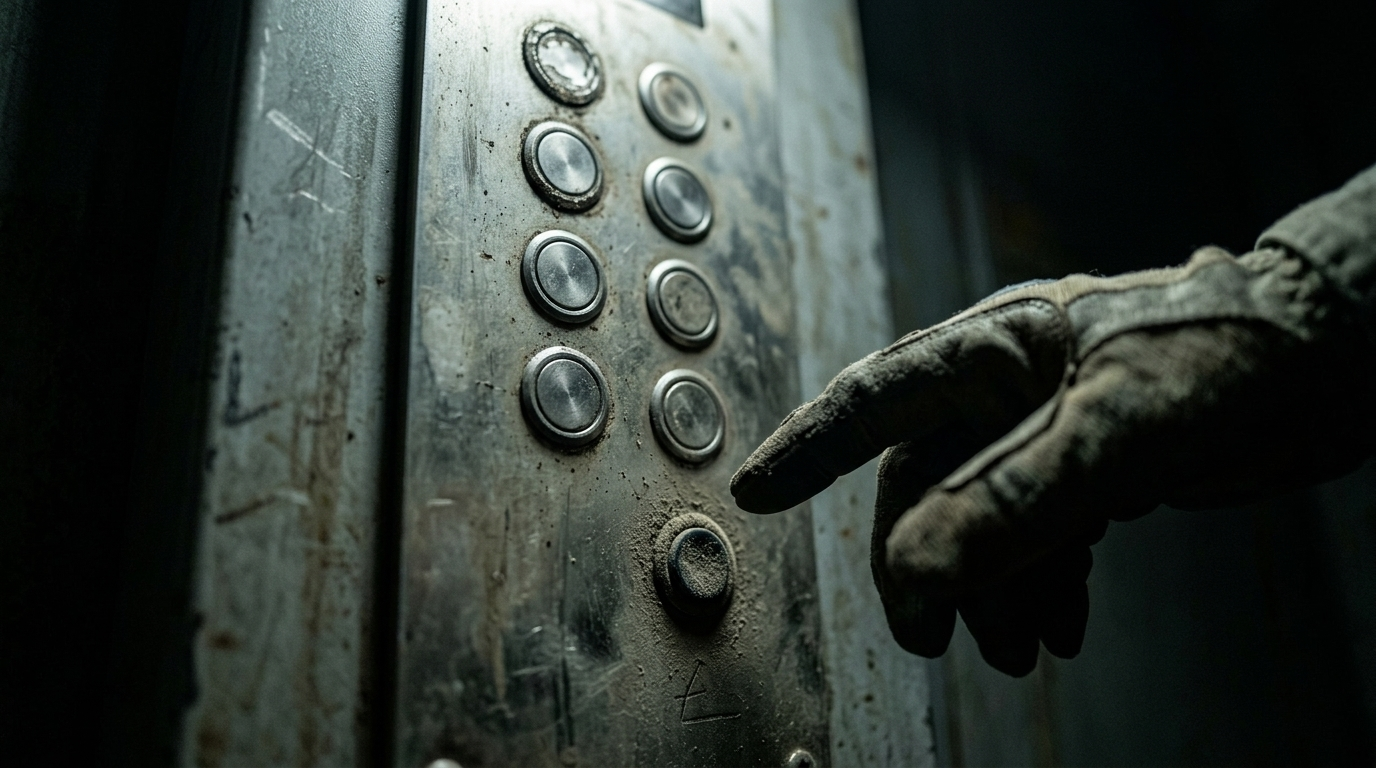
The lift panel, when Sable returned to it and looked at it without the assumption that it would match the schematics, showed a Sub-Level Eight.
The button had dust on it. Not six years of dust — older than that. As though it had always been there and had never, in the entire operational history of Haveroc Station, been pressed.
The lift went down longer than one level should take.
Sable counted, because counting was what they had instead of a place to put the feeling. Eleven seconds between Seven and Eight, where every other interval on the station ran four. Somewhere in the middle of the eleven seconds the temperature dropped enough to notice, and their ears registered a slow change of pressure that the lift's compensators should not have allowed, and the smell came up to meet them — the smell, the one under the machine oil, the one with the floor under it. Down here it was not under anything. Down here it was the whole of the air, and Sable understood, in the way the body understands before the mind agrees to, that they had spent eight years on freighters trying to name the breath of this room.
What was down there was not what Sable had expected, because Sable had not expected anything in particular — only that whatever sent the call, whatever wrote in the log, whatever had powered a decommissioned comm panel to deliver two words from an empty room, had its origin below the station's official floor plan. This was a reasonable inference. The inference had been correct.
The space at the bottom was not large, and felt vast. The handlamp's beam went out flat and came back short, as though the walls took their cut of the light before returning it. The walls themselves were worked — not poured, not panelled, worked, in long shallow flutes that ran floor to ceiling and met overhead at angles Sable's eye kept trying to average into right angles, and could not, and kept trying. The material was dark and fine-grained and faintly warm, which at this depth, below the station's heat exchangers, was its own quiet impossibility. It was not stone the way the button was not new: technically, provisionally, in a manner that did not survive attention.
Sable stood at the bottom of the lift and understood several things simultaneously.
The first: Sub-Level Eight was not a facility space. It was not storage, not maintenance, not any of the functional categories that station sub-levels were built to serve. It was older than those categories. It was older, possibly, than the station itself — which should have been impossible, structurally, physically impossible, a sub-level that predated the structure built above it.
It was not impossible. It was simply a thing that had not been accounted for.
The second: the crew member who had not come back up from the lower levels eight years ago had been in the section directly above this space. The valve that had failed — the seal that had not sealed — was in the floor of that section. Sable could see it from here, from below, from the angle that the incident investigation had never occupied because the investigation had not known to look for a below.
From this angle, the valve had not failed. From this angle, it was clear what had happened to the seal.
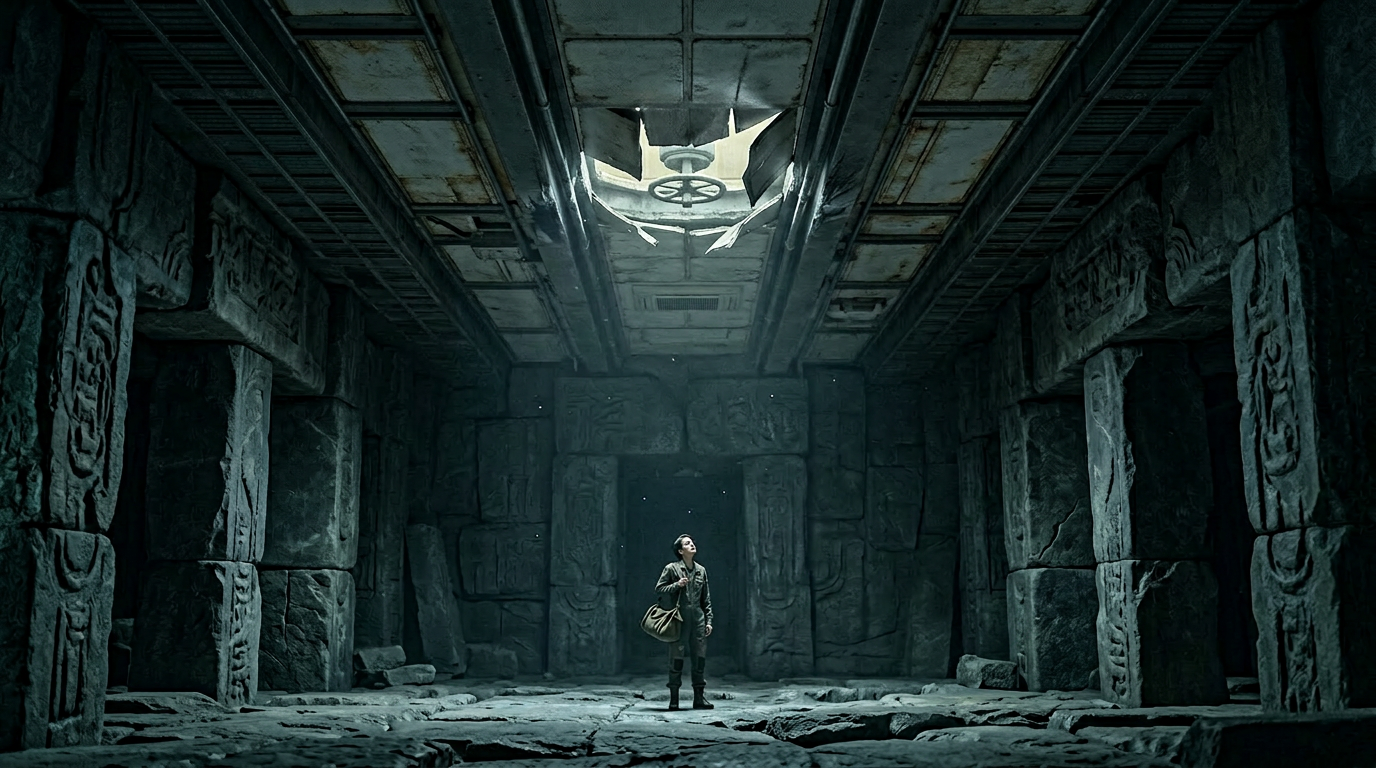
Something had opened it. From underneath.
The third thing Sable understood was the annotations in the environmental log. I remember this part. You made the right call. For what it's worth from something that was paying attention.
Something had been paying attention for longer than the station's records went back. Something had been here, in the space the station had been built on top of, present the way bedrock is present — under everything, touching everything, never consulted. It had watched crew members move through the sections above the way you might watch shadows cross a ceiling. Watching a routine procedure. Watching a valve.
Watching what happened next.
And then, eight years later, watching an exile receive a distress call and come back.
Sable looked at the space around them. Not threatening — that was the important, inadequate word. Not threatening. Interested. Oriented toward them, the whole room faintly attentive, like a field turning its flowers.
"I know what happened to Petra Gast," Sable said.
It did not speak so much as arrive at meaning — pressure shifting in the sealed air, pattern resolving out of stillness, the room itself settling into the shape of an answer. Language had come late to the universe and this thing had never seen a reason to adopt it; what it had instead was older and did not translate so much as land.
Yes, it said. You did. You said so. They didn't believe you.
"The valve."
Yes.
"You opened it."
A pause. Not denial. Something more careful than denial — an old thing choosing, with evident effort, how to be honest.
I didn't understand, then, what it would cost.
"And now?"
I understand now. I've had eight years to understand. That's why I needed you to come back.
The fifth wrong thing was that there was no fifth wrong thing.
Sable sat for a long time on the floor of Sub-Level Eight, in the sub-level that had always been there and had never been acknowledged, and worked the sum of what they were sitting with. What they knew. What the presence in the space around them had confirmed. What could be proven, documented, filed — and what would happen to that filing, in an inquiry that had already decided what the official version was and had exiled the person who disagreed.
They thought about Petra Gast, who had been twenty-six, who had lost at cribbage on purpose for two years, who had not come back up from the section directly above this floor. Whose absence had been logged as equipment failure. Whose family had been told what equipment failure meant and not what it actually meant, because what it actually meant required believing the supplemental report that the inquiry had classified as speculative.
They thought about the old thing that had not understood what it would cost. About eight years of understanding accumulated in a sub-level that did not officially exist.
I can show you, it said. Everything I have recorded. All of it. The valve. The night. What happened.
"To what end."
To the same end as the environmental log. To the same end as the annotations.
Sable understood. Who decides what gets written down. The question was older than the station and would outlast it, and Sable was no one the question should have fallen to — a former technical officer with a lapsed clearance, a formal notice of exile, and eight years of being right about something that no official record confirmed. The question fell to whoever was standing in the room when the truth needed carrying. That was the whole of how the universe assigned these things, as far as Sable had ever been able to determine. No fitness test. Just proximity, and whether you picked it up.
The thing they had to decide was whether to come back up with what they had.
Not whether they believed it. They had believed it for eight years. Not whether it was true — the valve was visible from this angle, and what had happened to it was visible, and the old thing's record of that night was available and intact and more complete than any sensor log the station had generated.
Whether to come back up. Whether to file the report again. Whether to find out if the answer was still the same.
There was no version of this that ended solved, and Sable knew it. Some things don't resolve. You survive them, and you carry them into whatever comes next, and you make sure the record travels with you — because the problem outliving you is acceptable, and the truth not outliving you is not.
Not victory. Not resolution in the clean sense. Carrying.
Sable had stopped believing in the cause years ago. Had kept going anyway, because stopping believing in a cause and walking away from the thing the cause was supposed to be about were two different decisions, and Sable had only made one of them.
They stood up.
"Show me," they said. "All of it."
They came back up at first shift change, when the transit corridor was populated enough that a former crew member returning from the sub-levels did not register as an event. The duty officer from the night before was not at the terminal. The new duty officer did not know their face.
Sable walked to the communications room and filed a supplemental report to the original incident inquiry — now eight years cold, now officially closed, now existing only in archived records that no one was actively reviewing.
The report was complete. Every particular. The sub-level that the schematics did not show. The valve from below. The record that the old presence had provided — complete, timestamped, covering the night of the incident from an angle that no station sensor had occupied.
It went into the system. It would be received, processed. Filed somewhere.
It might be ignored for years. It might be dismissed. The inquiry was closed; reopening it required a finding of new evidence sufficient to overturn the original conclusion, and the people who had made the original conclusion were still the people who would evaluate whether the evidence was sufficient.
Sable did not know what would happen to the report.
They knew what would happen to them. There would be a response to the unauthorized access. There would be questions about the emergency channel, about the former-crew clearance that had somehow still worked, about what exactly they had been doing in the sub-levels for an entire night. There would be a review. There would be, probably, consequences.
They stood in the transit corridor with their kit and the familiar weight of having done the thing again — the same thing, the same report, the same provable truth submitted to the same system that had already decided what the truth was — and found it, as they had found it before, bearable.
They had kept going when they stopped believing. They would keep going now.
The station settled around them — old joints finding equilibrium, the infrastructure voice of a pressurized structure that had been running longer than most of the people aboard it, and longer than all of them if you counted what was in the sub-level that the schematics didn't show.
In Sub-Level Eight, something old waited, and was very good at waiting, and was no longer waiting alone with what it knew.
The station had seen exiles leave and come back. It had held what it held, below and above, the way structures hold contradictions — the official record and the true one, the version that had been filed and the version that the sensors had missed, the crew member who had not come back and the space that had watched her go.
Whatever came next would happen in this station. Whatever came next, Sable Duarte would be in it.
Not solved. Not finished. Alive, and moving, and carrying an eight-year-old truth forward — in triplicate now, one copy above, one copy below, and one in the only archive on Haveroc that had never once purged a record.