The Dungeon Cell
“One truth told when the lie would have survived.”
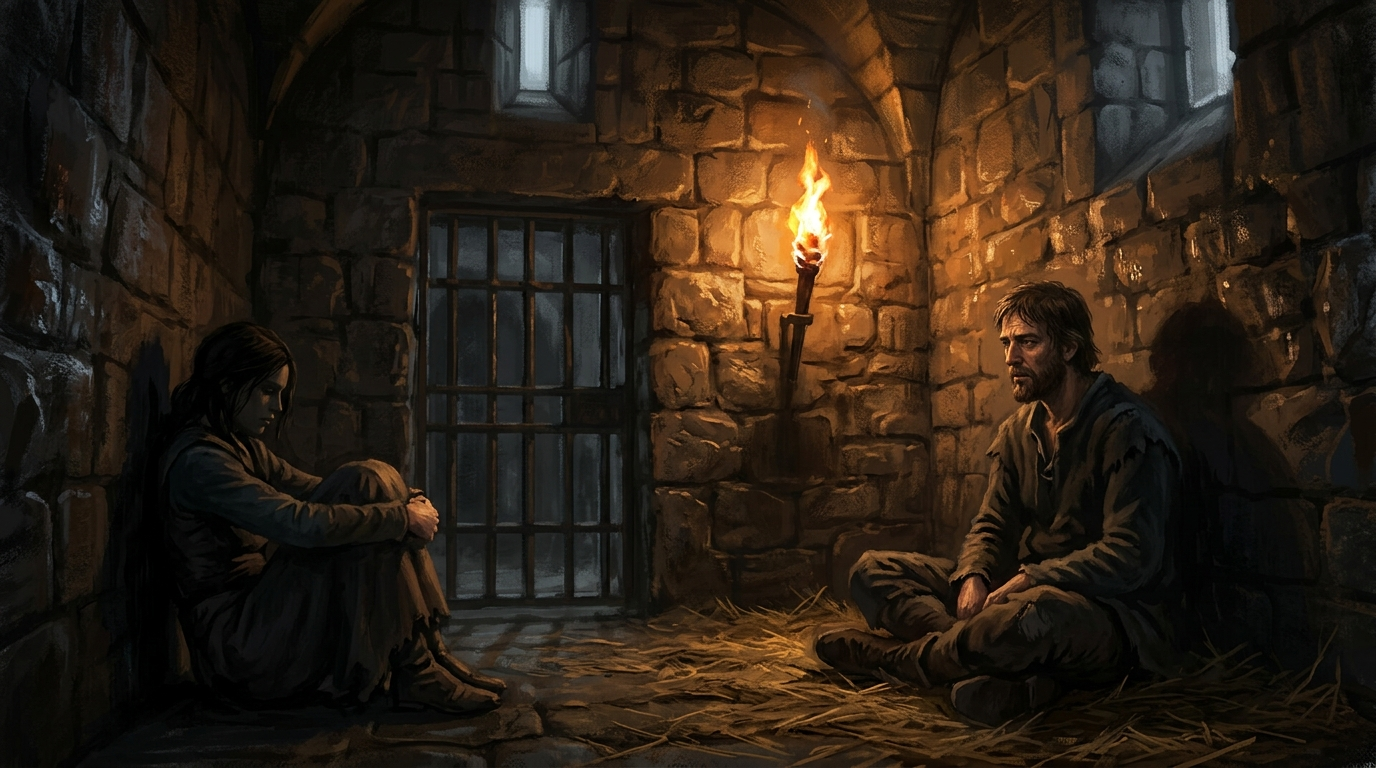
The torch had maybe an hour left. Kael had stopped pretending he wasn't watching it. It was the only clock in the room, and it was the kind that only runs down.
The cell was old enough to have outlived whatever it was first built to hold. Saltpeter bloomed on the stones like a frost that never melted, and the straw in the corner had gone black with the damp of other people's years, and the cold didn't come at you down here — it came up, through the floor, through the boot soles, settling into the backs of the thighs with the slow confidence of something that had won every one of these contests it had ever entered. Past the bars, the torch's reach gave out after four feet of corridor. Kael had spent six hours not looking at what came after the four feet. The dark down there wasn't the absence of the torch. It was older than the torch and merely waiting it out, rising as the flame sank, like water finding its level.
"You didn't have to come back," he said.
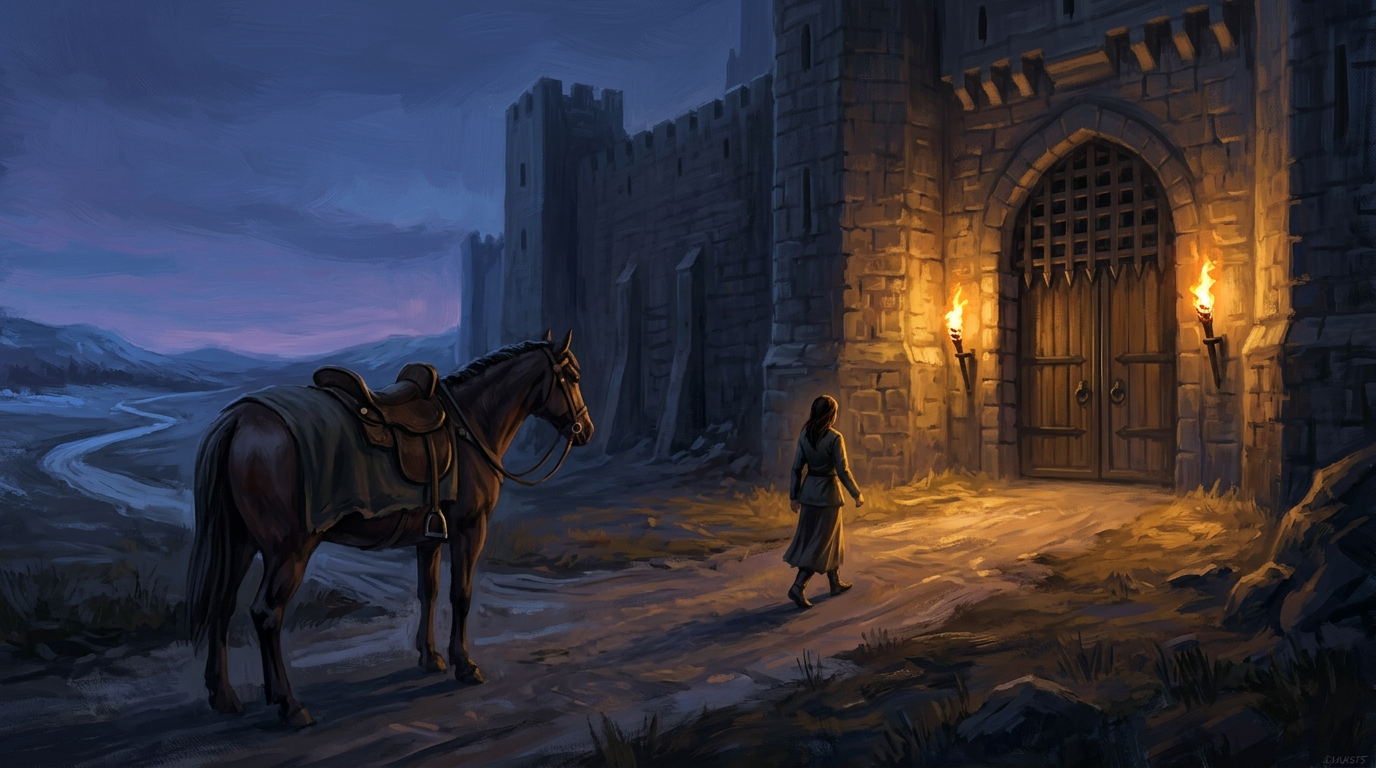
Senna didn't answer. She was sitting against the far wall, knees up, the same position she'd held since they put her in here six hours ago. Since she'd walked back through the gate six hours ago, when the road out was open and her horse was saddled and the only person who'd seen her leave was Fitch the stable boy, who owed her three favors and would have called it square at one.
"The others think you were caught," Kael said.
"I know."
"I haven't corrected them."
She looked at him then. First time in an hour. "Why not?"
He didn't answer that either. The torch popped. Something shifted in the corridor outside — a guard's weight redistributing, armor settling. Both of them went still until it passed.
The deadline was dawn. Everyone in the cell above theirs knew it. Everyone in the camp outside the wall knew it. Duke Reule had nailed his terms to the gallows post in fresh ink and good penmanship, because the duke was the sort of man who hired a fine hand to letter his cruelty: at dawn, and on each hour following, one prisoner of the Harrow Company will hang, the youngest first, until the name of the man who led the raid on the Carnath supply line is given up to the duke's justice.
The youngest first. The twins were sixteen. The duke knew that. The penmanship knew it too — youngest first had been underlined, once, with a ruler.
The name was Kael's.
Three years ago there had been no Harrow Company, just farmers along the Wether's floodplain watching the duke's levy wagons haul off seed grain in a famine spring, and one ex-soldier with a map bag who couldn't make himself watch it twice. The company had hit thirty-one wagon trains since. It had put grain back into four valleys and a fair number of the duke's men into the ground, and the price of it lived where prices live — in the work of going on, taken out of particular bodies, one at a time. Kael could name every body. That was the job nobody had given him and nobody could take away: he was the man who kept the ledger of what the right thing cost.
"The others will break before dawn," he said. It wasn't a question. He'd run it through every door he could find and the answer stood waiting behind all of them. Doran would hold. Tamsin would hold. The twins were wildcards — sixteen, and brave the way sixteen is brave, which holds right up until it doesn't. Priest would break by the third hour. Not from cowardice; from arithmetic. Priest had four children and a very clear understanding of consequences, and the third hour was when the duke's schedule reached the older twin. "When they do, they'll give him mine."
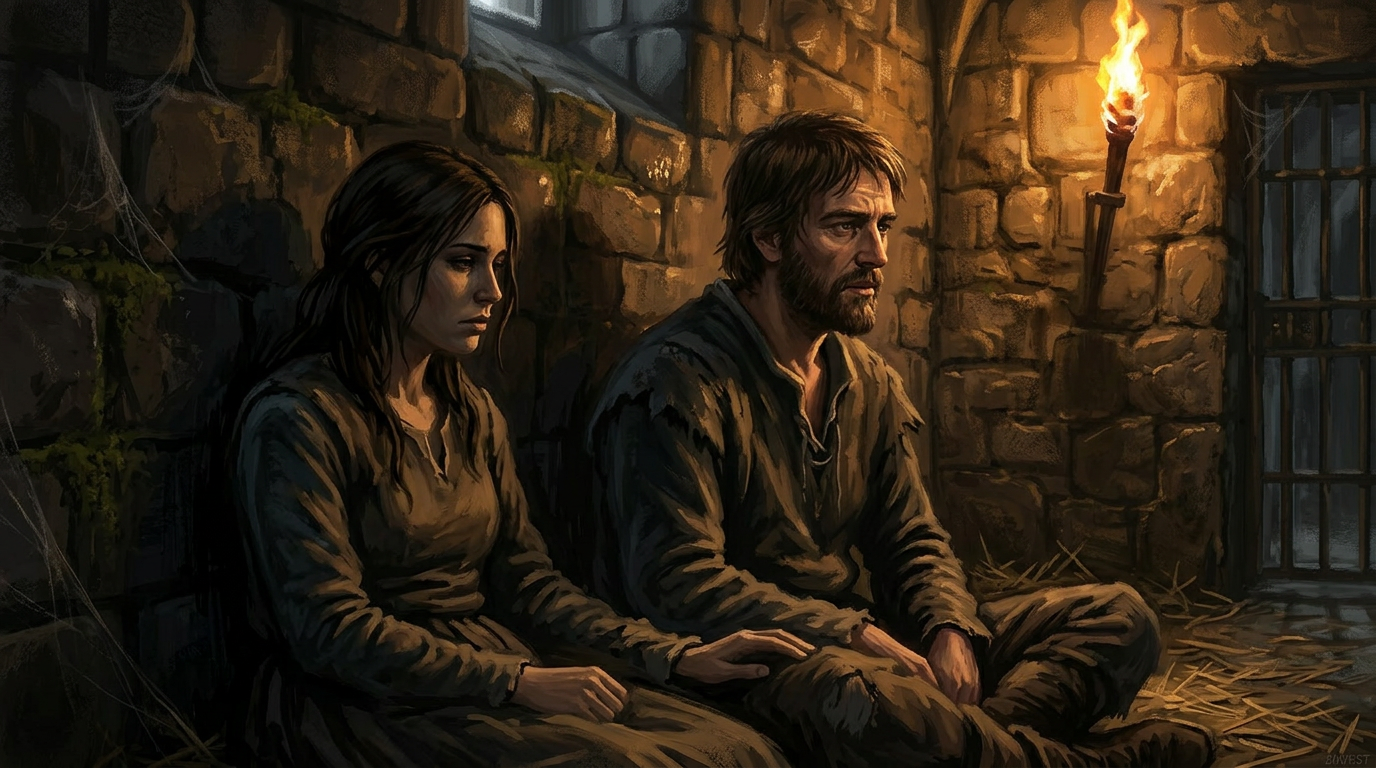
"I know."
"So you came back to — what. Watch?"
"I came back," Senna said, "because I needed to tell you something."
The torch. The corridor. The deadline sitting on the air like the pressure before weather, the kind every farmer in the company could read in an aching knee: something is coming, and knowing it changes nothing about the sky.
"Tell me."
She'd had the whole ride to work out how to say it. The whole ride back, the road unreeling behind her horse, the gate getting larger instead of smaller — and she'd noticed, somewhere in the last mile, that she'd stopped rehearsing and started just riding, because there are sentences no amount of road will make lighter. She'd had six hours in this cell since. She still didn't have a version that didn't cost something, so she stopped shopping for one.
"The raid on the supply line," she said. "I knew. Before you planned it, before you told the group — I knew what you were going to decide. Calla told me. She copies your maps; she'd seen where the pins were going. She thought I already knew."
Kael went very still.
"I could have talked you out of it. I had three days and I know how to talk to you." She didn't say I'm the only one who knows how to talk to you because she didn't have to. "I let you plan it. I let you run it. Because the supply line needed hitting and you were right about that and I didn't trust myself to argue you out of the right call for the wrong reasons."
The wrong reasons being that the supply line ran through Carnath Pass. That Doran always took point on Carnath operations — always had, since before anyone thought to assign it, the same as he always took the watch nobody wanted. That Doran had come back from the last three, and somewhere in the middle of them she'd stopped being able to sleep through the nights when he was out. She'd lie in her bedroll doing the same sum over and over, listening for hooves, hating the sum, getting up before light to check the picket line like the horses might know something.
"Tamsin lost two fingers," Kael said. His voice had gone somewhere flat and careful, a man carrying a full bowl across a moving deck.
"Yes."
"Aldric didn't come back at all."
"No."
"You knew the risk."
"I knew the risk. I decided it was worth it. I decided that without telling you I was deciding it." She met his eyes. "That's not your call I let you make. That was mine. I just used your hands."
The torch had less than an hour. Maybe less than that now. The dark past the bars had taken another foot of corridor and was not hurrying about the rest, and the cold had finished with their legs and was starting on the small of the back, and somewhere overhead, through stone, came the small blurred sounds of the cell above — a cough, a voice, somebody's boot heel going in slow circles. The twins were up there. One of the voices, too soft to make words, ran on and on at intervals, and Kael had decided hours ago it was the younger twin telling the older one stories, because that was what she did on bad watches, and he had decided not to decide what it meant that the stories hadn't stopped.
Kael stood up. Crossed the cell — four steps, the whole width of their world right now — and sat down against the wall beside her. Not facing her. Beside her, shoulder almost to shoulder, where you put yourself when the conversation is too heavy to be looked at.
"Why are you telling me this now."
"Because you're about to make another decision. About whether to give them a name before the others break, or hold until they do, or—" She stopped. "You're going to make it the same way you always make them. Alone. Carrying everyone." Her voice didn't lift and didn't harden; it just kept coming, level, the voice of a woman reading out a bill long past due. "And I've been letting you do that for three years, and it has cost you things you didn't know you were spending, and I am done letting you."
"That's not your call."
"No. It isn't."
The silence sat between them. Outside, something moved in the camp — a horse, a voice, a bucket set down on frozen ground, the ordinary noise of people who were not in a dungeon cell waiting for dawn and did not know what they had.
Kael said: "I'm going to give them my name."
"I know."
"It keeps everyone else—"
"I know, Kael."
He stopped. She'd never said it like that before. His name in her mouth like it was the last of something — the heel of the bread, the end of the candle, the coin you'd been keeping back all winter for no reason you could have named until the moment you spent it.
"The thing you're protecting," she said quietly. "This group. These people." A breath. "Ask them. Before you decide. Just once in three years — ask them what they want to spend themselves on. You might be surprised."
He didn't answer.
She didn't push.
That was the whole of it — the thing that ended it, sitting there unsaid in the space where his answer should have been. Because the answer was that he already knew. Had known for longer than he'd let himself admit. That Doran would spend himself on this without hesitating, the same way he took point at Carnath, as if the question bored him. That Tamsin would, with two fingers gone and eight left, and would say so in exactly those words. That Priest, with four children and a very clear understanding of consequences, would do the arithmetic and come out somewhere Kael had never once let himself calculate: that a man with four children understands better than anyone alive what things are worth dying for, and has the count of them exactly right, and it is not zero.
He'd been protecting them from a question they'd already answered.
He'd just never asked.
The torch had maybe twenty minutes. The dark held the corridor now to the last four feet and stood at the edge of the light the way water stands at a door it knows it is coming through, and for once Kael looked straight at it and found it had nothing new to say to him. In the corridor, a guard's boots turned toward the stairs. Dawn doing what deadlines do — arriving regardless.
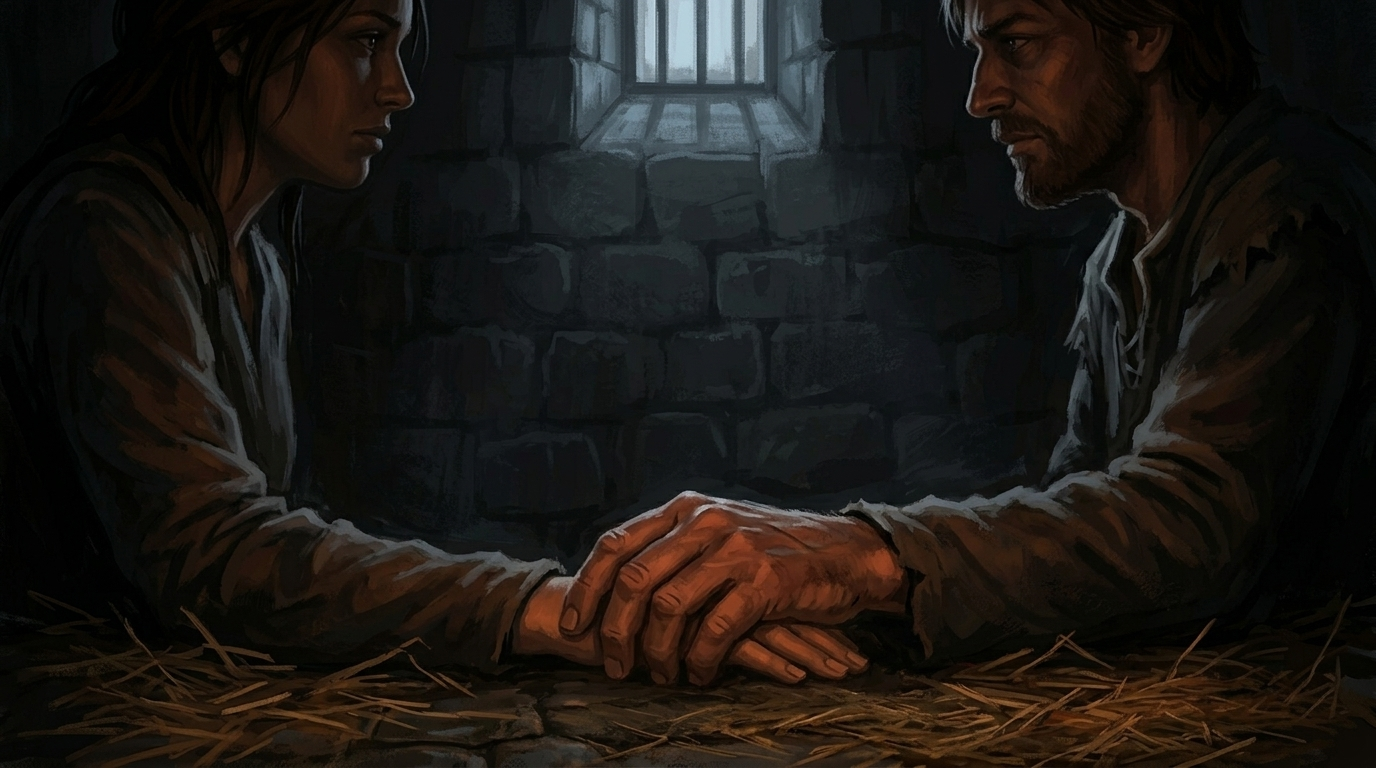
Kael reached over and took her hand. There was nothing in it of asking and nothing of apology. He held on like a man letting go of everything else, which is a kind of holding the hand learns exactly once.
Neither of them spoke.
The thing that ended it wasn't said.