The Trophy Door
“She walked out.”
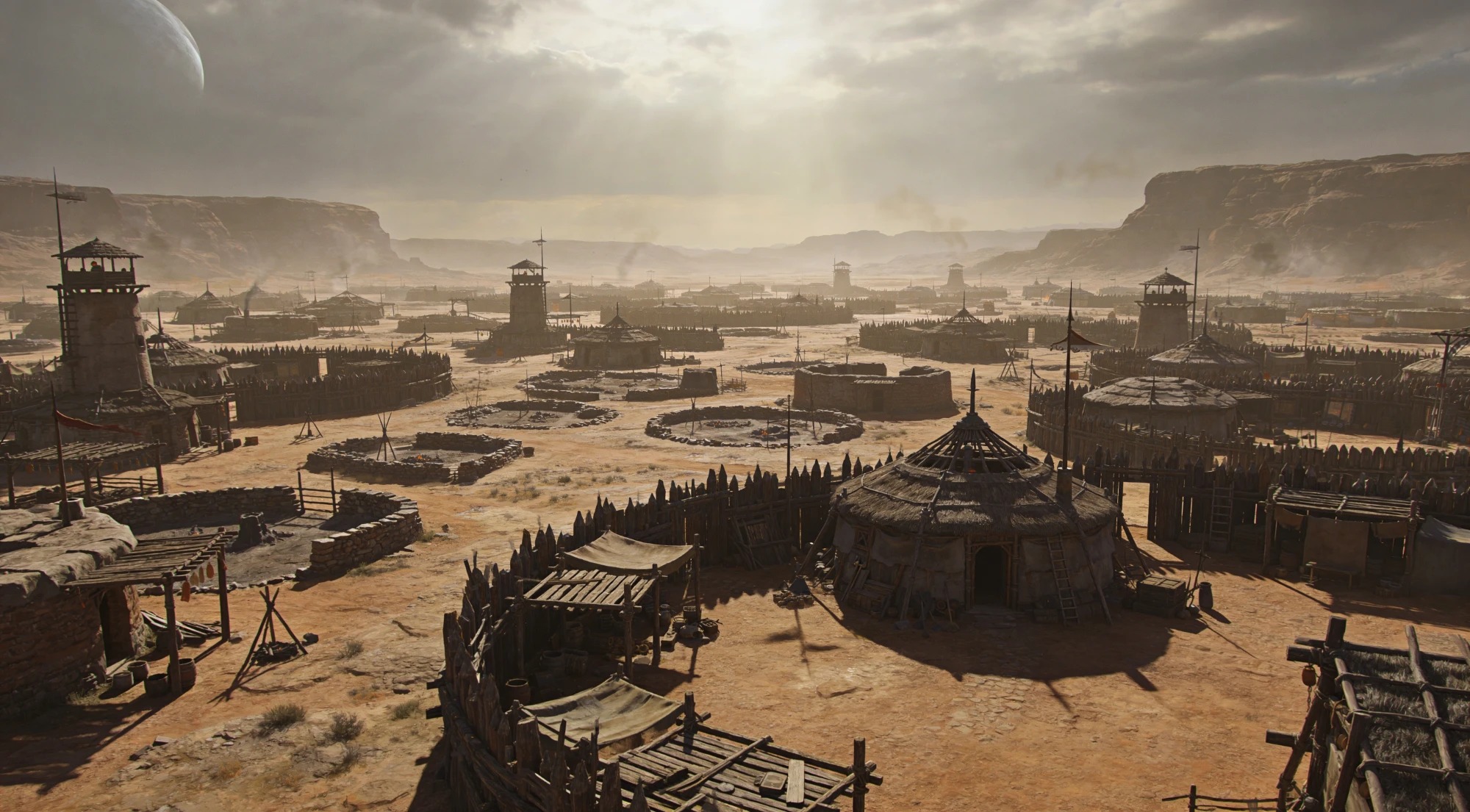
The fire rings were lit by the time Gorgen walked the yard, and none of them were for warmth.
Nobody in Dax built a fire to get warm. You built it on stone — on the old flat slabs the first families had dragged in and set in circles — because the ground under a fire ring was the only ground in the basin that had never once opened. Forty years of it holding. The children played inside the rings at dusk, not around them, and their mothers called them in by name when the light went orange, and the watchtowers turned their lamps outward toward the flats and downward toward the dirt.
The Hook was up already, low over the west wall, thin and pale as a paring.
His car sat where he'd left it, nosed against the palisade with the other hunters' cars, and he did what he did every evening before a run: he crouched at the driver's door and put his thumb on the badge.
It was cast pewter, the size of his palm — an Ixen head with the mouth open and the eyes done in red glass — and it sat between his two season cups, which Hollis had brazed onto the door himself the night of the second one, drunk and careful. The cups were small. You could have drunk a shot out of either. The badge was the club's, and only men who'd taken twenty got one. He rubbed the glass eyes with his thumb, left then right, and then he stood and scratched at the inside of his wrist, where the dust got under the cuff and stayed.
The car was older than he was. The frame was burrower bone — the long ribs of one cut and bolted into a cage, pale as driftwood and harder than iron — and the shell over it was lacquered with a paint the first families ground out of wader-wing. In daylight it was the color of oil on a puddle. At dusk it went purple, then green, then nothing at all, which was the point. He'd rebuilt the drive twice and the seats once. He'd never touched the frame. You didn't. It was the one part of the car that had already survived the flats.
In the glove box there was a ledger. Gorgen didn't need to open it. Thirty-eight. He kept it the way his grandmother kept her thread, in a fat little book with a cracked spine, a line for every one: the date, the place, how far, how many shots. He wasn't proud of the number. He'd have told you that if you asked, and most people in Dax didn't ask, because they knew what the number had bought them. Two seasons with no child taken off the flats. Two seasons the goats came home.

The roundhouse was dark when he came in, and that was wrong.
His mother had the lamp on the table turned down to a bead. Pell, who was nine and wanted to be eleven, sat on the floor winding ochre yarn onto a stick, and she looked up at him with her whole face asking the question she knew better than to say out loud. At the loom, in the far curve of the wall, where the lamp didn't reach, his grandmother was working.

Everybody in the basin called her Mother Fay. She'd come over on the second ship as a girl, and she'd buried two husbands and one son in the stone yard, and she had raised half of Dax in that roundhouse while their own parents were out on the flats doing what Gorgen did now. She was the last person living who remembered the old world's sky, or said she did. Her hands didn't shake. Her eyes had gone soft at the edges, gray-green, the color the river went in a dry year.
She had a thread pinched between her thumb and first finger, and she was drawing it slowly past her ear. She'd always done that. When Gorgen was small he'd thought she was listening to it.
"Lamp's low," he said.
"I asked for it low," Fay said.
His mother gave him a look over Pell's head that was not a look so much as a door closing.
He sat down on the bench by the loom anyway, the way he had when he was Pell's age, and watched her hands. It was the family runner on the frame — diamond over chevron, red and ochre and slate, the pattern only her line wove. Every girl in the family learned it before she learned to read. Gorgen had learned it too, because Fay had not believed in teaching a thing to only half a house.
"Pell," Fay said. "Come here. Look."
Pell came, still holding her stick. Fay put one finger on the cloth, low in the third diamond, where the slate crossed the red.
"What's wrong with it?"
Pell squinted. Gorgen didn't have to. He'd been shown the same place when his chin barely reached the beam.
"That one goes under," Pell said. "It should go over."
"It should," Fay said. "And it never will. One mistake, on purpose, every runner I've ever made. Right there." She pressed the place flat. "So the cloth knows whose it is."
Pell looked at it the way you look at a secret, which it was.
Fay's sleeve had ridden up when she reached. On the inside of her wrist, where the skin was thin and brown and spotted, there was a rash — a fine raised scatter of it, pale green, like the first fuzz on a seed potato left too long in the dark. She saw him see it. She drew the sleeve down without hurrying and went back to the thread.
"You're going out," she said.
"Hollis and me. The north flats."
"Bring the goats home," Fay said, which was what she said every time, which was what the old people had always said to the men going out. Then, after a moment, without looking at him: "You've been out there more than any of us, you know. Longer than any of us."
He didn't know what to say to that, so he scratched his wrist, and she watched him do it.
Hollis drove the first half, because Hollis always drove the first half, and because the north flats at night were country you learned by being wrong in it once and living.
"Cracked ground," Hollis said, the way he said it every time, tapping the wheel with the two fingers he had left on that hand. "Cracked means old. Old means it held. Smooth sand, you go around. I don't care if it's the long way. I don't care if it's the long way twice."
The headlights went out ahead of them across the hardpan and lit the rocks.
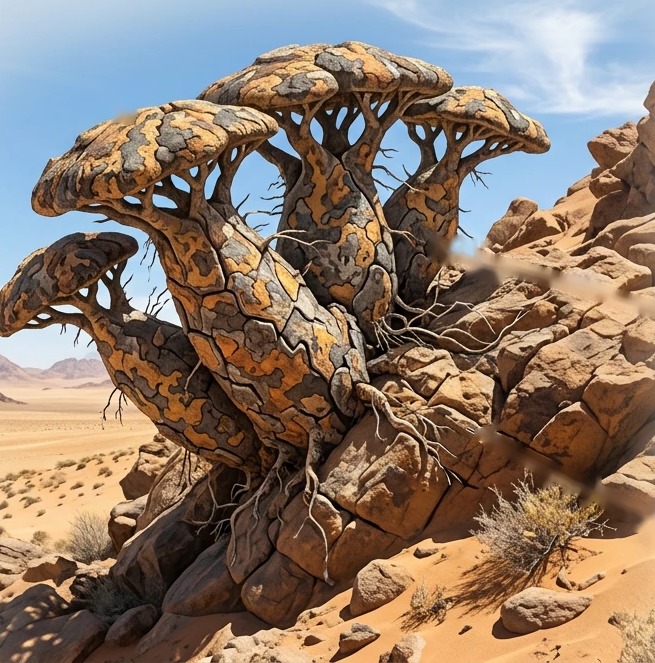
Gorgen had been driving the flats for eleven years and he still couldn't do it — tell the rock-cloaks from the rock. They grew in the scree at the foot of the spires, in clumps, armored and mottled, gray and rust and that dead-lichen yellow, and when the light hit them they were stone. Then a canopy would lift. Not much. A hand's width, the whole crown of the thing tilting toward the headlamps, the way a sleeper turns toward a window. And you'd see the roots, the pale, hairy roots, working down into the cracks they'd been splitting a quarter inch a year since before anyone in Dax had been born.
"They're drinking it," Hollis said. "The light. Old Teague used to say they could live a month off one set of headlamps." He snorted. "Old Teague used to say a lot of things."
"Teague walked out," Gorgen said.
"Teague walked out," Hollis agreed, and drove a while.
The thing about the flats was that nothing lied once. Everything lied all the time, steadily, as a way of living. The rock-cloaks were rock. The sand was solid. The low hump fifty yards off the track, red-brown and cracked in plates, was a boulder, right up until you saw the writing on it.
TOXIC. White paint, gone chalky. A hazard triangle somebody had done freehand.
"There's one of mine," Hollis said, pleased.
You didn't shoot burrowers. Their meat would kill a dog in an hour and a man in a day, and a dead one in the open drew others up from underneath to eat it, and then you had six. What you did was bait them. Poisoned goat, staked out on a long chain, and when the thing came up through the hardpan and took it, you drove close enough to paint the shell before it went back down — so whoever came after you knew which ground was going to die, and which ground was just going to try to eat them.
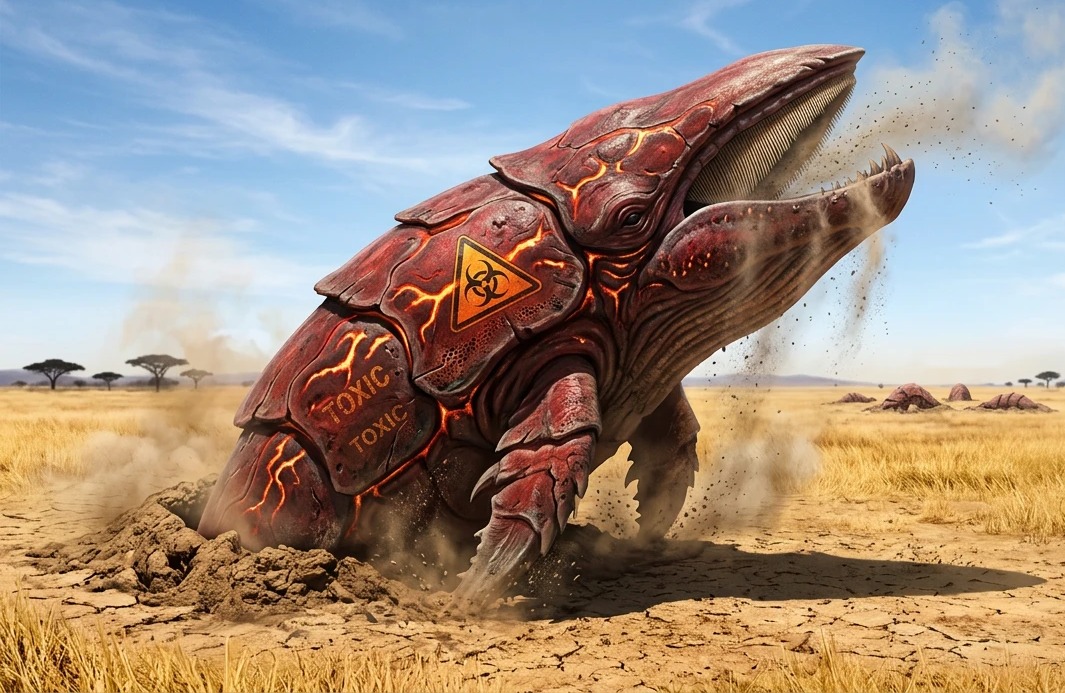
They saw one come up a little after midnight, a quarter mile east, across smooth sand Hollis wouldn't touch. It came up the way a whale comes up in the old pictures — the ground swelling and then breaking, dirt sheeting off the plates — and it opened its mouth to the sky and stood there with its jaws wide, straining dust through the comb inside like a man sieving flour. The cracks between its plates glowed dull orange. It was the size of the roundhouse.
Neither of them said anything until it went back down.
"Ixen?" Gorgen said finally.
"Not tonight." Hollis was rubbing his wrist through the cuff, and Gorgen, who had been about to do the same, stopped his own hand and put it on the dash. "They're thin this month. You noticed that?"
"I noticed."
"Thin means they're somewhere else." Hollis was quiet a while. "Thin means something."
At the far edge of the headlights, a little before three, there was a shape on the slope above the scree. Gorgen saw it for maybe two seconds. It was going on all fours, the way a man goes up a steep bank, using his hands. Then it stood up on two, and turned its head toward the light, and was gone behind a spire before he had the rifle off the rack.
He wrote nothing in the ledger. You didn't write down what you didn't take.
They came back the long way, down the creek, because Hollis liked to see the waders at first light and wouldn't admit it.
The creek ran wide and shallow there through grass gone gold, and the waders were in it the way they always were at dawn, a dozen of them, belly-deep, standing in the water on those long jointed legs with their heads down. Hollis stopped the car on the bank and turned the engine off and they sat.

They weren't pretty, exactly. They were black-green and spotted with pale dots that glowed a little until the sun got high, and their ribs showed through the skin in a cage you could count, and they had two long feelers hanging from the face down into the water, each one ending in a soft blue lamp that pulsed. When they fed, the lamps went bright and the fish came to them.
Then the sun came over the spires, and the waders lifted their wings.
They weren't wings. They didn't fly. They were long fans of fine stiff spines with skin stretched thin between, and every morning the waders spread them to the first light like a woman shaking out a sheet, and the light came through the skin green-gold and red at the edges, and for a minute the whole creek was lit from inside. Gorgen had seen it a hundred times. It didn't get smaller.
The nearest wader was close enough that he could see its haunch where it came out of the water, and there was a mark on it.
He'd seen it before, too. Everybody had. A ring, with a bar through it. Gone soft at the edges, swollen, the color of a fruit bruise — the way an old scar goes when the skin's been growing over it for a long time.
The Dax brand was a ring with a bar through it. It was on the gate. It was on the goats.
"First herd," Hollis said, without being asked. "Came over on the second ship, with your gran. Forty head of cattle. Ran off into this creek the first winter, the whole lot, broke the fence and just went. Never found a carcass."
"Cattle don't—"
"Nothing here stays what it came as," Hollis said, and started the car. "Rock-cloaks were a kind of tree once, Teague said. Burrowers used to swim." He pulled onto the track. "Drive the second half. My wrist's killing me."
The fronds came up at her collar three weeks later.
They were fine as new hair at first, and pale, and Gorgen's mother wound a scarf high on Fay's throat in the mornings and said nothing about it, and Fay let her. By the end of the second week they glowed. Not much. In the dark of the roundhouse, after the lamp was out, if you lay on your pallet and looked toward the loom, you could see where Fay was sitting by a faint green prickle at her shoulders, like dew on a web with the moon behind it.
She wanted the lamp out all the time now. She wove in the dark. She didn't need the light for it, she said, she never had, and she was weaving faster than Gorgen had ever seen her, the beater going thock, thock half the night. The runner on the frame grew a hand's width a day. Diamond over chevron. Red and ochre and slate.
Nobody in Dax said what was happening. That was the custom, and the custom was older than Gorgen. When it came to one of the old ones, you wound a scarf, and you turned the lamp down, and you didn't go to the stone yard to dig, because there was never anything to put in the ground. Children were told she's tired. Then one morning they were told she walked out. The old ones always walked out. That was how it was said, in that order, with nothing in between, and it was said kindly, and everyone who said it had stood at the gate at least once and seen the tracks.
Pell asked Gorgen about it once, on the bench outside, when their mother was at the well.
"Where do they go?"
"Out," he said.
"To the flats?"
"To the flats."
"What do they do out there?"
He had thirty-eight lines in a book in his glove box, and he had stood at the gate at nineteen send-offs, and he had never once in his life put the one number beside the other. He didn't then, either. He felt the shape of it go by him, very close, the way you feel a burrower pass under the hardpan — a give in the ground, and then nothing.
"They rest," he said.
Fay talked in her sleep that week. Gorgen lay awake and listened to it. Most of it was old-world talk, names he didn't know, a dog, a street. But near morning, twice, she said something that wasn't any language he'd heard in Dax, two soft words with a catch between them like a thread pulled through a tight weave.
Iyen-sel. And then, after a while, again.
The night before, she called him to the loom.
It was dark. He could see her by her collar, and by the faint green at the backs of her hands, where the rash had come up in a lace. The runner was off the frame. It lay across her knees, finished, and it was longer than any she'd ever made.
She took his wrist. She turned it over. She pressed her thumb into the inside of it, right where he scratched, right where the skin had gone rough and raised and tender over the last month, and she held it there.
She didn't say anything. He didn't either. After a while she let go and patted his hand twice, the way she'd patted it when he was small and had done something right without being told, and she went back to running her thumb along the edge of the cloth.
In the morning the loom was empty. The runner was gone. Her sweater was gone off the hook, the brown one, the old knit one with the elbow out.
At the gate, in the soft dirt past the stone apron, there were her tracks. Bare feet, small, a woman's. They went out straight toward the flats, and fifty yards on, where the ground started to rise toward the spires, there were hand-prints beside the feet. And then there were no more feet, only the four marks, going on, going up, going away.
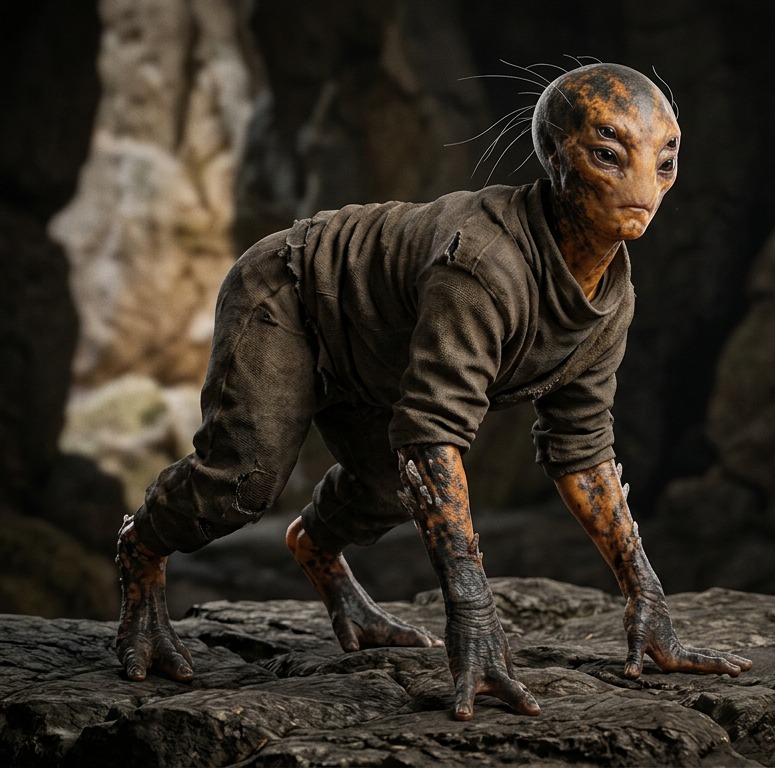
His mother stood at the gate a long time. Then she set the lamp on the gatepost, unlit, the way you did, and walked back inside without looking at anyone.
"She walked out," people said to Gorgen all that day, at the well, in the yard, at the cars, kindly, the way it was always said, and touched his arm.
He said thank you. He went to his car. He crouched by the door and put his thumb on the badge, and he rubbed the red glass eyes, left and then right, and he couldn't have told you why it felt like the first time.
Hollis wouldn't go out.
"Not this week." He was sitting on his own step with his sleeves rolled down in the heat, and he didn't look up from the knife he was sharpening. "Not with you like this."
"Like what?"
Hollis didn't answer that. He tested the edge on his thumbnail. He set the stone down. Then, as if Gorgen had asked something else entirely, he said, "Teague had a vest. Canvas. Patched pocket on the left, where he kept his pipe. Wore it every run for twenty years." He picked the stone back up. "Go home, Gorgen."
Gorgen went out alone eleven nights after Fay walked.
He took the north flats. He drove the cracked ground and went around the smooth, the long way, the long way twice, and he didn't think about anything, which was a skill, and which he had. The Hook was up. The headlights went out over the scree and the rock-cloaks drank them, lifting their canopies a hand's width, turning in their sleep.
At a little after two, at the edge of the lights, a shape stood up out of the rocks.
He had the rifle off the rack and his elbow on the door and the shot gone before he'd decided anything. Eleven years. The shape spun half around and went down among the rock-cloaks, and the canopies nearest it all lifted at once at the noise, the whole clump tilting, and then settled.
He sat with the rifle across the door and listened. Nothing. Then he took the lamp out of the back and walked in.
It was sitting against a boulder, inside the ring of rock-cloaks, with its legs out in front of it like a child's. It was tall even sitting. It was armored the way burrowers were armored, plated, orange and rust and black, and its head was smooth and long and its face was a hanging fringe of soft gray tendrils that moved when it breathed. Green fronds stood up out of its shoulders, glowing, the same green.
The bullet had gone in under the ribs on the left side. It had its long hand pressed over the place, and dark blood was coming out between the fingers and running down over the cloth tied at its waist.
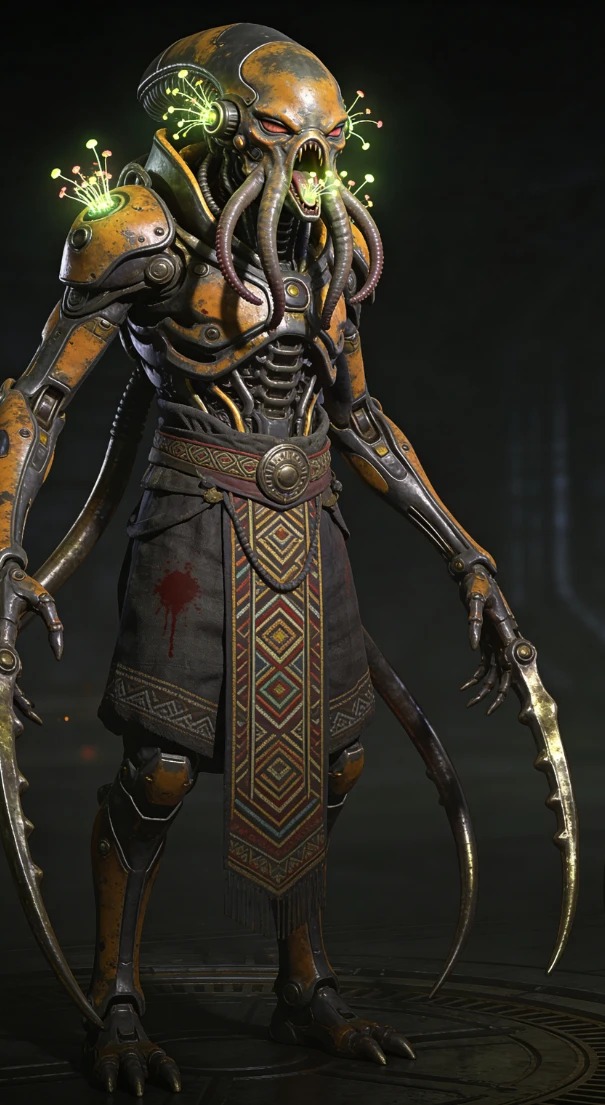
Diamond over chevron. Red and ochre and slate.
The lamp went low in his hand. He didn't put it down. He didn't do anything for a while. Then — because his body knew where to go even when the rest of him didn't — he crouched, and he held the lamp out, and he looked low in the third diamond, where the slate crossed the red.
It went under. It should have gone over.
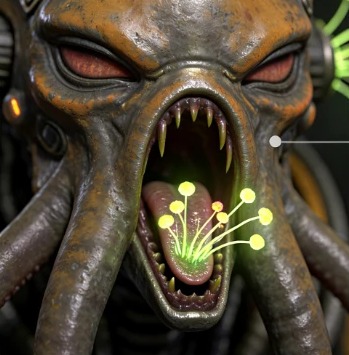
He made a sound. He didn't know what it was. The thing against the rock turned its long head at the sound and looked at him with two red eyes, and the tendrils over its mouth lifted and parted, and the mouth inside them was full of teeth and full of the little green fronds, glowing, crowding up from its throat like new grass.
It took its hand off the wound.
It reached down to the runner and found a loose end — the cloth had been torn by the shot, there were threads hanging — and it pinched one between two long claws, and it drew it slowly up past the side of its head.
Gorgen sat down in the dirt.
He didn't know how long. The Hook moved. The rock-cloaks around them lifted toward the lamp and settled and lifted. Fay — he let himself think it, the name, and the night didn't open under him, which surprised him — Fay let the thread go, and put her hand back on the wound, and breathed with that soft wet click in it, and looked at him.
"I'm sorry," he said. It was nothing. It was what he had.
She leaned forward. It cost her. He could hear it cost her. She reached out the hand that wasn't holding her side together, and she took his wrist, and she turned it over, and she pressed the hard tip of one claw into the inside of it, right where it itched, right where it was rough and raised. She held it there.
"Iyen-sel," she said.
The voice wasn't hers. The two words were.
Then she let go and patted his hand twice.
He took off his jacket and folded it into a pad and pushed it against her side, under her hand, and she let him. He sat with his palm on hers on top of it, pressing, the way you'd hold a door shut in a wind. It was the first time in eleven years he'd touched one living.
Near dawn, the rocks moved.
Not the rock-cloaks. The rocks behind them — the boulders up the slope, the gray hummocks in the scree he'd driven past a hundred times — they unfolded, and stood, and became Ixen. Six of them. Ten. They came down out of the spires the way men come down a steep bank, using their hands, and stood at the edge of the lamplight looking at him. He didn't reach for the rifle. The rifle was in the car.
One of them wore a vest. Canvas, old, gone the color of the dust. A patched pocket on the left side.
They came in around her and lifted her between them, easily, the way you'd lift a child who'd fallen asleep on a bench, and she let them. Before they took her up the slope she untied the runner from her waist, and she held it out to him across the lamp, wet and dark along one edge.
He took it. They went. The light came up gray over the spires and the rock-cloaks turned toward it, every one, and then the sun cleared the ridge and down at the creek, a mile off, the waders would be lifting their wings.
He drove back the long way. He didn't remember any of it.
The gate was open when he came in. A few people were in the yard already, at the well, at the ring, and they watched him park against the palisade with the other cars and get out without a jacket in the morning cold, and nobody came over.
He got the tire iron out of the back. He crouched at the driver's door.
The pewter badge took a while. Hollis had brazed it to stay. Gorgen set the flat of the iron under the edge and leaned on it, and leaned, and the red glass eyes looked past his shoulder at the sky, and then the solder gave with a little crack like a knuckle and the head came off into his hand. He set it in the dirt. Then the first cup. Then the second. He set them in a row, the head between, the way they'd been on the door.
Then he went and got the ledger out of the glove box, and he sat on the running board, and he opened it.
Thirty-eight lines. Date, place, how far, how many shots. He didn't have the send-offs written down anywhere. He didn't need to. He'd stood at every one. Teague, four years ago in the spring. Old Abby Rusk. The Marrow twins' father. His own grandfather, when Gorgen was six, which he'd been told was a fever and had believed until this minute. Nineteen. He started at the back of the ledger and went forward, date by date, and when he found a line that came after a send-off — a month after, a season after, a year — he put his thumb on it.
He ran out of thumbs. He used his whole hand, and then the other one.
When he looked up, Hollis was on the watchtower over the gate, leaning on the rail. He'd been there a while. He didn't wave. He didn't come down. He stood there looking at the row in the dirt, and after a time he rolled up his left sleeve to the elbow and scratched the inside of his wrist, slow, the whole length of it, and let Gorgen watch him do it.
The season turned. The nights got long.
The car's door stayed bare. Four bright scars where the solder had been, and the paint around them gone purple and then green in the dusk, and nothing else. People in Dax stopped asking whether he was going out. Pell sat on the bench beside him in the evenings and wound yarn and didn't ask anything at all, which he thought was the kindest thing anyone had done for him in his life, and once she put her small hand flat on the inside of his wrist, where the rash had come up in a fine pale lace, and left it there.
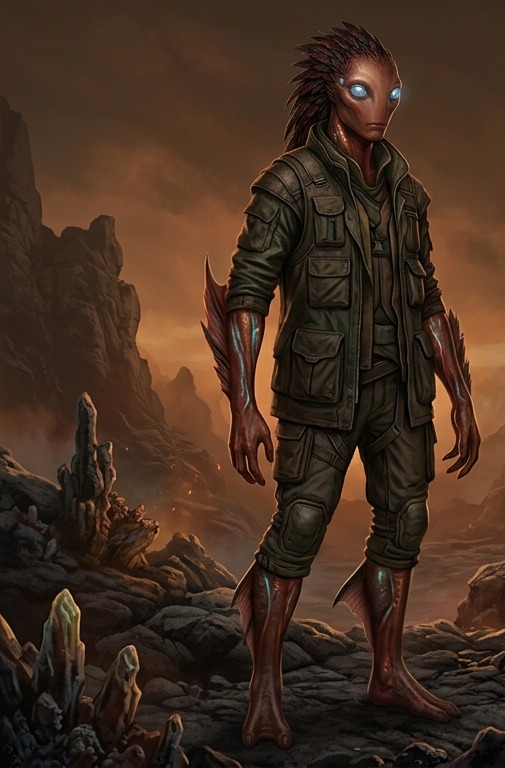
His boots stopped fitting a little before the first frost. He went barefoot after that. The ground in the yard was cold and it didn't bother him.
On the last evening, he hung the runner over the back of the driver's seat, where he could reach back and touch it, and he left the rifle on the rack in the roundhouse, and he drove out the gate at dusk with the lamps off.
He didn't need them. He hadn't for a while.

He drove the cracked ground. The rock-cloaks turned toward the sound of him in the dark, all of them, a long rustle going away across the scree like a thing being said. Somewhere up in the spires there would be a fire, or what they had instead of one, and a frame, and her hands. Diamond over chevron. And low in the third diamond, if he went looking, one stitch going under that should go over — put there on purpose, so the land would know whose he was.