Vanishing Point
“The water moves and the ship doesn’t.”
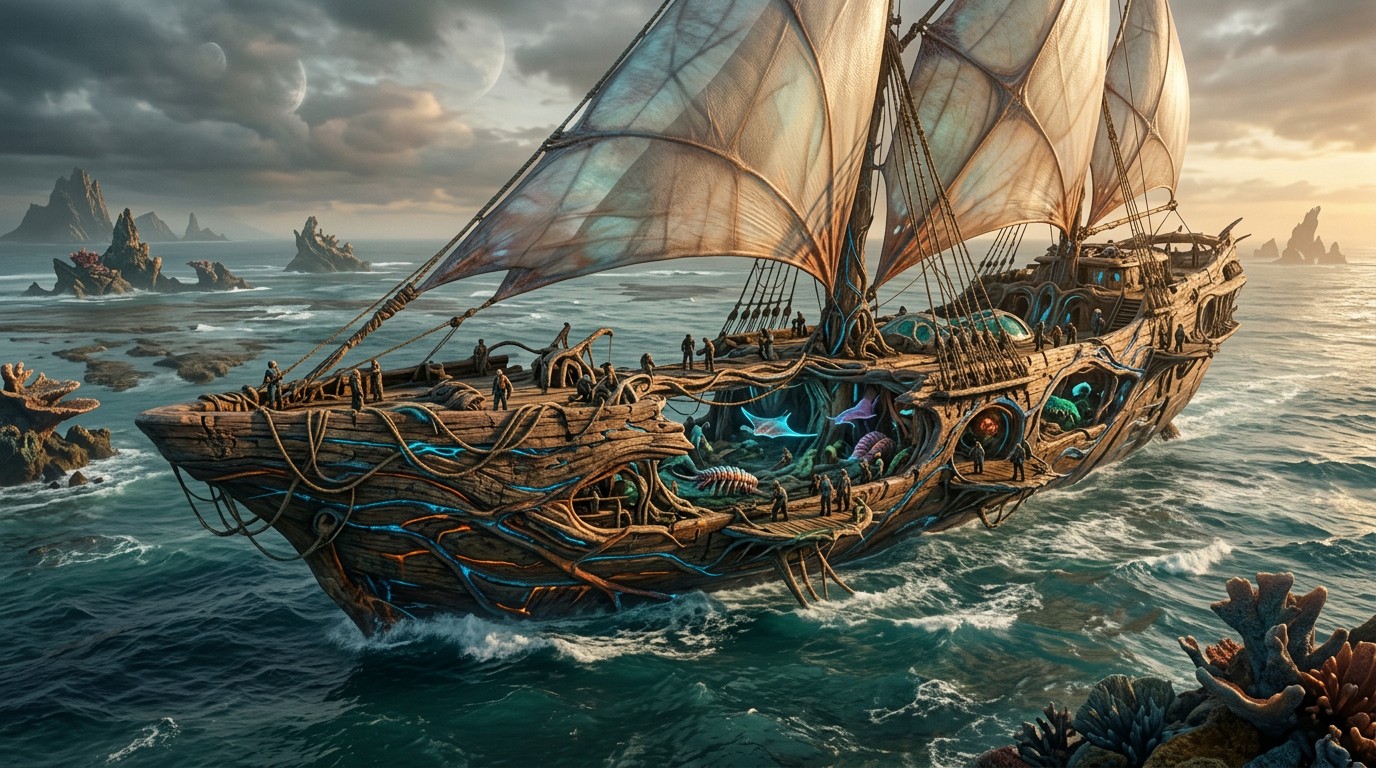
They blacked her every evening at the turn of the light, and on his first evening aboard Wick did it wrong.
He had the bucket and the rag and he'd watched the others for an hour, so he knew the motion — dip, wring, press the ash-tar into the seam and work it along with the heel of your hand until the glow underneath went out. Simple. He leaned over the rail where the hull bellied out under the main shrouds, found a seam lit blue as a gas flame from inside, and pressed.
The seam was warm. Not sun-warm. Warm the way the side of a horse is warm, with something moving under it.
He took his hand away so fast the rag went over the side.
"She won't bite," said the old woman at the bow, without turning around. "She'll sulk. That's worse. Get another rag."
Her name was Greer, and she was the listener, and on Vanishing Point that was the only job nobody joked about. She sat in the eyes of the ship every night of the season with her back against the stem and her right ear turned to the water, and she'd done it, the bosun told Wick, for thirty-one years, on this hull and two others before it. Her left ear was no good. A horn had gone off too close to it in a bad blow when she was younger than Wick, and she'd been deaf on that side since, and she said it had made her a better listener, because now she only had the one ear to argue with.
Wick got another rag.
You couldn't build a ship like Vanishing Point. You found one. That was the first thing anybody on the Reaches told you about a kar'ven, and the second thing was to shut up about it in front of the crew. She'd been a tree once — or the thing on this coast that stood where trees stood, a great slow root-and-bone growth in the shallows of the outer estuary — and some shipwright two hundred years dead had seen the shape of a hull in her and spent his life coaxing it out. Bent her while she grew. Hung her with weights. Cut nothing, ever, because a kar'ven you cut bled sap that never stopped. When she was big enough they'd floated her free, and she'd gone on growing, slower. Her timbers were still alive. Her seams still lit at dusk, blue mostly, running to orange at the joints, the light pulsing very slowly the length of her, bow to stern, bow to stern, like breath.
And in lantern season, when the moons went dark and the demens flew, a light on the water was a death.
So you blacked her.
He worked down the starboard side behind the bosun, a broad quiet man called Tolly who hummed through his nose. Dip, wring, press. Under his palm the seams flinched — he'd swear to that later, and no one would argue — and then went dark. Down past the waterline, through the round windows set into her belly, he could see the hold lit green: the ship's own garden, grown into her when she was young, full of seawater and the things that lived in it. Flat rays as wide as a man's arms. A pale armored crawler longer than his leg. Little bright things that turned in schools. Nobody had stocked it. She had. They swam in through ports she opened at the waterline and they stayed, and the crew fed them scraps and called them the ship's, the way you'd call a dog the house's.
"Do we black those too?" Wick asked. The windows.
Tolly stopped humming. "There's shutters," he said. "She closes them herself, come dark. She knows the season." He went back to humming, and then, a little later, added: "Better than some."
At full dark the captain walked the deck once, bow to stern, looking for light. Captain Imra Hask was a small, square woman with a burned hand she kept in her coat. She found a thumb's width of blue at the foot of the mizzen and stood over it until Wick came running with the bucket, and she watched him put it out, and she didn't say a thing. That was worse than if she had.
Then she went below, and there was no light anywhere on Vanishing Point, and no light anywhere on the sea, and both moons were new, and Wick stood at the rail in a dark so complete he couldn't find his own hand, and listened to the ship breathe.
They anchored that first night in the lee of the stacks at the mouth of the Reaches, and Greer called him forward.
He went on his hands and knees, the way she'd told him to. The deck was a thing he'd walked all afternoon and he couldn't find a plank of it now. When he reached the bow she put out her hand and found his collar and sat him down beside her, against the stem, his left shoulder to her right.
"Shut up now," she said. "Don't talk for an hour. Then tell me what you heard."
He shut up.
At first it was just noise. Water, wind, the ship. Then — slowly, the way your eyes come in after a lamp goes out, except it was his ears — it came apart into pieces.
The water moved and the ship didn't. That was the main thing. At anchor the sea kept on going about its business, the swells rolling in under them from the outer water, and Vanishing Point sat on her line and let it go by, and every time a swell ran under the bow it slapped the hull. Wap. A pause. Wap. Against the wood right behind his back, so close he felt it in his spine before he heard it. Wap. The anchor line creaked through the hawse in a long complaint, easing and taking up, easing and taking up. Overhead, something fluttered in short hard bursts — the telltales, Greer would tell him later, the little ribbons tied to the shrouds to show the wind — beating together in gusts and then going slack. Wap. Creak. Flutter. Wap.
And under all of it, far off to the west, a long soft roar that came and went and came.
When the hour was up — he didn't know how she knew it was, but she did — Greer said, "Well?"
He told her. The slap on the hull. The anchor line. The flutter. The roar.
"Roar's the stacks," she said. "Swell breaking on the rocks. That's your west, all night, and it's your distance too — louder, you're closer, and if it gets loud and you didn't move, then the anchor's dragging and you wake the captain. Flutter's the telltales. You'll learn them." She was quiet a moment. "Now. The hull. When the wind comes up, what happens to it?"
He listened. A gust came through the shrouds; the telltales beat. A breath later, two slaps came close together on the hull, harder.
"It gets worse," Wick said. "When the wind does."
"It always does. The wind makes the swell and the swell makes the wap. They keep time together. Wind, then wap, every time, all night, all season." She reached back and laid her palm flat on the stem, and he felt her settle against it, thirty-one years deep. "That's all listening is. You learn the time the sea keeps. And when something knocks on the hull that isn't in time — wind's quiet and the wap comes anyway, or the wind blows and the wap doesn't — then something's under us. Or beside us. And you don't wait to find out which."
"What do you do?"
"Tell the captain. Blow the horn if it's a hull. Shut your eyes if it isn't."
He wanted to ask what isn't meant. He didn't. Later he was glad, because she would have told him, and it was better to learn it the way he did.
At first light they went into the mangroves, and he saw why anybody sailed in lantern season at all.
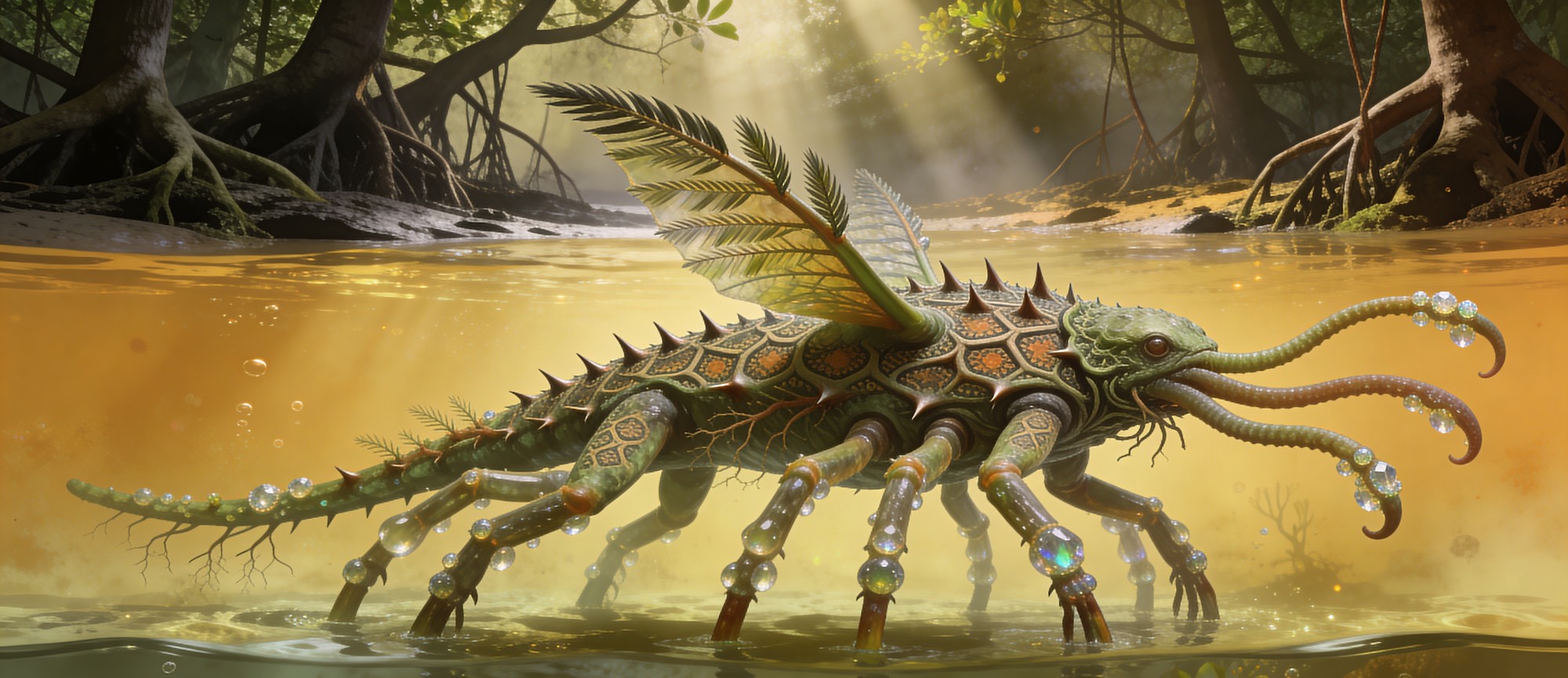
The Reaches were a hundred miles of shallow amber water under roots — the estuary forest standing up out of it on stilts, the roots arching down into the flats like the legs of something too big to see whole. Vanishing Point couldn't go in. The boats did. Wick rowed bow in Tolly's boat with a long-handled sieve across his knees, and the light came down in slats through the canopy and lay on the water, and the water was full of them.
The jewelers.
They waded in the shallows on a dozen jointed legs, slow, in no hurry about anything, each as long as a rowboat. Green backs plated in a pattern like old tile. Fronds standing up off their shoulders like ferns. From the faces hung curled feelers that trailed in the water, and all along the legs and feelers there were beads — clear beads, catching the light, hanging off the jewelers the way dew hangs off a spider's web, except dew doesn't have a fire in it.
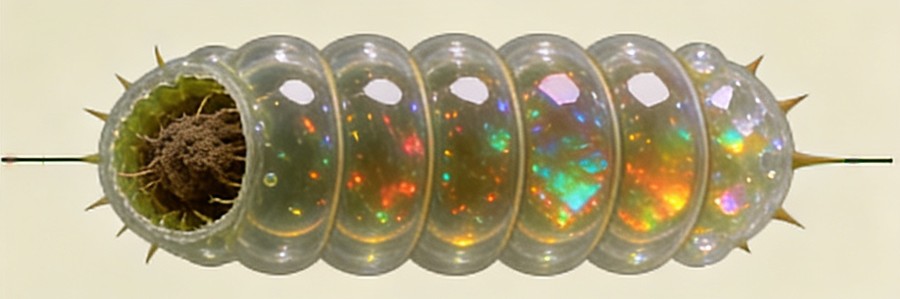
"Pods," Tolly said, low, as if they were in church. "Watch."
The beads grew on the jewelers in strings, he explained between strokes. Every string a seed pod, segmented, swelling all season, filling with milk-light — and they couldn't ripen alone. Something had to come in the dark and work them. Something came, every night of lantern season, out of the black over the stacks, and in the mornings the ripe pods split and the seed-cores dropped into the flats to root, and the clear shells — fist-sized, opal-bright, fire in them red and green and gold — dropped to the bottom in the amber water, and the jewelers walked on and left them.
The crew dove for the shells. They brought them up in sieves and dropped them into canvas buckets, and by the end of the morning there were six buckets in the boat and Tolly said it was a poor day. One shell, Wick learned that night, would buy a family a year inland. A full season's hold would keep Vanishing Point in tar and rope and wages for three.
"What comes in the dark?" he asked, when they were rowing back. "To work the pods."
Tolly hummed through his nose for a long time.
"Ask Greer," he said.
He heard it on the third night.
They were anchored deeper in, among the outer roots, where the swell was smaller and the wap came softer and further apart. The wind had died near midnight. The telltales hung slack. Greer was asleep against the stem — she did that, short sleeps, a few minutes at a time, and woke if anything changed — and Wick was listening alone for the first time, and he was proud of it, and the night was very quiet.
To starboard, off in the dark, rigging sang.
He knew the sound. Every sailor did. A vessel at anchor in a breeze, her shrouds and stays thrumming, that low thin hum like a finger round the rim of a glass. Not close. A few hundred yards. Another ship, then, running dark like them, come in among the roots for the jewelers. He was almost glad of it. Company.
Then he thought: there's no wind.
He put his hand back on the stem the way Greer did. The hull lay still. No slap. The anchor line hung quiet in the hawse. The telltales overhead didn't move at all.
And off to starboard, in the dead calm, a ship's rigging sang in a wind that wasn't there.
He touched Greer's shoulder. She was awake before his hand left her. She turned her good ear to starboard and listened for perhaps the space of ten breaths, and then she took his wrist in her hand — her fingers dry and hard as rope ends — and she put her mouth against his ear, and she said:
"Shut your eyes."
He shut them.
"Keep them shut. Whatever you hear. That's not a ship." Her breath was warm. "It's the jewelers' company. That's what works the pods."
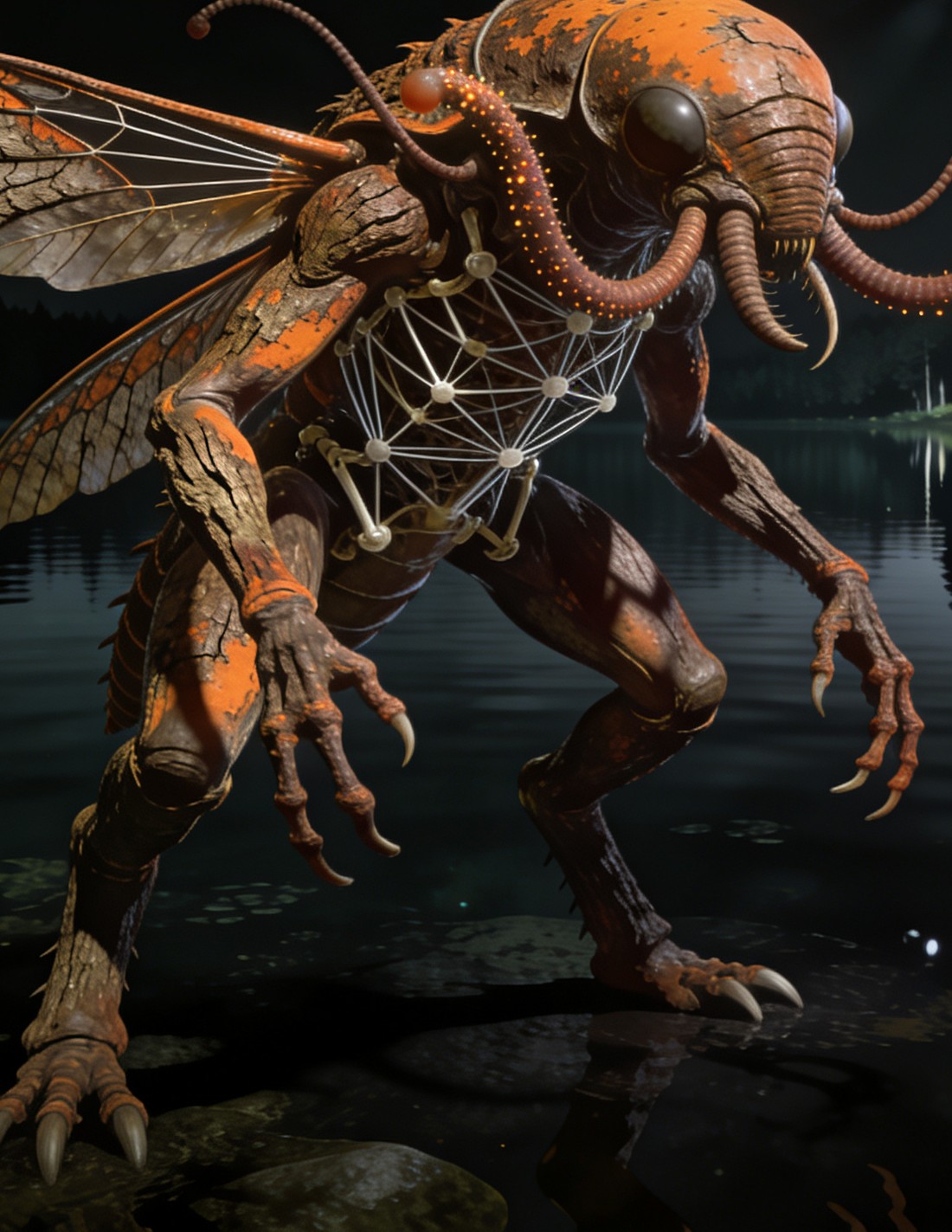
The singing came nearer. He could hear now that it wasn't one hum but many, layered, rising and falling out of step with each other, and under it a dry quick rattle like a sail luffing — wings. Something big moving through the dark over the water on wings, and the rigging sound coming from it, not from any mast.
"They string it on themselves," Greer said into his ear. "Across the chest. White thread, like shroud-line, like a net. Spin it out of their own mouths. Nobody knows what for. When they fly the air goes through it and it sings." Her hand tightened on his wrist. "Demens, the scholars call them, from some old word for out of your mind. Sailors just say the riggers. They come to warmth and they come to light. She's warm. That's why we black her. Warm they'll look at, and pass. Light, they come aboard."
"And if you look at them?"
The singing was very close now, off the starboard bow, a little above. He felt the air of the wings move his hair.
"There was a man on my first ship," Greer said, low and even, "called Dunmore. Good hand. Good ear. Opened his eyes on a night like this to see one, because he couldn't stand not to. Said it was the most beautiful thing he'd ever seen. Said so all the next day. Next night at full dark he walked out along the bowsprit, past the end of it, after them." She let go of his wrist. "It isn't madness, I don't think. I think you just want to go where they're going. Which comes to the same."
The rigging sang right over the ship.
Wick sat with his eyes shut so hard he saw red, and his back against the stem, and the hull of Vanishing Point lay warm against him in the calm. And he felt it — he would swear to this all his life, and Greer would never once tell him he was wrong — he felt the ship lean. Not roll. Lean. Toward the sound, the way you lean toward a voice you know in a crowded room.
Then Greer began to hum.
It was nothing. A few notes, low, going round and round, an old work song from the net-yards that every child on the Reaches knew. She hummed it with her lips almost against the stem, the tune going into the wood, and the hull under Wick's back stopped leaning. He felt it settle. The rigging sang over them, and past them, and away up the channel toward the jewelers, getting thinner, until it was a thread of sound at the very edge of the dark, and then it wasn't anything at all, and the night was just the night.
He opened his eyes when she told him to. There was nothing to see. There never was.
"She likes to be sung to," Greer said. She sounded tired. "Nobody believes me. I've been telling captains thirty years."
"I believe you," Wick said.
"Well," said Greer. "You've got two good ears." And she went back to sleep, sitting up, between one breath and the next.
The weather came on the eleventh night, and it came as Greer said it would: in the wap first.
All evening the wind had been fitful, and the slap on the hull kept time with it, gust and slap, gust and slap, the way it should. Then, a little after dark, the slaps started to come harder than the gusts — two, three, four of them, heavy, right under the bow, when the telltales overhead had barely lifted. The swell was outrunning the wind. Something big was out at sea, pushing water ahead of it.
"Wake the captain," Greer said, before Wick could open his mouth.
By midnight it was a blow. Not the worst Hask had seen, she said, standing at the wheel with her burned hand in her coat and her good one on the spokes. Not the worst by a long way. But they were anchored inside the outer roots with the stacks a mile to the west and the swell building, and every wap on the hull was a hammer now, and the anchor line had stopped creaking and started to groan.
The rain took the blacking.
It took it in an hour. Wick, roped to the bow rail beside Greer, felt it go under his hands as the water ran down the hull — the ash-tar softening, sliding, sluicing off in black streams — and then the first seam came alight. Blue, near the waterline. Then a run of orange at a joint. Then the whole long seam of the starboard bow, lit from inside like a lamp turned up, and the rain coming through the light in silver lines.
"Tolly!" Hask shouted from aft. "Buckets! Black her!"
They tried. You couldn't. The tar wouldn't hold on the wet wood, and the rain took it off as fast as they put it on, and Vanishing Point was waking under their hands — Wick could feel her waking — every seam from stem to stern coming up blue and orange, pulsing, faster than he'd ever seen it, bow to stern, bow to stern. Not breath now. A heart going.
"She's frightened," Greer said into his ear. "Of the blow. That's what the light is."
And off over the stacks, high up, under the roar of the surf, rigging sang.
Not one. A hundred. The sound came down on them out of the black like a fleet of ships all heeling in a gale at once, every shroud in every one of them screaming, and under it the dry thunder of wings.
"Eyes!" Greer shouted — to the whole ship, at a pitch Wick had never heard out of a human throat. "Every soul — eyes!"
He shut his. All over the deck he heard men stop moving. And the singing came down on Vanishing Point, and the riggers came aboard.
He felt them land. He felt the deck take the weight of something big settling on the bowsprit beside him, and on the shrouds over his head, and the yards. He heard their claws on the wood. He heard the white thread on their chests hum as they folded their wings, and he smelled them — dry, like a hot attic, like singed paper — and the ship under him burned with light he could see through his own eyelids, red, orange, red.
And over all of it, the stacks.
The roar to the west had changed. It had been a mile off all night, a long soft sound coming and going. It was louder now. It was much louder, and the wap under the bow had gone strange — the swells were coming in and the hull was riding up them and not coming down right — and the anchor line wasn't groaning anymore. It was silent.
"She's dragging," Wick said. "Greer. The anchor's dragging. We're going onto the stacks."
"I know."
"Somebody has to steer."
"I know," said Greer.
He understood, then, what the captain had understood from the wheel, and Tolly at the buckets, and every man on deck with his eyes shut and his face turned down. A ship going onto the rocks in the dark in a blow is steered by eye. By looking. By seeing the white water and the black rock and putting the bow where they aren't. And there were a hundred riggers on the yards of Vanishing Point, singing, and the first person on board who opened their eyes to see the rocks would see them instead.
"There's a way," Greer said. "By ear. If the ear's good enough." She found his wrist in the dark. She pulled him to his feet. "Mine isn't. Not in this. Not with one. Come on."
They went aft along the lifeline with their eyes shut and the riggers singing on every side of them, so close Wick felt the wind of wings across his face, and once something dry and thin as paper brushed his cheek and he made a sound and kept walking. Greer kept hold of his wrist. Hask, at the wheel, with her eyes screwed shut and her face running wet, heard them come and stepped aside without a word, and Greer put Wick's hands on the spokes and put her own over them.
"Now," she said in his ear. "Listen."
He listened.
At first it was everything at once — rain, wind, wings, the white thread singing, the surf, the ship. Then — slowly, the way it had come apart on the first night — it came apart again.
The stacks were to the west. To port, now; the ship had swung. The roar of the surf on them was a wall of sound, and it had a shape: louder forward, quieter aft. The bow was closest. He put the helm over, away, and waited, and listened, and the roar shifted — a little — toward the beam. Under his feet the hull took a swell and came down on it in time, wap, and for the first time in an hour the wap kept time with the wind.
"Good," said Greer.
There was a gap in the stacks. Every sailor on the Reaches knew it — the Throat, they called it, a channel between two of the great rock pillars where the water ran deep and fast out to sea. If you could find it in the dark. He listened for it. The surf roared steady along the whole wall of rock — and then, at one point off the port bow, it didn't. It dropped. A hole in the sound, where the swell ran through instead of breaking.
He put the bow on the hole.
They went through the Throat with the surf thundering on both sides of them close enough to taste, and riggers singing on every spar, and the captain standing beside the wheel with her eyes shut, saying nothing, letting a boy who'd been aboard eleven days take her ship through a hole in a noise. Vanishing Point burned like a lamp the whole way. He could feel her under his hands. He could feel her lean, the way she'd leaned that night, toward the singing over her — and he did what Greer had done. He didn't know he was going to until he was doing it. He hummed. The net-yard song, the stupid, round-and-round one. Into the wheel. Into the wood.
She steadied. She went where he put her.
And then the roar was behind them, both sides of it, and the swell was the long clean swell of open water, and the wap on the hull came slow and even and in time with the wind, all the way down.
They stood there till dawn. Nobody opened their eyes.
The singing thinned in the last hour before light. Wick heard them go — one at a time and then in a long ragged cloud, the hum of the white thread drawing off northward toward the Reaches, toward the jewelers and the pods, the dry thunder of the wings getting smaller and smaller until it was only the wind.
Greer told him when. He opened his eyes.
Vanishing Point was still lit. Not burning now; glowing, soft, blue and orange, bow to stern, slow as breath. And all along her seams, where the riggers had perched — on the bowsprit, on the rails, on the shrouds and the yards and the curve of the hull below the waterline — there were beads.
Clear beads, hanging in strings. Dozens of strings. Hundreds of beads, catching the first light, and in every one, very faint, a fire beginning, red and green and gold.
Tolly said a word Wick had never heard him say. Hask came forward along the rail, slowly, and put out her good hand and touched one string of them with a single finger, barely, as if it might ring. Her face did something Wick wouldn't see it do again for a long time.
"She's never," the captain said. "Not in forty years. Not one of them, not any hull on this coast. Not ever."
"Nobody ever let her," said Greer.
She'd sat down on the deck by the wheel with her back against the binnacle and her eyes closed, and she was smiling, and her good ear was turned to the ship.
They blacked her again that evening, because it was still lantern season and the law was still the law, and because Hask said so, and Hask was right. But they blacked her gently. Wick did the starboard bow himself, and he didn't flinch when the seams moved under his palm, and he hummed while he did it, and the seams went dark one at a time without any sulking at all.
The strings of beads hung off her all that season, swelling, filling with milk-light. In the mornings Wick sat in the eyes of the ship with his back to the stem, beside Greer, and listened to them tick against the hull in the wind.
They ripened on the last night before the moons came back. In the morning the beads split, and the cores dropped one by one into the water off the stern, small and dark and rooted already, and sank a little, and then floated, the way a seed floats when it means to travel. Wick went aft to watch them go.
Vanishing Point's wake ran out behind her straight and white across the morning sea, and the seeds rode it, hundreds of them, small dark points on the water, drifting apart as they went. He watched until the wake and the sea and the sky all ran together into one line at the far edge of the world, and every one of her children went out along it, smaller and smaller, until they reached the place where the lines meet, and he couldn't hear them anymore, and he couldn't see them, and he still knew exactly where they were.